



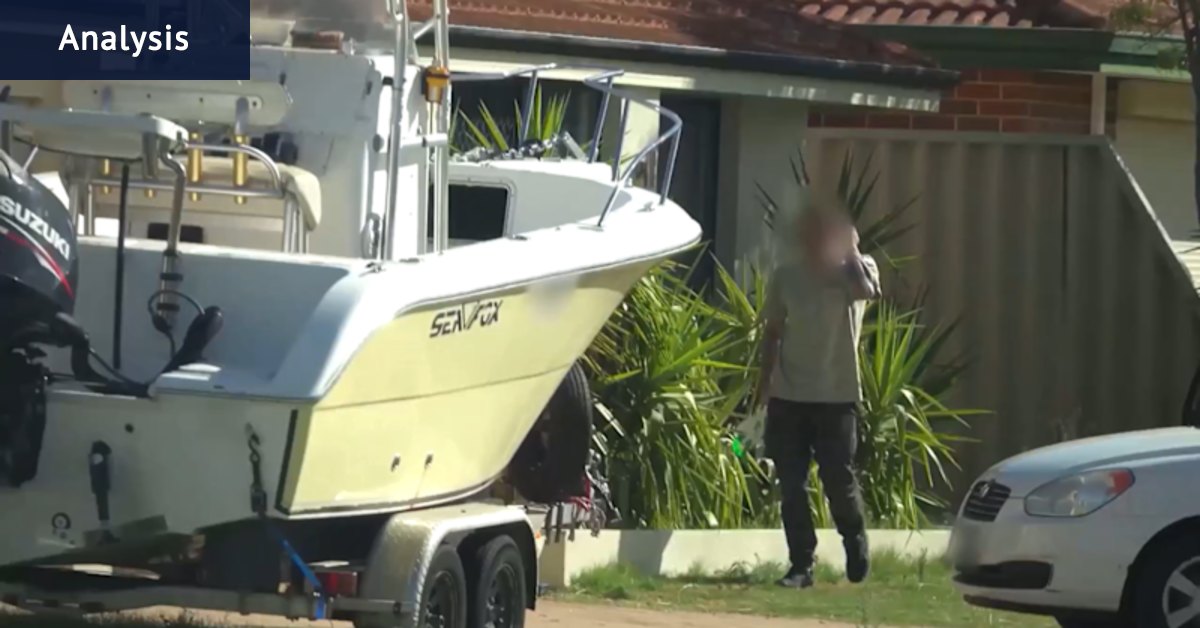
The feed flickered in the back of an unmarked police surveillance van sitting on an innocuous suburban street south of Perth.
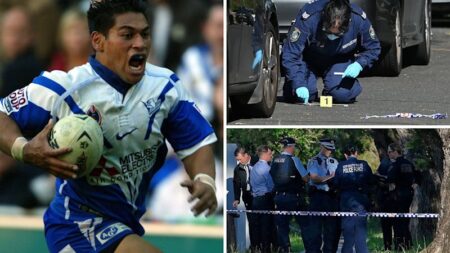
For the detectives of Taskforce Ravello, the mission had become an obsession: find the ghost who pulled the trigger at the Kwinana Motorplex on December 12, 2020 and killing the tattooed patriarch of the Rebels outlaw motorcycle gang, Nick Martin.
They knew the shot was too clean, too professional for the average street thug. They were looking for a specialist.
Then, a figure appeared on the screen – lean, disciplined, moving with a calculated gait that didn’t match the heavy-set swagger of the bikies usually frequenting the property. As the man stepped toward the front door of David Pye’s home, the air in the van must have sharpened.
Inside the house, the walls were “bugged”, the very air saturated with invisible police ears.
The watchers saw a stranger; the listeners heard the rustle of a Woolworths bag. They didn’t know yet that the bag contained the blood money for an assassination – $150,000 in cold, hard cash.
They only knew that the man they were watching was the bridge between a sniper’s nest and the man they believed had ordered the hit.
It was the moment the hunt for a killer collided with the downfall of a kingpin.
And it was this man’s evidence, given to a packed Perth court last year from behind a thick layer of protective bullet-proof glass, that led to the conviction of arguably one of WA’s most dangerous men: David Pye.
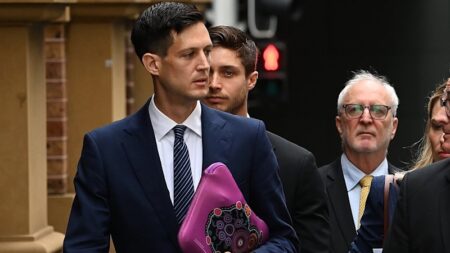
On Friday, members of that police taskforce sat in the Supreme Court of WA to witness the culmination of five years of hard work.
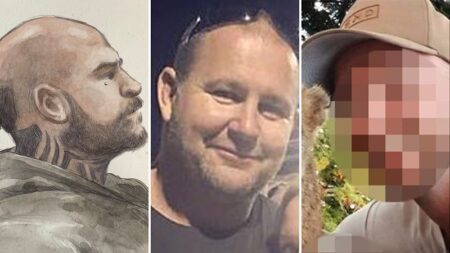
Pye was found guilty of ordering the murder of Martin, as well as inciting the same hitman to kill an ex-girlfriend and another bikie rival, Ray Cilli.
It would have been a big moment for the WA Police force who have dealt with the fallout of organised crime for years. The conviction of one of its top players is rare.
But after the verdict on Friday, WA Police Commissioner Col Blanch described the catalyst for Martin’s killing as “petty bikie politics”, and belittled the men who wore patched colours with pride and use threats of violence to get what they want.
“David Pye, because of petty bikie politics, decided to pay someone to kill another person,” Blanch told media after the verdict.
“Here we have grown adults planning murders of each other over silly things. I’m not even going to entertain how stupid they are because the level of buffoonery is extraordinary within outlaw motorcycle gangs.
“Nick Martin was surrounded by family, friends and young kids – he paid the ultimate price for petty bikie politics, but in the presence of families and young people – an eight-year-old young boy suffered injuries, another person suffered shrapnel wounds – these things should just not happen in Western Australia.”
Blanch said more than 40 police vehicles responded to numerous triple-zero calls after the shooting.
More than 700 staff formed Taskforce Revello and executed search warrants on gang members.
Out of 286 search warrants, 271 people were charged.
Blanch was questioned on whether he believed police would have found Pye if the shooter, whose name is suppressed by the courts, didn’t provide evidence against him, given part of bikie politics is related to a code of silence.
“The bikie code of silence is not real,” Blanch replied.
“They might not stand in front of cameras and say what they’re doing, but plenty of bikies ring Crime Stoppers, plenty of bikies tell police what’s happened.
“There’s no code of silence.”
That was certainly true for the 39-year-old soldier who, in return for a lenient sentence, coughed up everything to police in the weeks following his arrest over Martin’s death.
He’s now spending his 20-year stretch writing a book about his involvement in the murder.
The former soldier at the heart of the case
He was a man who lived in the “dead space” between two identities. From the Australian Army, and later the private military contractors in Iraq, then back to suburban Perth, the soldier was a man trying to buy his way into a normalcy he didn’t quite know how to inhabit.
The contrast was jarring. While he was calculating the 365-metre trajectory that would end Martin’s life, he was also helping his girlfriend with her small business.
And there was no high-tech vault for his earnings. Instead, the court heard of a man who took bundles of cash – payments for the death of one man and the planned execution of another – and shoved them into the dirt in a plastic tube he buried in a precise location near Lake Coolongup – a place he regularly walked his dog.
Even as he sat behind the bulletproof glass of the witness stand, the “soldier” archetype seemed to slip.
The defence painted him not as a warrior, but as a “pathological and compulsive” weaver of fantasies.
They pointed to his exaggerated tales of overseas conquests and his “mercenary” persona as proof that he was a man who couldn’t tell the truth if his life depended on it.
And yet, as Justice McGrath handed down his decision on Friday morning, it became clear that while the man may have been a flawed vessel, the evidence he carried was undeniable.
The judge had to look past the bravado to the cold, hard facts.
There was the single bullet that had travelled through Nick Martin and into the arm of Ricky Chapman.
There were the bugged conversations where David Pye ranted about his ex-girlfriend.
And there were those chilling digital breadcrumbs: the coffin emojis and the “one dead, one serious” text exchange.
When the verdict of “guilty” was read out on Friday, the transition was complete.
The soldier was no longer just a sniper or a drug-seeking mercenary; he was the key that locked the cell door for David Pye.
The “trial of the century” didn’t end with a cinematic confession, but with a clinical summary of banknotes in dirt, drones in the night, and the slow collapse of the bikie myth. Pye, the defector who thought he could outsource his vengeance to a man with a rifle, now sits in a cell, awaiting a sentencing date that will likely see him grow old behind bars.
The hundreds of thousands of dollars buried near the lake was dug up by police.
And the “code of silence” that once protected men like Pye has been replaced by a more transactional reality: in the modern underworld, the most dangerous man isn’t the one with the gun – it’s the one with the plea deal.
From our partners
Read the full article here