


Technical difficulties have been reported during Magna International’s pilot project of its automated delivery bots in Toronto.
From confusion surrounding Toronto’s endless construction to difficulty turning right at a red light, the City of Toronto says it received a number of unsolicited reports from members of the public during the pilot that ran June until October.
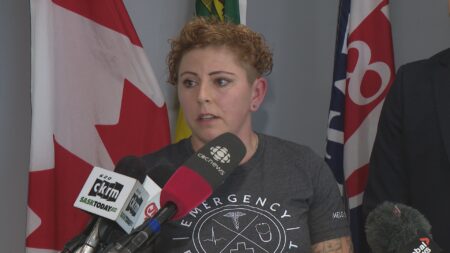
“There was an instance of the vehicle not turning right on red lights,” said Jennifer Niece, manager of strategic policy and initiatives at the city’s transportation services. “Likewise, a very small number of observations at stop-controlled intersections, and in situations with construction signage where it appeared that the vehicle hesitated longer than would be necessary or would be normal for a human driver.”
She stressed that the observations were based on what was submitted by members of the public as city officials were not able to observe themselves.
“We were not invited to actively observe, although we did see the vehicles at their storage facility,” she said. “We were not involved in any observation from the vehicles in action.”
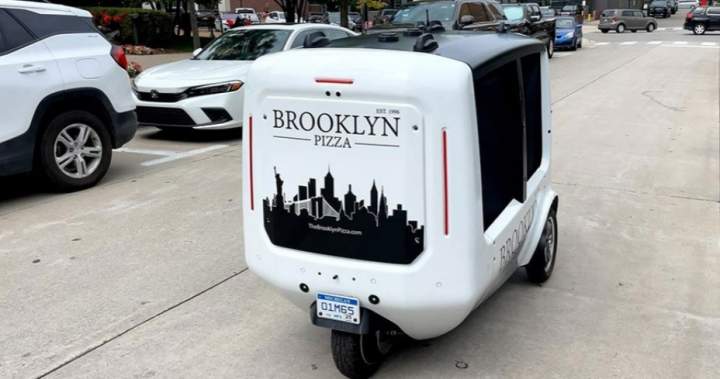
The pilot project rolled out in June, with Magna’s driverless, three-wheeled “Last Mile Delivery Device” vehicles to deliver small packages throughout several west end and downtown wards over time, including all of Ward 9 Davenport, and portions of Ward 4 Parkdale-High Park, Ward 5 York South-Weston, Ward 11 University-Rosedale and Ward 12 Toronto-St. Paul’s.
The vehicles had received a permit under federal law that allows them to be used in Canada for up to a year.
Each vehicle would have constant human oversight from a “chase vehicle,” with a supervisor on hand for immediate intervention, according to then general manager of transportation services Barbara Gray.
“Important safety measures include maximum speed of 32 kilometres per hour, travelling only on roads with a posted limit of 40 kilometres per hour or less, no use of left turns, and adherence to internationally recognized cybersecurity and privacy standards,” Gray said in the report.

Get daily National news
Get the day’s top news, political, economic, and current affairs headlines, delivered to your inbox once a day.
The vehicles are roughly the size of a large cargo bike with the average height of a typical sedan, the report reads. It will have space to carry small packages stored in separate locked compartments, which are secured with a multi-digit code only known to the receiving customer.
The city’s infrastructure and environment committee were told, however, that it has no regulatory authority over the provincial pilot. Ontario’s Ministry of Transport did invite city staff to review Magna’s application into the province’s Automated Vehicle Pilot Program and provide input.
It’s not the first time the city has seen automated vehicles on its roads.
In 2021, Toronto launched an automated shuttle pilot in Scarborough, but due to factors outside its control — including the company contracted to supply the shuttles going out of business — it scrapped the program a year later.
The city cited that project in a letter to the province in October in which it made recommendations for changes to the Highway Traffic Act.
In that letter, acting general manager Ashley Curtis said in the city’s pilot and the one by Magna, various behaviours were observed including “veering out of lane of travel, turn signals that didn’t function, and an unscheduled shut-down and re-boot in a lane of live traffic with inability to move to the side of the road.” It also noted the issues Niece told Global News with regards to red lights and construction.
The letter did not distinguish which issues were observed in what pilot, but Niece said the issues involving veering out of lanes, turn signals, and a shut-down and re-boot were seen in the 2021 city pilot.
Global News reached out to both the province and Magna for comment on what the city was told regarding issues with Magna’s trial.
A government official on background told Global News that regarding testing within the pilot, no traffic incidents, collisions or road safety violations were reported to the Ministry of Transportation.
Magna did not respond by publication.
Toronto Police also confirmed to Global News that traffic services advised they had no calls in relation to any self-driving vehicles.
In its letter to the province, the city called on the provincial government to put a cap on how many automated vehicles a company can pilot “until they have demonstrated their ability to obey all basic rules of the road.”
“So start out with a very slow, very low number of vehicles, so that learning can take place before there’s a substantial impact of any kind,” Niece said Monday.
“In transportation services, we are not closed to the idea or opposed to the idea of automated vehicles coming to the city, but we want to make sure that it is being done with a precautionary approach, gradual proving of capabilities before the area of deployment or the number of vehicles expands.”
© 2025 Global News, a division of Corus Entertainment Inc.
Read the full article here