


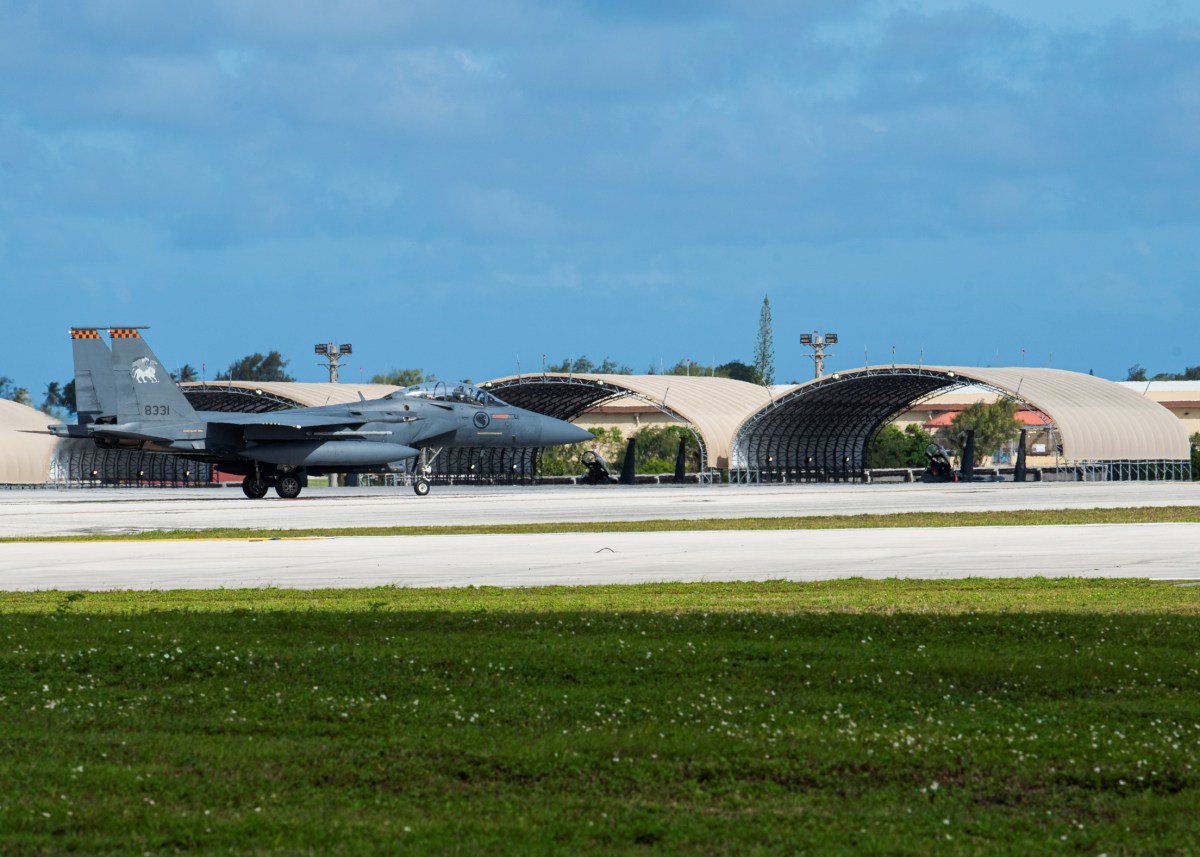
Singapore, a United States partner in the South China Sea, recently concluded an air force exercise on Guam, extending the island nation’s decade-long military partnership with Washington that includes deploying its forces to American soil for training.
In a Facebook post on November 26, the Republic of Singapore Air Force said its jets and other aircraft had returned home after a monthlong training on Guam, the U.S.’s westernmost territory, where they used the island’s vast airspace to sharpen their skills.
Why It Matters
Singapore has called itself a “long-standing, reliable and steadfast strategic partner” of the U.S. on a range of issues, including defense and security. The city-state is a key U.S. partner in the South China Sea, a hotly contested region where China—the U.S.’s major rival—claims vast swaths of waters that overlap with those of other countries.
Strategically located between the Indian Ocean and the South China Sea, Singapore serves as a critical access point for the U.S. military across the Indo-Pacific, hosting aircraft carrier visits and supporting rotational deployments of littoral combat ships and patrol aircraft—bolstering the U.S.’s military presence in Southeast Asia.
What To Know
According to the Republic of Singapore Air Force, its Guam-based training detachment included F-15SG and F-16 fighter jets, G550 airborne early warning aircraft and A330 tanker transports, conducting “challenging and realistic” training both day and night.
A released photo shows Singaporean air force personnel loading a bomb onto an F-16 jet during training designed to hone their skills in using munitions on targets. The training took place at Andersen Air Force Base, a major U.S. military facility on Guam.
Singapore has been deploying fighter jets to Guam for rotational training since 2017.
The training came after the Singapore Ministry of Defense and the Pentagon agreed to end discussions on permanently stationing a Singaporean fighter jet training detachment on Guam, which is instead set to be conducted through periodic short-term exercises.
The original plan involved hosting 12 F-15SG jets and about 200 personnel and their dependents, with the U.S. Air Force planning to construct new airfield pavement, a parking apron and fuel lines to support the deployment, The Guam Daily Post reported.
Citing an Air Force document, the report said the cancellation of the “beddown” of the Singaporean air force training detachment was based on several factors, including operational analysis, site survey results, environmental impacts and military judgment.
Given Singapore’s airspace constraints, the country’s air force currently deploys three training detachments in the U.S. These are an F-16 jet unit and an AH-64D helicopter unit in Arizona and an F-15SG jet unit in Idaho, established between 1993 and 2009.
These U.S.-based detachments provide access to what the Singaporean air force called “vast training airspace and challenging operational environments,” allowing personnel to sharpen their skills and enhance readiness, according to a 2019 news release.
The Singaporean F-16 jet detachment—officially known as Peace Carvin II—is expected to relocate from Luke Air Force Base to Ebbing Air National Guard Base in Arkansas, which is also set to serve as a training site for future Singaporean F-35 jets.
What People Are Saying
Singapore’s Ministry of Defense said in August: “Singapore and the U.S. have excellent and long-standing bilateral defense cooperation. We thank the U.S. Department of Defense (DOD) for their continued support of the Republic of Singapore Air Force (RSAF)’s training detachments in the U.S., which are integral to the RSAF’s honing of its operational capabilities.”
Andersen Air Force Base said on its website: “Andersen’s ideal flying conditions, relatively unlimited airspace and nearby air-to-ground range make this an ideal training area for the U.S. military and militaries of nearby countries.”
What Happens Next
The U.S. military is expected to continue its partnerships with foreign forces around the world to strengthen cooperation. In October, Defense Secretary Pete Hegseth said Qatar—a key U.S. partner in the Middle East—would have an air force facility in Idaho.
Read the full article here