



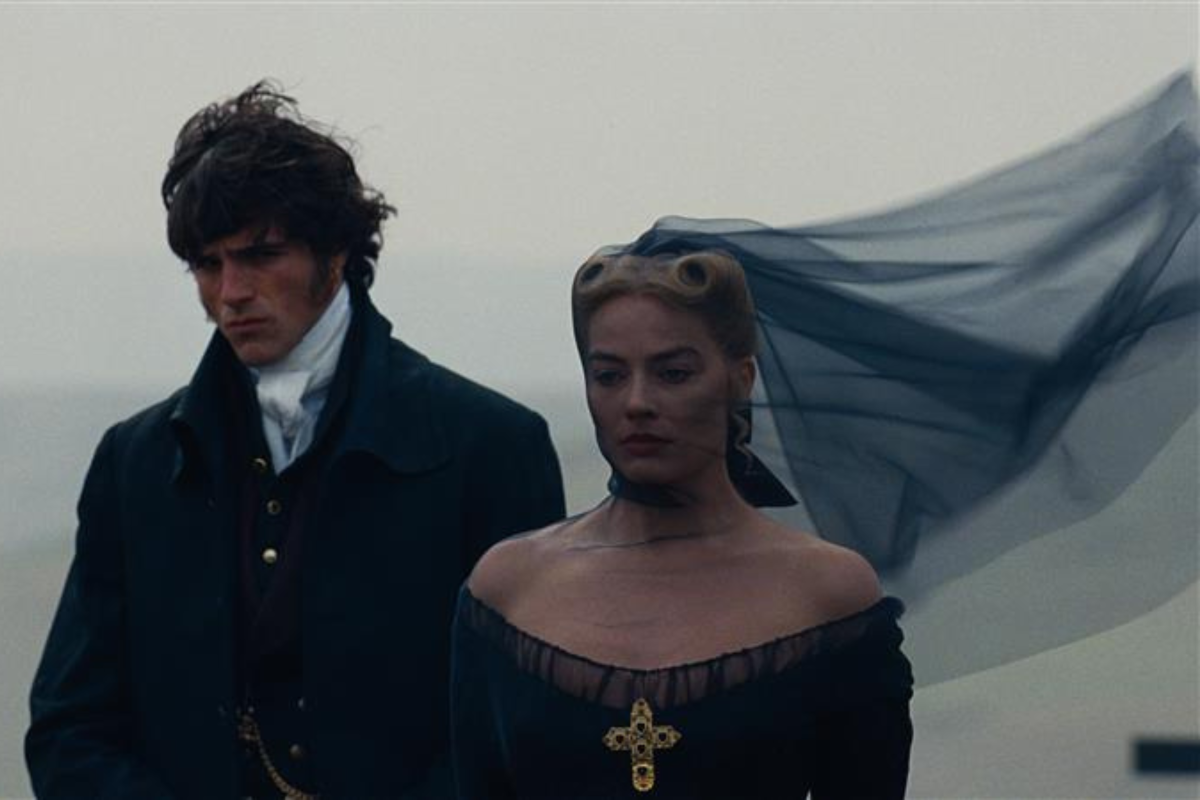
The buildup before the release of Emerald Fennell’s “Wuthering Heights”—starring Margot Robbie and Jacob Elordi—has ignited a continuous wave of online debate over casting, age, historical authenticity, music choices and marketing tone, with disagreements spilling across TikTok, Instagram and film-criticism circles.
At the center of the backlash, fueled by a heavily publicized press tour, trailers and first looks, are questions about the faithfulness of the adaptation to Emily Brontë’s 1847 novel—ranging from the ages of the leads to Heathcliff’s racial ambiguity, along with complaints about glossy costuming, set design and a pop-forward soundtrack that some say reframes the gothic tragedy as a stylized romance.
The project, with its star-studded cast and Valentine’s Day release date, has not been short of speculation and debate.
Here are all the biggest topic points and controversies about the upcoming film.
Margot Robbie’s Age Debate
One of the earliest viral criticisms centered on Robbie herself.
When a still leaked from set, it spread fast alongside claims she looked “too modern” and too “perfect” to play Catherine Earnshaw, written as a scrawny teenager in Brontë’s world.
The teaser reignited the issue, with viewers arguing both leads read older and too polished than the characters the book implies.
In internet shorthand, it is the familiar complaint: prestige casting versus textual age. And because Robbie is not only the star but also tied to the film’s producing apparatus, the critique has sometimes expanded into a broader frustration about celebrity gravity overwhelming character truth.
Jacob Elordi, Race, and Erased Representation
The most-sustained backlash has targeted Elordi’s casting, as an Australian of European descent playing someone who was likely a person of color.
In the novel, Heathcliff is described in ways that many readers interpret as racially ambiguous—often discussed as Romani, Black, or of mixed ethnicity—and his outsider status is intertwined with class and prejudice.
On social media, the critique has been even sharper, with some creators accusing the film of whitewashing and sanitizing a story about class and race, turning it into a glossy romance with its signature political bite removed.
Fennell’s approach—leaning into personal interpretation—has not soothed that concern, because the underlying argument is about representation, not taste.
Costumes: ‘Period’ as Moodboard, Not Museum
Then came the clothes. The film’s wardrobe has been debated as loudly as its casting, with fans calling the look anachronistic and incoherent. Costume designer Jacqueline Durran has been explicit in saying that historical accuracy was not the goal: the intention was a stylized version that nods to the era, pulling references across centuries rather than pinning the story to one.
For period-drama purists, that is the problem: if the costumes signal “this is a costume,” then the adaptation can feel less like a world and more like a concept, as many fans have expressed online.
Set Design: When the Moors Look Like a Soundstage
The set and overall production design have been folded into the same critique—an atmosphere that, to some viewers, with red flooring and white walls, reads more stylized spectacle than lived-in period truth.
Charli XCX and the ‘Wrong’ Soundtrack for Brontë
The music also became another dividing line, turning heads and raising eyebrows.
For some fans, Charli XCX’s work on the soundtrack reinforced a suspicion that the movie is chasing cultural currency over period fidelity. To those fans who want wind-swept austerity, hypermodern pop reads like an intrusion; to others, it is the clearest signal that Fennell is aiming for reinterpretation, not reenactment.
Robbie’s British Accent: Another Authenticity Tripwire
Even performance choices have been parsed.
Fans quickly spotted from the trailer that Robbie did not adopt a northern dialect in her role; instead, she leans closer to received pronunciation English—fueling yet another minor “accuracy” complaint in a discourse already crowded with bigger ones.
Still, others have argued that it is unclear whether her character even spoke with a Yorkshire accent, arguing that it was likely she sounded as if she were from the south of England.
Fennell’s Answer on Elordi: The Quote That Backfired
When The Hollywood Reporter asked Fennell about breaking from the book to cast Elordi, her response—meant to articulate adaptation as personal interpretation—became its own controversy.
“I think the thing is everyone who loves this book has such a personal connection to it, and so you can only ever make the movie that you sort of imagined yourself when you read it,” Fennell said, adding that the movie “could be made every year” with “so many different takes.”
For many fans, that answer landed as evasive, because it did not directly engage with the representation argument. It sounded, to critics, like a director talking about vibes while readers were talking about race and historical erasure.
‘Codependent’ on Set: Romance Rumors vs PR Stunts
Robbie then added fuel to the press-tour machine with a quote about her bond with Elordi.
In a cast interview, she said she became “so codependent” with the 28-year-old Frankenstein actor while on set, describing how she felt “unnerved and unmoored” when apart from him.
The internet quickly did what it does best: some interpreted the intimacy as evidence of off-screen chemistry spilling into romance rumors; others dismissed it as a perfectly calibrated anecdote for a big promotional run, especially given Robbie’s public family life and the press tour she expertly executed when promoting Barbie.
The Quotation Marks: Punctuation as Provocation
Finally, there is the title itself—styled with quotation marks as “Wuthering Heights.” The creative choice has sparked plenty of discussion among fans about whether they will even be seeing an adaptation of the book or an entirely different story.
Read the full article here