




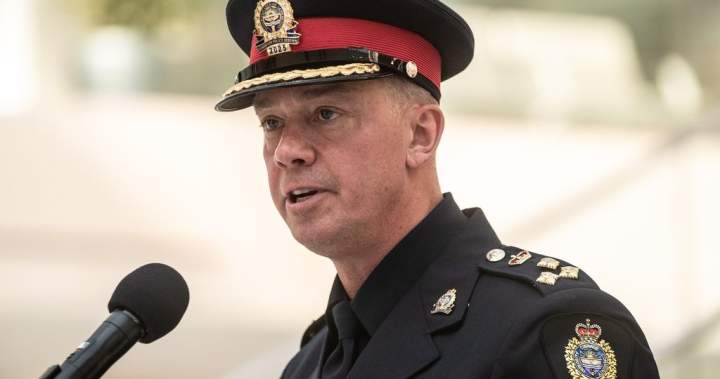
A retired Mountie and a group representing Alberta’s defence lawyers are both calling for a third-party investigation into possible criminal behaviour by the Edmonton Police Service chief and his top departmental lawyer.
The Criminal Trial Lawyers’ Association (CTLA) says Chief Warren Driechel and EPS legal and regulatory services director Megan Hankowich need to be investigated for statements made over the recent manslaughter case involving the 2023 death of eight-year-old Nina Napope.
The call came in a letter to Alberta Justice Minister Mickey Amery from Edmonton lawyer Tom Engel on behalf of the association. The letter was also made public Tuesday.
The association is asking Amery to direct the Police Review Commission to examine whether there is enough evidence to pursue charges.
Engel said their behaviour merits examination for possible criminal violations, including extortion, obstruction of justice and intimidation of a justice system participant.
“Police made criminal threats against the Crown that they have to do something, set aside a plea bargain — or else,” said Tom Engel, an Edmonton lawyer and chair of the CTLA policing committee.
“When the police cross the line like they did here, it undermines the administration of the criminal justice system in Canada — and that has to be jealously guarded.”
Former RCMP homicide detective and security professional Neil LeMay also filed a separate, second complaint, asking the Edmonton Police Commission and Amery to launch a formal investigation for the same reasons.
The letters are the latest chapter in a controversy that challenged the firewall between police — who investigate and can either recommend or lay charges — and prosecutors, who decide in the public interest how the case and the charges are handled in court.
The CTLA and LeMay were referring to public comments made last fall by police warning that prosecutors were willing to accept a sentencing deal it suggested was too lenient and a “miscarriage of justice.”
In September, Driechel and Hankewich took the highly unusual step of publicly intervening in the sentencing of Ashley Rattlesnake in Nina’s death, after saying they had learned the Crown was poised to accept an eight-year manslaughter sentence in the case that initially prompted first-degree murder charges.
EPS warned if the Crown did not change course, police would release their own details of the case so it can be judged in the court of public opinion.

Get daily National news
Get daily Canada news delivered to your inbox so you’ll never miss the day’s top stories.
The issue sparked a public debate on the firewall.
Alberta Premier Danielle Smith weighed in at the time, backing the EPS concerns and stating the public needs to understand why Crown prosecutors make their decisions.
No deal was finalized, but in February, an Edmonton judge sentenced Ashley Rattlesnake to eight years in prison for manslaughter. The Crown had asked for a nine-year prison sentence, while the defence had requested seven years.
In his decision, Justice Jody Fraser called police comments surrounding the sentencing “reprehensible,” and suggested their “veiled threat” may have obstructed justice.
He also cited the comments as a “somewhat” mitigating factor in sentencing.
The Rattlesnake case contained disturbing details of the child’s final hours.
Napope was living with Rattlesnake in west Edmonton at her incarcerated father’s request when she died of blunt impact trauma.
Court heard Rattlesnake was drinking alcohol and using methamphetamine the night Nina was killed. The girl was found lying on the floor bleeding next to a hole in the wall, but it isn’t known how she sustained her fatal head injury and who may have struck the fatal blow(s).
Rattlesnake didn’t call 911 and instead asked acquaintances for help. Four others were charged in the case. Nina was found dead in a hockey bag in the back of a truck a few days later on Samson Cree Nation in Maskwacis, and her death was confirmed to be a homicide.
An autopsy showed she had multiple broken bones and injuries, some which had previously healed. She also had sepsis because of an infected tooth that was left untreated. Court heard the blood infection reduced her chances of survival.
LeMay said on Tuesday those convicted of murder should face justice, but the legal process must also remain lawful, independent, and visibly fair to maintain public confidence.
“The public should remember that justice requires consideration of all relevant circumstances, not only the crime itself, but also the fairness of the prosecution, the integrity of the proceedings, and the rule-of-law principles that must govern every serious case,” LeMay said.
“Police investigations are not a perfect science. Mistakes are made. Witnesses change their stories. Under cross-examination, evidence that once looked powerful can be weakened to the point that it carries little or no weight at all. All too often, murder cases go off the rails and no one is ever convicted.”
LeMay added in his experience, that is why the old saying about a bird-in-the-hand has real force here.
“When a lawful conviction is secured, the justice system, including the police, must be careful not to jeopardize it in pursuit of something more emotionally satisfying but far less certain.
“Justice must be done carefully, properly, and in a way that can be seen to be fair.”
The Edmonton Police Service declined to comment on the letter while Alberta Justice said it was reviewing it and unable to comment at this time.
The Edmonton Police Commission said it had not received the complaint, but noted since Dec. 1, 2025, complaints about police officers are made through the Police Review Commission.
The PRC, created by the province late last year to replace the “current patchwork of police investigating police,” is an independent, centralized, civilian-led body that looks into complaints about the conduct of police officers, and is the banner under which ASIRT operates.
The PRC told Global News it was aware of the matter but as of Tuesday afternoon, there was “no active investigation.”
In a follow-up message later Tuesday afternoon, the PRC said Section 42.2 of the Police Act sets out the provisions for making a complaint to the Police Review Commission. To summarize the key parts here:
- Members of the public can make a submission to the PRC
- The CEO of the PRC or the chief of the involved police service could initiate a complaint in the absence of a submission from the public
- The minister of Public Safety and Emergency Services could refer a matter to the PRC if deemed in the public interest
—with files from Lisa Johnson, The Canadian Press
© 2026 Global News, a division of Corus Entertainment Inc.
Read the full article here