



In the spring of 2013, B.C. NDP leader Adrian Dix was well ahead in the polls with days to go before the province’s 40th general election and was poised to beat the incumbent Christy Clark and the BC Liberals.
But then Dix got nervous that the Green Party would siphon off New Democrat votes and allow the B.C. Liberals to win seats on vote splits. So Dix did what would become known as the “Kinder Morgan Flip Flop”. Kinder Morgan, which we now know as Trans Mountain, wanted to triple the capacity of the oil pipeline from Alberta to the Port of Vancouver. Dix had steadfastly refused to say yea or nay to this project, preferring to wait for an environmental assessment. But with the Green Party threatening, he decided, with three weeks to go in the campaign, to come out against the expansion of the pipeline.
He promptly lost an election that was his for the taking, as many voters agreed with fresh attacks by Clark that the NDP was anti-development, anti-business and cared little for resource industry workers.
Dix was succeeded by John Horgan who also fought against the pipeline expansion but did much to repair his party’s reputation with resource workers.
Horgan would eventually lock horns with another NDP premier, Alberta’s Rachel Notley, over that Trans Mountain pipeline. Notley — again, a New Democrat — wanted to push ahead with its expansion. Notley would win that debate — and the Government of Canada would end up buying the pipeline and completing its expansion — while Horgan and his NDP successor David Eby became enthusiastic proponents of shipping liquified natural gas out of B,C. ports.
That is your Western Canada NDP: all-in on responsible development of oil and gas. That support has led to electoral success.
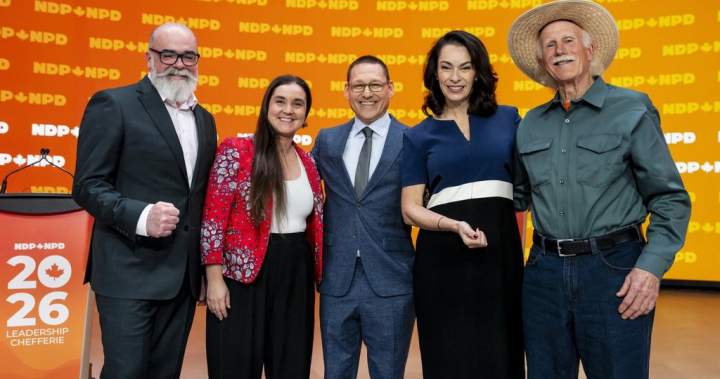
Now, though, comes the 2025 federal NDP leadership race where leading candidates are arguing for a rapid shift away from oil and gas development.
“We’ve got to be straight with Canadians. No more approvals for new pipelines, LNG terminals, offshore oil,” leadership candidate Avi Lewis said. “We need to build the 21st century economy, and it’s a massive opportunity.”
Lewis, last week, released what he’s calling his “Green New Deal”, the outlines of a plan to eventually shut down fossil fuel production while at the same time creating a million new jobs. He cautions that his plan is about a transition, not an abrupt shutdown of oil and gas extraction.
Other leadership hopefuls also believe in such a transition and, if there’s a debate among them, it’s about pace and scale of that transition.

Get breaking National news
For news impacting Canada and around the world, sign up for breaking news alerts delivered directly to you when they happen.
“We’ve got a climate crisis. Everybody in Alberta knows that,” said Heather McPherson, the only sitting MP in the leadership race who represents the Alberta riding of Edmonton-Strathcona. “But we also have to be very realistic and pragmatic that we are not going to turn off oil and gas today. That’s not going to happen.”
McPherson is in favour of a transition that weans the Canadian economy off of oil and gas production and she believes that some of the 190 billion barrels of oil still buried in northern Alberta will have to stay buried for the good of the planet. “All of that gas — oil and gas — cannot come out of the ground.”
Rob Ashton, the B.C.-based leader of the International Longshore and Warehouse Union Canada, would not say who he would have backed in that argument between two NDP premiers, Notley and Horgan, over a pipeline. “The federal government under an NDP led by me — we’re going to be looking at building the infrastructure for the energy platforms for tomorrow because employers won’t do that,” Ashton said. “We’re going to build this stuff and the government will own it and we’re going to put Canadian workers to work in new energy fields.””
But too rapid a shift away from oil and gas production brings with it the same political peril that saw Dix lose his chance to become B.C.’s premier. And that political peril was on full display in the 2025 election.
Certainly, many New Democrat voters, spooked by Donald Trump, saw Mark Carney as their best chance to stave off what seemed like an existential threat to Canada.
And so New Democrat Laurel Collins lost to Liberal Will Greaves in Victoria; Peter Julian, an NDP MP for 21 years, lost in New Westminster, B.C. to 25-year-old Liberal candidate Jake Sawatzky who ran his campaign from the back of his car; and in Hamilton Centre — NDP orange since 2004 — New Democrat Matthew Green lost to Liberal Aslam Rana.
But that Carney-Trump dynamic is surely a one-off thing.
It was the other losses — losses to Conservatives in ridings dependent on manufacturing and the resource industry — that were the most damaging to the federal NDP because they represent a structural shift in longstanding voter coalitions. Where orange switched to blue, voters — especially young male working class voters — responded positively to Pierre Poilievre’s messages about affordability and the cost of living.
And so Conservative Ellis Ross beat NDP incumbent Taylor Bachrach in a northwest B.C. seat that had been NDP since 2004. Harb Gill became the first Conservative to win Windsor in more than 60 years, beating New Democrat Brian Masse, who had held off every challenge since first winning Windsor West in 2002. With New Democrat Charlie Angus retiring, a Conservative, Gaetan Mallette, promptly won his northern Ontario seat.
Make no mistake, Conservatives are not ready to relinquish these new gains among working class voters. Poilievre continues to make campaign-style stops on shop floors and warehouses around the country as he seeks to solidify this party’s support.
“The NDP has been attacking working class men and women,” Poilievre said Thursday outside of the House of Commons. “They have abandoned the working class people who literally built this country with their hands. The only party that stands up for working class people is the Conservative Party.”
Not surprisingly, Ashton is unimpressed.
“Poilievre has been doing nothing but cosplaying as a worker. He isn’t from the working class,” Ashton said. “He may talk about working class issues but I have yet to see a Conservative government or a Conservative opposition ever do anything for the working class.”
That said, the NDP leadership candidates know what the Conservatives did to them last spring and their diagnosis is that their own party lost connections with workers.
“What I’ve been getting is, unfortunately, that the NDP forgot their roots,” said Ashton.
But will a “Green New Deal” or any other policy that would restrict, slow or even stop work in Canada’s extractive industries save the NDP? Tacking towards its climate-conscious green flank did-in Dix’s chances in 2013.
“I don’t think it is one or the other,” McPherson said. “I think there is a reasonable path where, as Canadians, we recognize that we have had a resource industry, that we need to continue to support the workers that are in that industry [but] there needs to be a path off the extractive oil and gas sector.”
Lewis, too, rejects the idea that you have to choose between winning elections or the climate.
“I think we owe a great debt to fossil fuel workers. They’ve kept the lights on and the pistons pumping in this country for 150 years,” said Lewis. “But we have to make a big change now, and everybody knows it.”
David Akin is the chief political correspondent for Global News.
Read the full article here