


The myth of Stephen Harper — a myth created by his supporters as much his detractors — is that he was a one-man, decision-making band, working long hours into the night to protect Canada from a global bank tax, prosecute and then end the war in Afghanistan, negotiate multiple new free trade deals while dealing with myriad day-to-day issues that cropped up during his near-decade office from 2006 to 2015.
But the man himself says that the myth does not match reality.
“With any decision that was a government decision, as opposed to a specifically prime ministerial decision, they were done by cabinet or by the planning and priorities committee,” Harper said. “They were not done bilaterally with an individual minister.”
And now the receipts to back up that claim are part of Canada’s official record with the inauguration last week of the Stephen J. Harper Fonds at Library and Archives Canada.
“No decision, no matter how small, in our office or in our government, ever got made other than in writing. We did not do oral decisions, which leads to all kinds of chaos,” Harper said. “Every decision was in written form.”
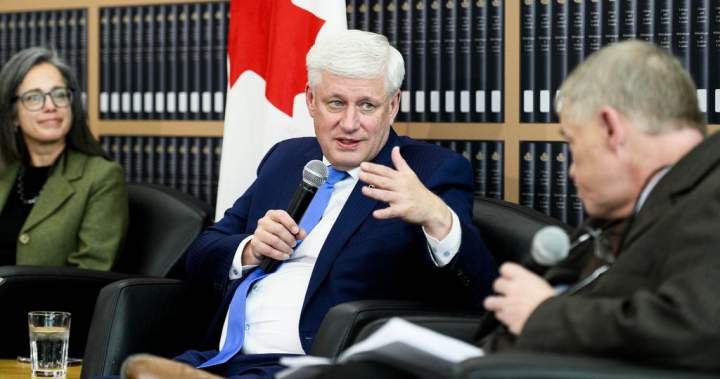
Harper spoke about his archives at a Thursday afternoon event held in the Alfred Pellan room at the Library and Archives Canada building just west of the Supreme Court in Ottawa. The inauguration of the Harper fonds capped a week of events during which Conservatives celebrated the 20th anniversary of Harper’s first election win in early 2006.
The fonds — a term archivists use for ‘collection’ — are impressive in terms of its quantity.

Get breaking National news
For news impacting Canada and around the world, sign up for breaking news alerts delivered directly to you when they happen.
“Terabytes of digital records,” Jennifer Schofield, the assistant deputy minister in charge of collections at Library and Archives Canada, said. “The acquisition of Mr. Harper’s files marked the largest digital archival acquisition ever undertaken by Library and Archives Canada.”
That record includes more than 640 boxes of text records; nearly 1.3 million digital photographs (“pretty good for someone who didn’t like his picture taken,” Harper quipped); 809 hours of digital sound recordings; 171 hours of videotapes on VHS, Beta and other formats; plus two temporary tattoos, one quilt, one lapel pin, one hockey card and much more. It will now be up to professional researchers to determine the quality of the Harper fonds (and find out what those temporary tattoos are all about).
Harper said he believes that, whether or not you agree with what he did in office, those researchers will learn something about governing and about decision-making.
“In this era of accelerated social media and a kind of very quick and superficial communications, it is just so essential that those who are going to lead in the future find ways to cut through that and make sure that they are actually making decisions in a considered manner,” Harper said.
During the Thursday event, Harper said that the way his government documented its decision-making process changed once Guy Giorno took over in 2008 from Ian Brodie as Harper’s chief of staff. As Harper explained it, Giorno instituted a system in which written policy recommendations from the bureaucrats in the Privy Council Office (PCO) would be received and logged but would be matched with a separate written policy analysis and recommendation from the political appointees in the Prime Minister’s Office (PMO).
“I cannot emphasize how important this was to the good running of the government,” Harper said. “I think it’s very important for any chief executive to receive, even on surely trivial matters, more than one independent piece of advice.”
The process Giorno initiated in Harper’s office has continued, in a slightly modified form, in how the office of the current Conservative leader, Pierre Poilievre, manages policy development, according to Conservative MPs speaking on background.
Harper assisted Library and Archives Canada (LAC) staff with the preparation of his archives, including recording 50 hours of interviews from his Calgary home in which he discusses his time in office and many of the decisions he made. Those interviews will not be made available to researchers until 2030, though LAC has released a one-hour video of Harper talking about this oral history project.
But the work he did preparing his own archives also prompted Harper to finish the work on his own memoirs, which he said he expects to be in bookstores by November.
David Akin is the chief political correspondent for Global News.
Read the full article here