



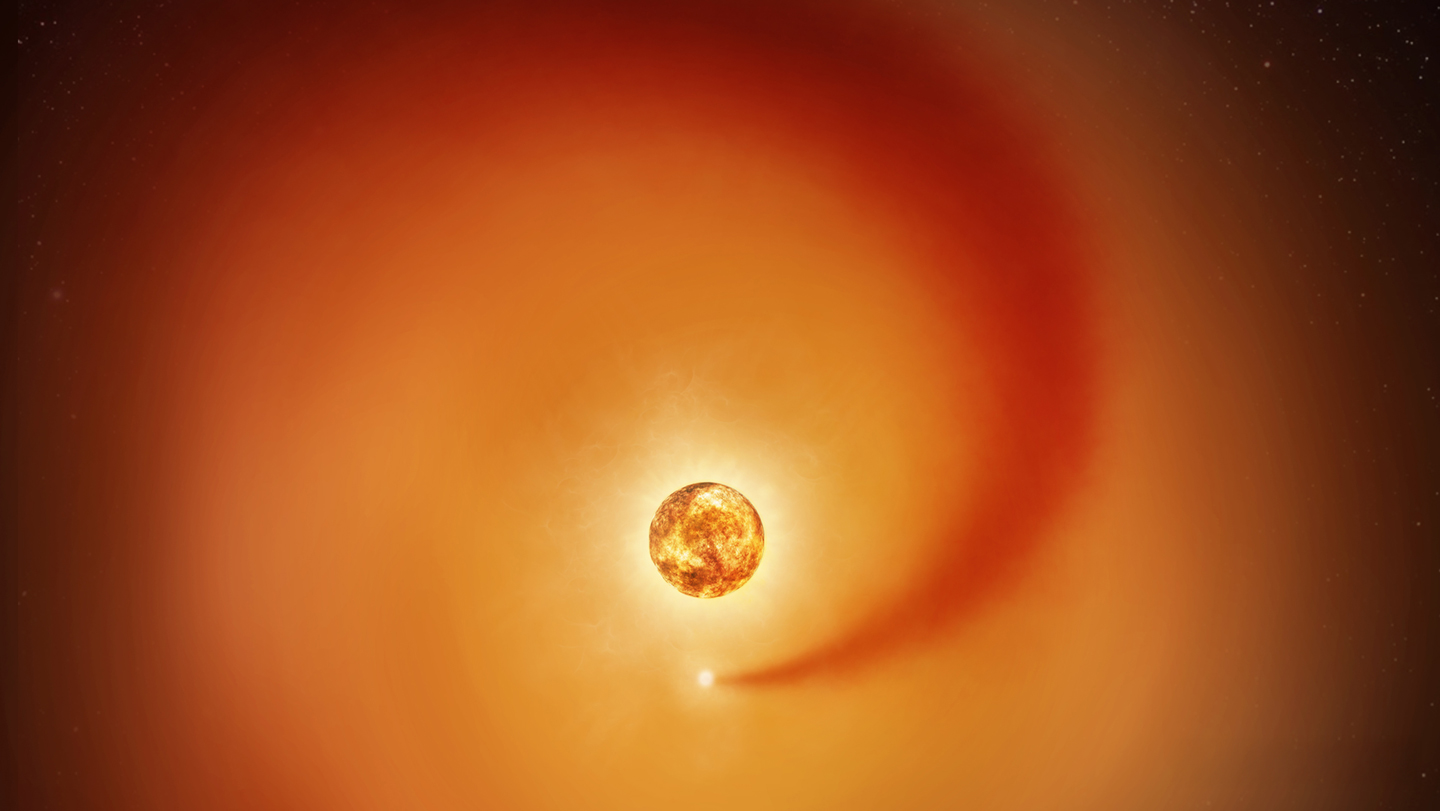
PHOENIX — Like a motorboat doing doughnuts in a lake, Betelgeuse’s companion star leaves a wake in the giant star’s atmosphere.
Signs of the smaller star’s trail around the red supergiant are the best evidence yet that Betelgeuse’s buddy actually exists.
“It confirms there really is an object there creating a wake, really, honestly, truly,” says astrophysicist Andrea Dupree, who presented the evidence at the American Astronomical Society meeting on January 5.
Betelgeuse marks one of the shoulders of the constellation Orion. Its brightness changes periodically. Over centuries of observations, astronomers have identified two distinct cycles, or periods, of brightening and dimming, one lasting about 400 days and one about 2,100 days.
Betelgeuse’s intrinsic pulsations cause the short period. “But the long period, we really did not know,” Dupree of the Harvard-Smithsonian Center for Astrophysics said in a January 5 news conference at the meeting.
In 2024, another group of astronomers found an explanation for the longer period: Betelgeuse has a smaller companion, about the mass of the sun. Other astronomers released a fuzzy photograph of the purported pal in 2025.
But neither of those results “made everyone say, OK, problem solved, let’s go home,” Dupree says.
The companion’s orbit put it at a distance from Betelgeuse just four times that of Earth from the sun. That means it should be within the supergiant’s outer atmosphere — Betelgeuse is so huge that its surface could envelop Jupiter if it were the star in our solar system.
Dupree and colleagues realized that perilous position meant the smaller star should drive a wake through the gas. The team used eight years of data from the Hubble Space Telescope and telescopes on the ground to search for signs of the companion’s effects on Betelgeuse’s extended atmosphere.
The team found that certain wavelengths of light grew brighter after the companion passed in front of Betelgeuse’s face and slowly dimmed as the companion moved behind the star. That’s consistent with a slowly expanding outflow of gas trailing behind the companion — the wake. The result was presented in a poster at the meeting and in a paper posted on arXiv.org.
“I think that Andrea’s result is very convincing and adds another ‘brick in the wall’ of evidence for the companion’s existence,” says stellar astrophysicist Anna O’Grady of Carnegie Mellon University in Pittsburgh. Between the theoretical papers arguing for the star’s existence, the image and O’Grady’s own work showing that the object doesn’t emit X-rays, meaning it is probably not a black hole or neutron star, she is “extremely convinced” that the star is real.
Betelgeuse is currently eclipsing the companion. But when the star comes back into view in 2027, “we are certainly going to look for it,” Dupree said. She also plans to look at other supergiant stars with long and short periods to see if they, too, have unseen companions.
Read the full article here