


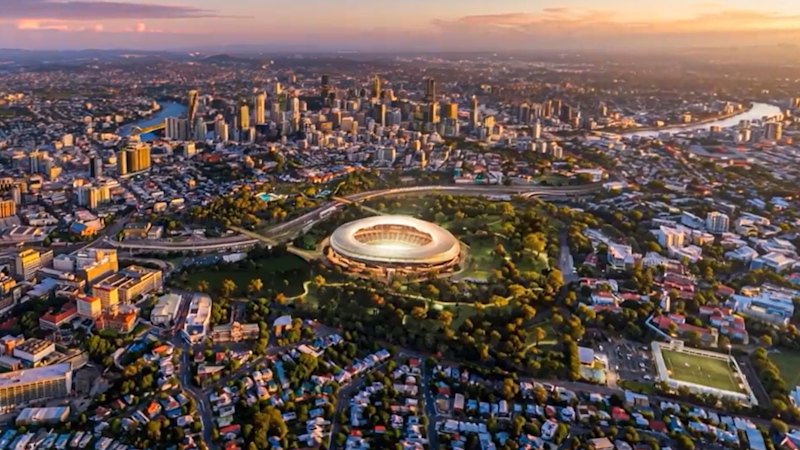
Western Australia’s population – particularly its construction workforce – is likely to be materially impacted by the mammoth construction program required to get the Brisbane 2032 Olympic Games off the ground.
A new deep dive by the Bankwest Curtin Economic Centre into WA’s population found the west and Queensland were already locked in a tight battle for labour, given the states’ similar economic profiles – and it predicted the Olympics would pull more workers to the east.
“Recent developments have sharpened this competition,” the report said.
“Strong construction activity and targeted workforce incentives in Queensland, combined with preparations for the Brisbane 2032 Olympic Games, have increased demand for skilled trades and construction workers, creating retention challenges for Western Australia.
“At the same time, the strength of Western Australia’s resources sector, supported by global commodity demand, continues to exert a strong gravitational pull on labour, drawing workers from across Australia when economic conditions favour the state.”
The Queensland and Commonwealth governments have set aside a $7.1 billion infrastructure budget for the games.
The report, one of the most detailed looks at WA’s population since it hit 3 million people in 2024, predicted 3.5 million would call the state home by 2033, and WA is on a trajectory to hit 4 million by 2043.
Bankwest Curtin Economics Centre director Professor Alan Duncan said WA’s migration patterns historically followed the rhythm of the resources sector.
“Movements in iron ore prices and mining investment shape labour demand and wages, and those signals translate into migration flows with a clear and measurable lag of around 12 to 18 months,” he said.
“When we explicitly incorporate those economic drivers into population modelling, forecasting becomes far more predictable and relevant for decision-makers to be able to fend off the economic strain caused by rapid population growth.
“A sustained lift in mining investment intensity could add around 60,000 people to WA’s population by 2039, and a 10 per cent increase in iron ore prices would add around 40,000.”
The report’s modelling suggested that for every 10 per cent increase in the iron ore price, about 283 more interstate migrants entered WA per quarter.
The price hike has a 12 to 18-month lag on population impacts, which the report said the government could use to plan ahead on issues like housing.
Housing also heavily impacted population growth, with every 10 per cent lift in home completions generating measurable lifts.
“When housing supply lags behind labour demand and migration inflows, pressure builds quickly in rental markets, construction costs and labour mobility,” Duncan said.
“Housing is now functioning as economic infrastructure. Without sufficient completions, migration slows, and growth potential is curtailed.”
Despite the known issues around housing in WA, the report found migration of construction-related workers had slowed – and it sounded a warning to government.
“The tightening migration pipeline into construction suggests that work remains to be done to ensure an adequate supply of skilled workers in building and construction,” the report said.
“This highlights the continued risks that skills shortages pose for construction project timing and costs – particularly given strong competition from other jurisdictions for skilled trades … it also suggests that domestic training alone may be insufficient to meet workforce requirements over the short term.”
The report called for housing supply to be treated as economic infrastructure rather than leaving it solely to the market.
The report also calls for the government to establish a WA population and migration strategy to set objectives for the scale and composition of migration including the skills, age and settlement patterns.
 Hamish Hastie is WAtoday’s state political reporter and the winner of five WA Media Awards, including the 2023 Beck Prize for best political journalism.Connect via X or email.
From our partners
Read the full article here