



As Canadians grapple with food affordability, the federal government and the Manitoba provincial government are trying two different tactics in a bid to provide some relief for consumers.
One of the methods involves freezing the price of some staple food products, while the other tops up the budgets of some Canadians to better afford food and other needs.
This comes as food inflation topped five per cent in December 2025, according to Statistics Canada, which was more than double the national average year-over-year price increase for all goods and services.
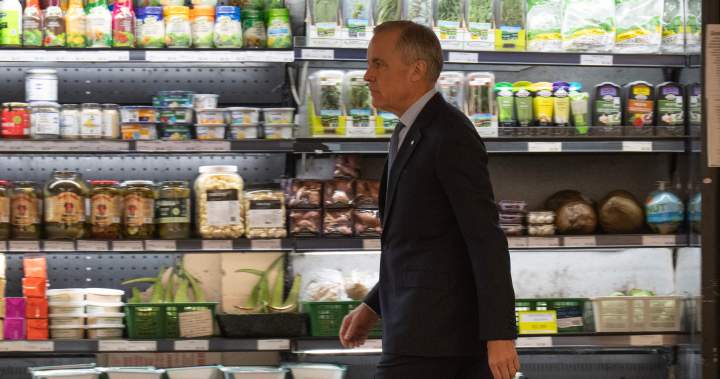
On Monday, Prime Minister Mark Carney spoke at a grocery store in Ottawa and outlined a series of new measures Ottawa was implementing to tackle food affordability — including a consumer rebate.
“We know that many low-income Canadians are choosing to buy cheaper food or having to do that trade-off between buying groceries and paying the rent,” said Mike von Massow, a professor and food economist at the University of Guelph.
“I think this will provide some real relief to the Canadians who are feeling these cost price increases most acutely.”
Carney outlined what he called the “Canada Groceries and Essentials Benefit,” which involves increasing the current GST credit to qualifying Canadians by 25 per cent, in addition to a one-time payment that is “equivalent to 50 per cent of the GST credit this year.”
The plan also includes measures aimed at improving food price stability in Canada over the long-term.
“These payments make up for the higher level of food prices since the pandemic. In parallel, we’re working to address the root causes of inflation and working on longer-term solutions to bring down the cost of groceries in Canada,” Carney said.
“That starts by improving the resilience of our supply chains, because when issues arise and supply chains from transportation to process to distribution costs rise at every step along the way, and these costs end up on the grocery bills.”
The consumer rebate portion Carney announced would mean some consumers will end up with more money in their pockets as a result of these tax rebates from the federal government.
“This new measure, an enhanced GST/HST credit that’s set to run for the next five years, should provide some relief for lower-income families,” Clay Jarvis, a banking and personal finance expert at NerdWallet Canada, said in a written note.
“It’s a considerate move on the part of the federal government, but a few hundred dollars spread out over the course of a year won’t be enough to stabilize struggling households.”
The federal Conservatives issued a statement saying they plan to support the rebate and allow it to pass in the House of Commons but urged other efforts to improve food affordability.
“In 2022 the former Liberal Prime Minister announced a similar policy – a one-time doubling of the same credit. The cost of living crisis has only gotten worse since then,” the Conservatives said.

Get breaking National news
For news impacting Canada and around the world, sign up for breaking news alerts delivered directly to you when they happen.
“Conservatives have real solutions that could be adopted immediately: repeal the food inflation packaging tax, the industrial carbon tax and the fuel standard that will add 17 cents per litre of gas so that the food Canadians eat can get from field to fork affordably.”
Prices at grocery stores are set by the businesses themselves, but the numbers they arrive at are because of a lot of different factors, and the complexity of food pricing means it’s no easy task to improve food affordability for Canadians overnight.
Supply chains are one of the main areas that contribute to the prices consumers pay.
If a supply chain is disrupted, like during a global pandemic or geopolitical tensions, that can mean less or no product on store shelves and drive up prices.
Poor weather conditions can also impact crop yields, leading to less supply and higher prices. For example, prolonged periods of drought can mean there is less supply of products like coffee beans or corn, and even beef products.
Tariffs are also part of the story, with some food products seeing price increases because of the cost suppliers wind up paying that could get passed onto the consumer — although Canada’s tariffs on most food products, including from the U.S., have been removed.
On Monday, Carney outlined an additional $500-million commitment to help improve Canada’s food network and supply chain resilience, intended to help keep food prices relatively stable over the long term, plus an added $150 million for the current Tariff Response Initiative.
One of the goals, Carney said, was to help build more greenhouses faster in Canada.
“That will give us resilience to things like the lettuce issue in California and winter vegetable price increases,” von Massow said.
“Now that’s not going to change food prices in the short term. People building greenhouses and making those investment decisions takes some time.”
This means if Carney’s ambitions to improve food affordability for the long term are going to work, consumers may still struggle with food affordability in the interim.
“Direct payments is really the only thing that the federal government can do to control prices, given what’s driving prices up,” von Massow said.
In Manitoba, the provincial government is locking in the maximum price for a litre of milk purchased in stores for the year.
This was touted by Premier Wab Kinew two weeks ago as an immediate affordability measure for consumers.
“We are squeezing the profit margins to save you money,” Kinew said.
“Rather than try to squeeze the dairy producer or the consumer, we’re saying that these grocery chains can help us out a bit during this cost-of-living crisis.”
Manitoba is one of the few provinces able to regulate the price of milk, which means other provinces and territories may have a tougher time with this.
“Although milk is a staple, not everyone drinks milk. So giving people money and allowing them to choose what they spend it on, to me, is a better and more efficient approach,” von Massow said.
No other jurisdictions in Canada appear to have used a similar method of price freezing in recent history.
In 1975, though, former prime minister Pierre Elliott Trudeau implemented countrywide price and wage controls in an effort to try to force down high inflation.
According to a New York Times report on Oct. 14, 1975, about the proposal, “Price increases will be prohibited, Mr. Trudeau said, unless it can be shown that costs have increased, and will be permitted only to an extent sufficient to cover extra costs. Furthermore, he said, if costs go down, prices must be reduced accordingly.”
The three-year move proved highly contentious, including from unions.
“The Pierre Trudeau government tried these [price controls] in the 1970s, and they created a lot of tension in the economy, and I don’t think they really worked,” said David Soberman, a marketing professor at the Rotman School of Management at the University of Toronto.
“Price controls could work in the short term, they could give people some relief, like for a month or two months, but they’re not going to address the structural problems we have that lie behind inflation.“
Soberman goes on to describe what could happen in a scenario where price controls may be implemented at a larger scale.
“Price controls are certainly targeted. So you can target all the products that are sold in a Loblaws or a Sobeys and fix the prices. You could do that. But now the question is, what is the effect of that?” he said.
“The effect could be that there’s some empty shelves because if you have a supplier and the prices are fixed and they can no longer make money, they stop producing.”
Food prices are expected to continue rising in 2026 by about $1,000 for the average family of four, according to Canada’s Food Price Report released in December 2025 by Dalhousie University.
Read the full article here