




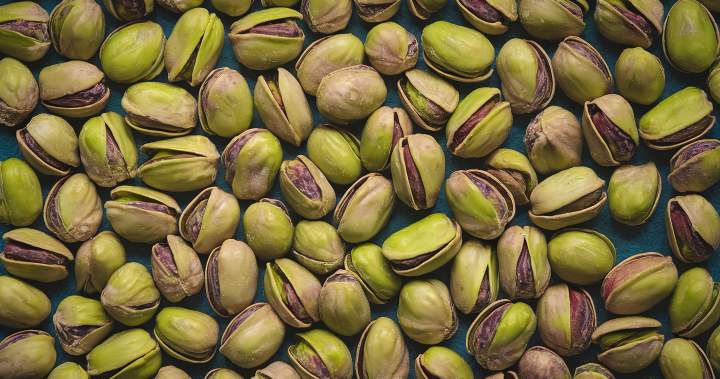
More people have become ill from salmonella due to an outbreak linked to some brands of pistachios and pistachio-containing products from Iran, prompting new restrictions on imports of the nut.
As of Dec. 2, the Public Health Agency of Canada says there are now 155 lab-confirmed cases of salmonella infections across six provinces, with the majority found in Ontario and Quebec.
Other infections have been confirmed in British Columbia, Alberta, Manitoba and New Brunswick.
The illness has impacted people from one to 95, with 70 per cent of cases among women and a total of 24 people hospitalized.
“We’re looking at quite a lot of illness associated with this event,” said April Hexemer, director of the outbreak management division at PHAC. “It is a concerning event and that is why we’ve issued this new advice. We’re trying very hard to control it and to put an end to it.”
The number of illnesses is an increase from PHAC’s last report on Oct. 21, when there were 117 cases confirmed and 17 hospitalizations.
According to PHAC, people became sick between early March and as recently as mid-November 2025.
The agency said many people who became sick reported eating pistachios, and products containing pistachios.
The various strains of salmonella in the outbreak were found in samples of recalled pistachios and samples of recalled Dubai-style chocolate.
“It does appear a little bit niche, but the thing is when we’re out and about picking up a littl snack, and you might be drawn to a baked item that has pistachios on top of it, there’s no way to tell where those pistachios came from,” she said. “We just really don’t knwo how much pistachios from Iran we’re routinely consuming.”
The recalls are part of an ongoing food safety investigation by the Canadian Food Inspection Agency (CFIA) that started with the Habibi brand of pistachio kernel on July 24.

Get weekly health news
Receive the latest medical news and health information delivered to you every Sunday.
The CFIA confirmed to Global News last week that the pistachios involved in the current recalls were imported from Iran, though did not say if it was from a specific crop.
At the end of September, as a result of its investigation, the CFIA announced it would implement a temporary restriction of imports of pistachios and pistachio-containing products from Iran as a precautionary measure.
On Tuesday, the agency announced further measures, making it mandatory for all federally-licenced importers and manufacturers that have Iranian pistachios that were imported prior to Sept. 27, to hold and test them for salmonella before they can be sold in Canada.
The new measures include any products made with pistachios from Iran that are not already recalled.
Hexemer told Global News that the agency recognizes that it can be “really difficult” to identify where pistachios are from because they may be purchased in bulk or repackaged throughout the distribution chain.
“We’ve defaulted to this advice where if the country of origin can be confirmed to not be Iran, it’s not affected and not part of this outbreak or set of recalls,” she said. “If the country of origin is unknown, you can’t identify it, or you do know it to be Iran through the label, we’re asking people to avoid those products to to prevent the risk of a salmonella infection.”
She also said people should be cautious as cross-contamination is possible should they have a contaminated product in the kitchen or even your lunch bag.
This includes cooking, with Hexemer cautioning people against using the recalled in cooking as she said it’s not always possible to kill salmonella through baking or cooking.
Multiple recalls have occurred for the products in just the past month with 151 listed between Nov. 12 and Dec. 2. In fact, between Nov. 25 and Tuesday, 65 products were recalled.
The products recalled in the past month were distributed to all provincess except Prince Edward Island, according to the CFIA, with some products also sold online. None of the territories were listed.
Some products recalled over the past several months have dated back to those sold in October 2024.
The CFIA noted in its investigation that pistachios have a long shelf life and may remain on the market for many months.
Canadians are asked to check if they have a recalled product, throw it out or return it if so, and to contact their health-care provider if they think they became sick consuming one.
Those who sell pistachio and products that contain them are advised to also check if they have any of the recalled products and to ensure they do not serve, sell or distribute them.
While food contaminated with salmonella may not look or smell spoiled, it can make you sick, with symptoms ranging from fever, nausea, vomiting, abdominal cramps and diarrhea.
It can take more than a month from the time someone gets sick, sees a doctor, gets tested, and has their results confirmed and PHAC says the illness reporting period for this outbreak is between 12 and 99 days after illness onset.
PHAC says researchers estimate for each case of salmonella reported to public health, there are 26 more cases that are not reported.
© 2025 Global News, a division of Corus Entertainment Inc.
Read the full article here