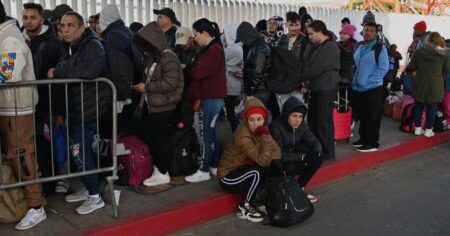


More Americans now describe ICE’s operations as too tough when stopping and detaining people, and there’s a growing view that President Trump’s deportation program is targeting more people than just dangerous criminals.
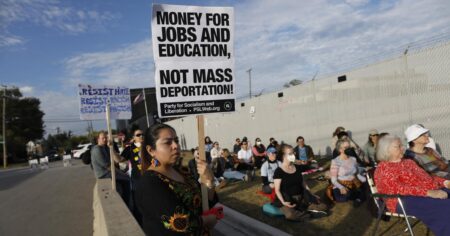
Meanwhile, Republicans overwhelmingly feel the protesters have gone too far.
In the wake of events in Minneapolis, overall support for the deportation program — which has roughly divided the nation for months — has dipped even as it continues to draw strong backing from Republicans and especially strong backing from MAGA.
And in sum, the public expresses a difference between how they see the goals of the deportation program and how it’s being carried out.
There are shifting perceptions of who is being targeted by the program. Americans are increasingly likely to say the administration isn’t prioritizing dangerous criminals, and most think the administration is trying to deport more people than they thought it would.
So, as Americans look overall, a slight majority feel ICE is making the communities where it is conducting operations less safe, many more than feel it’s improving safety.
Over the course of the term, overall approval of the deportation program started net positively, became more divided over the summer, and then hovered near that division for months. In the wake of events in Minneapolis, it dropped to its lowest overall mark of the term.
More people like what they believe the program’s goals are than like the approach being taken. The former is mixed, while the latter is negative.
Overall, Mr. Trump’s approval on handling immigration has also ticked down to its lowest point of his second term, though it continues to outpace his approval on the economy and inflation.
Views on the shooting of Renee Good by an ICE agent in Minneapolis hew closely to party lines. Republicans tend to call it justified, while Democrats and independents say it was not. Most also say that they don’t believe the administration’s response to it has been fair.
Non-MAGA Republicans are less inclined than MAGA to call the shooting justified.
Thinking about what should be next for ICE, the recent events in Minneapolis appear to have at least partially reinforced preexisting views about the deportation program. Democrats say recent events mean ICE operations in the U.S. should be decreased, though they already opposed the program. Republicans either say it means operations should be increased or kept the same; they’ve long favored the program.
Looking overseas to Greenland and Iran
Looking overseas, with widespread opposition to the prospect of military action in Greenland or Iran, a majority of Americans appear pessimistic about what Mr. Trump’s policies might bring in terms of peace and stability in 2026.
Most Americans think the U.S. does have strategic interests in Iran, but they are more divided on whether or not it has moral responsibilities there.
Most don’t think the U.S. has effective plans for military action there, and two-thirds feel it would be a long and costly involvement. Those sentiments are closely connected to opposition to the idea of force.
The idea of using military force to take Greenland faces overwhelming opposition across party lines, including most MAGA Republicans, who say they would disapprove. For context, they have largely backed the president after he has taken military actions, including in Venezuela and the strikes on Iran’s nuclear facilities last year.
Whether they support military action in Greenland and Iran or not, most Republicans do think Mr. Trump has made the U.S. position in the world stronger.
What do Americans think would happen if the U.S. took Greenland by force?
Some think taking Greenland would constitute a show of force to Russia and China, and just over half think it would provide access to needed natural resources. But large majorities also think it would cause the U.S. to leave the NATO alliance and create instability in the world.
Views about the latter two implications are very closely associated with opposition to the idea.
This CBS News/YouGov survey was conducted with a nationally representative sample of 2,523 U.S. adults interviewed between January 14-16, 2026. The sample was weighted to be representative of adults nationwide according to gender, age, race, and education, based on the U.S. Census American Community Survey and Current Population Survey, as well as 2024 presidential vote. The margin of error is ±2.3 points.
Toplines
Read the full article here