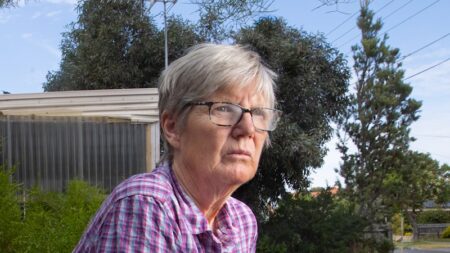


Six-year-old Jemima Jeffery stands on the blackened block near a school bus stop.
“I feel like everything’s changed,” she says.
“Everything looks different and everything feels different.”
In bushfire-ravaged areas of Victoria, families are still putting out fires, have had to euthanise their livestock and defend their homes as preppies and kids like Jemima prepare for their first days of school on Monday.
As of 9am on January 30, there were 21 schools, kinders and childcare centres impacted by fires, according to the Country Fire Authority. Four had been relocated, five had delayed starts and 12 were closed due to their proximity to fire, smoke and ash. The Victoria School Building Authority has inspected the fire impacts on 34 government school sites.
A CFA spokesperson said no schools had been lost. In the devastated town of Ruffy, the historic 1800s school building – no longer used as a school – burnt to the ground. In the last five years, the surrounding community faced the disruption from COVID-19, two major floods and a bushfire.
Euroa MP Annabelle Cleeland, who lives in Tarcombe, said her mothers’ group WhatsApp had shifted from a parenting logistics app to a critical check-in tool on how they were coping with the fires.
Cleeland evacuated with her three children Arthur, 6, Quinn, 5, and Sigrid, 16 months old, while her husband stayed to defend their house. About 300 of the family’s merino sheep had to be euthanised.
“I think we’re all a bit numb still. We’re kind of replaying what happened and not necessarily understanding the significance of the loss yet,” she said.
“Country kids are resilient. How they process things … I don’t know yet. And I worry about that, but we don’t have time to really sit and genuinely process how they’re holding onto things.”
When they returned to their burnt-out property nine days after the fire, one single ruby tomato survived in their veggie patch.
“My baby picked the tomato and, as she does, squeezes it, and put it on the ground,” she said.
At that point, her son, Arthur, unravelled.
“I think that’s what probably lingers the most when looking at transitioning back to school,” she said.
Before the fires, Cleeland’s daughter, Quinn, was very ready to start prep, but now due to the uncertainty of the past month, she’s craving what she knows – her kinder and the strong emotional ties to mum and dad.
“That is what school provides, the routine, the continuity, the care beyond your parents and your family,” she said. “They are the village for your family.”
On January 30, the state and federal governments announced a $158 million disaster recovery fund for families, businesses and primary producers affected by the fires and an extra $2 million for schools within fire-affected areas to engage extra mental health services. Some 30 schools have been supported to access specialist wellbeing services so far.
A Victorian government spokesperson said teachers and school staff were providing tailored support to help students adjust to disruptions caused by the fires and re-establish routines in the classroom. “Teams and specialist equipment have also been deployed to clear schools of smoke and bushfire residue,” he said.
But Cleeland, a Nationals MP, says mental health counsellors and support are too far away.
“We need trauma specialists on the ground here now because recovery is not just about rebuilding fences and houses, it’s about rebuilding people.”
Principal of Seymour’s St Mary’s College, Wayne Smith said the school of 625 students delayed returning on Monday because of the fires. Some teachers had been defending their homes, volunteering with the CFA or working at relief centres.
“We have families who’ve lost everything except the house,” he said.
Smith said the school would provide counselling support for students and families. St Mary’s, he says, has a strong wellbeing team, a full-time counsellor at the college, would run a targeted children’s grief program and is identifying students who might need extra help.
“Little children might say something, they may not. If they say something, it will be dealt with in the right way or responded to in the right way. But we want them to enjoy the day, enjoy school.”
The school is telling parents that they are welcome to talk to their counsellors as well.
Mother of three Felicity Jeffery, 39, whose Tarcombe house was saved but whose property was burnt out, said better education around natural disasters, especially for bushfire-prone areas, could be woven into the school syllabus or school programs.
“It’s the longer tail of the psychological impact. When children are tired, when dad’s not home until after bedtime [from working on a property], it can manifest itself in those moments.”
Her husband, Ned, is a Mitchell Shire councillor and CFA volunteer and stayed to defend their property and his parents’ property while she evacuated with their children.
They returned a few days ago, to prepare their daughter Jemima to start year 2 at St Mary’s College.
A Department of Education spokesperson said the familiar routine of schools were critical in helping students recover after natural disasters and were working to ensure impacted schools would open as soon as possible.
“School sites and early childhood services within evacuation zones have been closed this week, with relocation plans in place in line with each school’s emergency management plan,” she said.
Jeffery said some fire-affected families would have welcomed an earlier school start date to provide a sense of normality and routine for their kids, saying there was only so long they could look at a blackened block of land.
But there was some relief for Jemima, having shared the experience with her best friends. She is ready to go back to school.
“I’m feeling good,” said Jemima.
“I feel like everything’s changed, but I don’t mind.”
Start the day with a summary of the day’s most important and interesting stories, analysis and insights. Sign up for our Morning Edition newsletter.
 Nicole Precel is an education reporter at The Age. She was previously an audio video producer. She is also a documentary maker. Get in touch at nicole.precel@theage.com.auConnect via X, Facebook or email.
From our partners
Read the full article here