



China—the world’s third-largest nuclear power, behind Russia and the United States by number of warheads—is unlikely to increase transparency around its buildup in the new year, following this year’s unveiling of new weapons, an analyst told Newsweek.
China has little appreciation of the value of reassuring adversaries about the ultimate objectives or military rationale behind its nuclear buildup, said Tong Zhao, a senior fellow at the Washington, D.C.-based Carnegie Endowment for International Peace.
In response to Newsweek‘s inquiry, Liu Pengyu, spokesperson for the Chinese Embassy in Washington, D.C., said in a statement that China has maintained a defensive nuclear strategy, keeping its nuclear forces at the minimum level required for national security.
Why It Matters
Unlike the U.S., which provides official information about its nuclear stockpile, China closely guards the size of its arsenal. The East Asian military power is estimated to possess over 600 nuclear warheads, a figure the U.S. military predicts will rise above 1,000 by the end of the decade, according to a Pentagon report released on Tuesday.
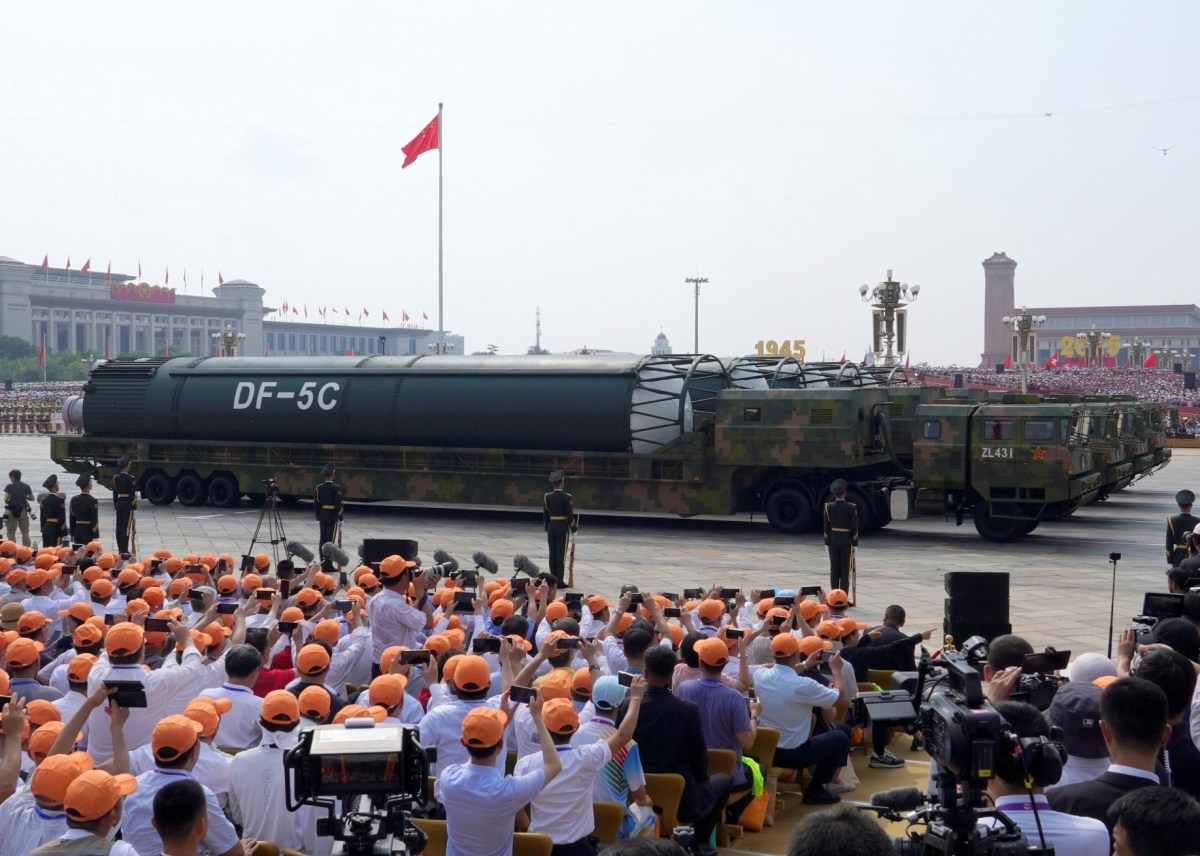
During a high-profile parade in September, the Chinese military unveiled new nuclear missiles, including a land-based intercontinental ballistic missile it claimed could target the entire globe with “defense-penetrating” capabilities, as well as weapons designed to launch from air and underwater, showcasing the nation’s nuclear triad for the first time.
China’s rapid nuclear modernization is part of efforts to build a “world-class” military by 2049, an ambitious goal outlined by President Xi Jinping to challenge U.S. military supremacy. By comparison, Russia—which has forged an “unlimited partnership” with China—and the U.S. have about 4,300 and 3,700 warheads ready for use, respectively.
Advances in Nuclear Weaponry
Regarding China’s development of its nuclear triad, Zhao said there should be little doubt about the country’s second-strike capability, referring to the ability of a nuclear-armed state to respond to an enemy nuclear strike with its own nuclear counterattack.
If China’s objective has been to move from an existential nuclear deterrent to an actual combat nuclear deterrent through the development of a highly assured second-strike capability, that goal should already have been “sufficiently achieved,” the analyst said.
Prior to the September military parade, China’s nuclear triad was considered “much less complete or capable” than its U.S. and Russian counterparts, the Federation of American Scientists’ Nuclear Information Project said in a March report. The Pentagon previously described China’s air-, land- and sea-based nuclear forces as forming a “nascent” nuclear triad.
Each leg of the triad provides unique and complementary attributes, according to a Pentagon fact sheet. Land-based missiles can be launched and strike targets within minutes, submarines are difficult for adversaries to track when they are on patrol, and bombers provide a variety of deployment and explosive power options.
One of China’s most significant nuclear achievements this year is the unveiling of the DF-5C intercontinental ballistic missile, a “global-covering” weapon with an estimated range of over 12,400 miles, state media reported. Zhao noted observers may interpret this as a reference to a fractional orbital bombardment system, or FOBS, capability.
A FOBS is an intercontinental ballistic missile with much shorter flight times when flying in the same direction as traditional missiles, or the ability to travel over the South Pole to avoid early warning systems and missile defenses. The U.S. Defense Intelligence Agency has estimated China would possess 60 such missiles by 2035.
“Washington is concerned that China could use FOBS to conduct strategic strikes against U.S. leadership targets and/or key nuclear command-and-control facilities with too short warning times,” the analyst said, adding that the weapon, if indeed developed, could complicate the management of nuclear escalation risks between the two powers.
‘Lean and Effective’ Nuclear Force
Over the past year, the Chinese government published two documents—one on a five-year plan for national economic and social development and one on arms control—that touch on the issue of nuclear strategy, providing a glimpse of the country’s intentions.
“We should strengthen our strategic deterrence forces to ensure global strategic balance and stability,” said the 15th Five-Year Plan released in late October. About a month later, China released an arms control white paper, claiming that by modernizing its nuclear forces, it can safeguard its strategic security and global strategic stability.
The white paper also reaffirmed China’s long-standing policy of no-first-use of nuclear weapons, adding that the country “never has and never will engage” in a nuclear arms race with other nations in terms of expenditure, quantity, or scale of nuclear weapons.
While these documents clearly indicate China’s continued interest in nuclear expansion, “there is still no convincing evidence that China has decided to pursue nuclear parity with the United States,” Zhao said, adding that the country is pursuing its traditional goal of maintaining what Beijing calls a “lean and effective” nuclear force.
From the Chinese leadership’s perspective, nuclear weapons have their value in what the analyst called “political coercion”—the ability to compel adversaries to accept peaceful coexistence and respect China’s core interests, including sovereignty, national security, territorial integrity, national reunification and the country’s political system.
Looking ahead to 2026, Zhao said that while significant improvements in transparency and greater clarity or predictability regarding China’s nuclear expansion are unlikely in the near term, the U.S. should avoid overestimating China’s intentions regarding it nuclear arsenal or overreacting in a way that could come at the expense of its own conventional-deterrence development.
What People Are Saying
Tong Zhao, a senior fellow at the Washington, D.C.-based Carnegie Endowment for International Peace, told Newsweek: “China’s approach to nuclear transparency is mostly oriented toward delivering deterrence signals rather than providing strategic reassurance. As new nuclear platforms enter service—such as a future strategic bomber or next-generation ballistic-missile submarine—Beijing is likely to showcase them at moments of its own choosing.”
Liu Pengyu, spokesperson for China’s Embassy in Washington, D.C., told Newsweek: “China is willing to work with all peace-loving countries to advocate for an equal and orderly multipolar world and inclusive economic globalization, consolidate and develop the international arms control system with the United Nations at its core, and jointly build a community of shared future for mankind.”
A white paper titled “China’s Arms Control, Disarmament, and Nonproliferation in the New Era” read: “In building a lean and effective nuclear force system, China is improving its capabilities in strategic early warning, command and control, missile penetration, and rapid response, as well as its survivability, in order to ensure the safety, security, reliability and effectiveness of its nuclear weapons and deter other countries from using or threatening to use nuclear weapons against China.”
What Happens Next
It remains to be seen whether China will conduct another test launch of a nuclear-capable missile in the new year, following its previous test in September 2024. Nuclear-armed states regularly verify their capabilities through unarmed testing.
Read the full article here