



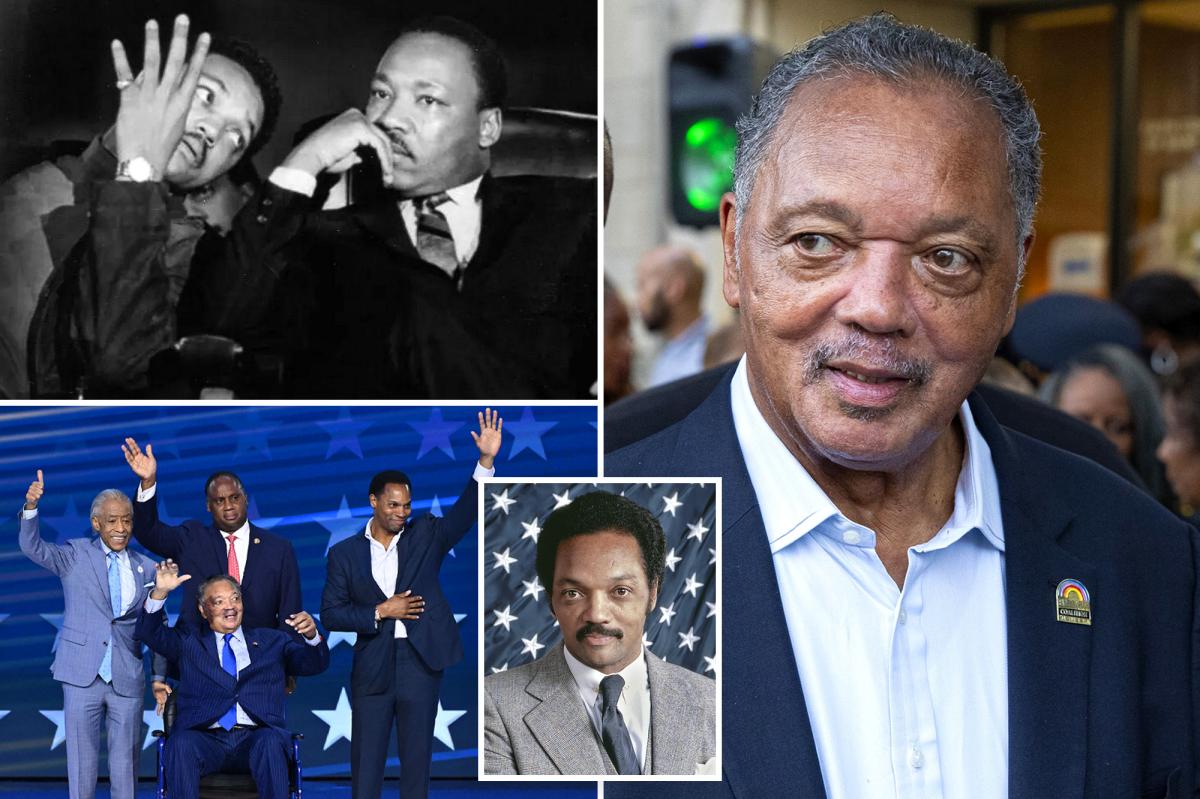
Civil rights activist Rev. Jesse Jackson died Tuesday morning. He was 84.
Jackson died peacefully, his family said in a statement shared on Facebook.
“Our father was a servant leader — not only to our family, but to the oppressed, the voiceless, and the overlooked around the world.
“We shared him with the world, and in return, the world became part of our extended family.
“His unwavering belief in justice, equality, and love uplifted millions, and we ask you to honor his memory by continuing the fight for the values he lived by.”
Jackson’s cause of death hasn’t been revealed.
The renowned civil rights leader’s death comes after he was hospitalized in Chicago last November for progressive supranuclear palsy — a rare brain disease.
“He was originally diagnosed with Parkinson’s disease; however, last April, his PSP condition was confirmed. The family appreciates all prayers at this time.”
On Nov. 16, his family pushed back against “inaccurate media reports” that the activist was on a form of life support after he suffered a significant drop in blood pressure, saying he was still “in stable condition” and “breathing without the assistance of machines.”
“In fact, today he called for 2,000 churches to prepare 2,000 baskets of food to prevent malnutrition during the holiday season,” his son, Yusef, added in a statement.
Jackson, known as Dr. Martin Luther King Jr.’s protégé, had garnered a lifetime of national acclaim for his dedication to civil rights.
He was one of the first major leaders to suggest giving reparations to descendants of black slaves.
In his lifetime, Jackson launched Democratic presidential bids in both 1984 and 1988 and was granted several high awards — including the Presidential Medal of Freedom by former President Bill Clinton in 2000.
Jackson had been struck by a wave of health issues in recent years.
The reverend announced in 2017 that he had Parkinson’s disease.
In 2021, he underwent gallbladder surgery and was hospitalized after testing positive for COVID-19. He also ended up in the hospital after falling and hitting his head during a visit to Howard University.
It wasn’t immediately clear when he was diagnosed with PSP — a rare brain disease that can affect a person’s ability to walk, balance and swallow.
Read the full article here