



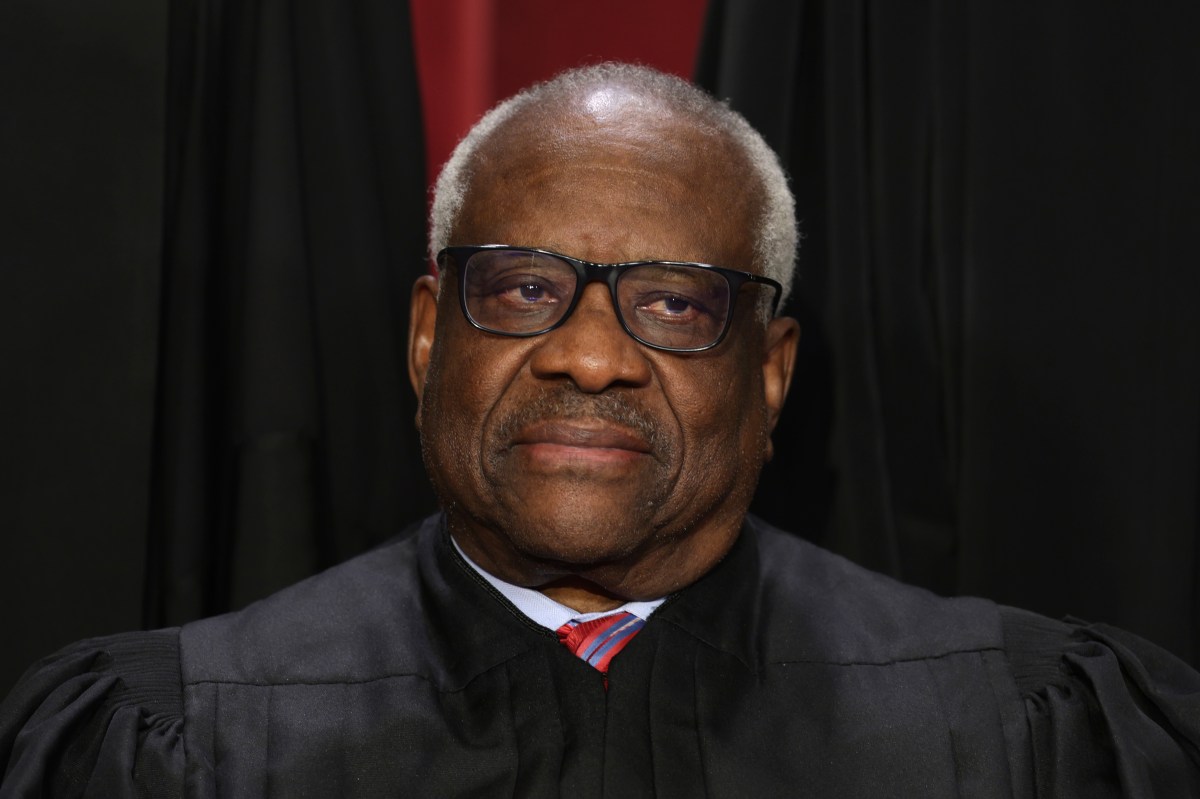
Supreme Court Justice Clarence Thomas wants the court to revisit a longstanding rule that has been in place for at least 105 years, he wrote in an opinion on Tuesday.
Why It Matters
The Supreme Court handed down a ruling in Hain Celestial Group, Inc. v. Palmquist on Tuesday, a case dealing with jurisdictional matters. The ruling was unanimous among the justices, with Thomas issuing a concurring opinion in which he would like to see the court revisit the improper-joinder doctrine, a rule at the heart of the case.
What To Know
The case was brought by Sarah and Grant Palmquist, a Texas couple who fed their child baby food made by Hain Celestial Group purchased at Whole Foods. Their child was diagnosed with a “range of physical and mental conditions that some doctors attributed to heavy-metal poisoning,” the court wrote.
After a congressional subcommittee in 2021 released a report finding that certain baby foods, including Hain’s, contained elevated levels of toxic heavy metals, they filed a lawsuit against Hain and Whole Foods in Texas state court, according to the court’s syllabus.
Hain, a Delaware-based company with its principal place of business in New York, sought to remove the case to federal court on diversity-of-citizenship grounds, the court said. Federal courts can exercise diversity jurisdiction when no defendants are from the same state, but Whole Foods is headquartered in Texas.
The District Court found that it lacked jurisdiction. Hain argued Whole Foods had been improperly joined and sought their removal. The district court agreed. The case went to trial, and the court found that the Palmquists did not provide sufficient evidence to prove causation.
However, the Fifth Circuit Court of Appeals found Whole Foods was not properly dismissed and that the company was properly joined because the parents “plausibly argued” it had violated state law by misrepresenting the products as safe, according to the ruling. The Fifth Circuit vacated the judgment and sent it back to the state court.
The Supreme Court ruled that the Fifth Circuit was correct and that the “erroneous dismissal of Whole Foods did not cure the jurisdictional defect that existed when this case was removed to federal court.”
Clarence Thomas Wants Court to Address Longstanding ‘Improper Joinder’ Doctrine
Thomas wrote a concurring opinion addressing the improper joinder doctrine.
“I write separately to note my skepticism of the doctrine of ‘improper joinder,’ which the District Court invoked to dismiss Whole Foods in this case. The doctrine appears to allow federal courts to enlarge their jurisdiction by assessing the merits of claims over which they lack jurisdiction,” he wrote.
The doctrine allows federal courts to “exercise jurisdiction over cases that originally involved nondiverse defendants by first deeming the claims against those nondiverse defendants sufficiently weak on the merits and then dismissing them,” he wrote.
The circuit did not vacate “because it thought that conducting an improper-joinder inquiry was inappropriate,” but because it thought the Palmquists potentially stated meritorious claims against Whole Foods, he wrote.
Thomas believes precedent does not allow federal courts to dismiss nondiverse parties based on views of merit, he wrote.
In his view, precedents “concerned only whether the plaintiff avoided federal diversity jurisdiction by bad faith or actual fraud—such as lying about a party’s conduct or citizenship.”
“Federal courts sitting in diversity likely cannot dismiss nondiverse parties based on their view of the merits of the claims against those parties. Doing so appears unfaithful to Congress’s limits on our diversity jurisdiction and inconsistent with this Court’s precedents,” he wrote.
He wrote that he would like to see the court address the doctrine in the future.
“In a future case where the issue is briefed and squarely presented, this Court should consider the propriety of the improper-joinder doctrine,” he wrote.
The doctrine of “fraudulent joiner” dates back to at least the 1921 case Wilson v. Republican Iron & Steel Co. In that case, the court decided the “right of removal cannot be defeated by a fraudulent joinder of a resident defendant having no real connection with the controversy.”
What People Are Saying
Supreme Court Justice Sonia Sotomayor wrote in the court’s opinion: “It is important to emphasize at the outset ‘two ‘givens’ in this case.” Caterpillar Inc. v. Lewis, 519 U. S. 61, 70 (1996). First, no party asks this Court to revisit the Fifth Circuit’s holding that the District Court’s improper-joinder decision was incorrect and that Whole Foods should not have been dismissed. See Brief for Petitioners 7, n. 1. Second, no party disputes that, had the District Court performed the joinder analysis correctly when the case was initially removed, it would have lacked jurisdiction and would have been required to remand the case to state court.”
In a polarized era, the center is dismissed as bland. At Newsweek, ours is different: The Courageous Center—it’s not “both sides,” it’s sharp, challenging and alive with ideas. We follow facts, not factions. If that sounds like the kind of journalism you want to see thrive, we need you.
When you become a Newsweek Member, you support a mission to keep the center strong and vibrant. Members enjoy: Ad-free browsing, exclusive content and editor conversations. Help keep the center courageous. Join today.
Read the full article here