




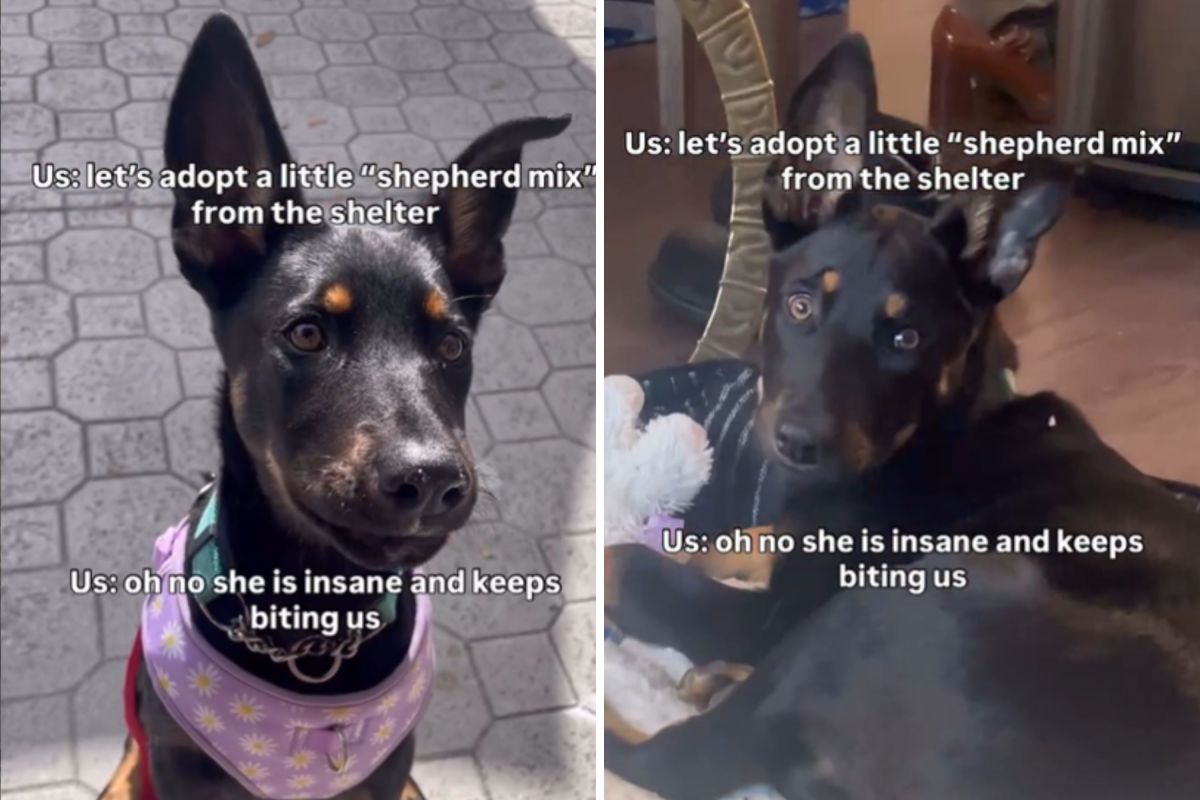
A couple expected a loyal, energetic companion when they adopted a “shepherd mix,” but what they got was a whirlwind of nonstop biting that left them questioning the pup’s true breed.
Alyssa Lucarello told Newsweek via email that she adopted Indi in October. Since Indi is a puppy, she expected the typical challenges of a young dog—chewing, house training, and occasional puppy antics. Plus, hearing that Indi was a shepherd mix, she and her partner were drawn to her, as they wanted an active and loyal canine.
“We expected her to be very intelligent, pretty energetic and very affectionate with us, ” she said. “…By the end of week 1, we realized that Indi was really intelligent, but had a level of intensity that we hadn’t seen before in any of our pet dogs.”
It became clear that Indi was not a typical shepherd. She was “mouthy and tenacious.” It went from puppy behavior to nonstop biting, tearing clothes and jumping after their legs while biting them. The couple started noticing similarities between Indi and Belgian Malinois puppies in videos online, raising suspicions that their energetic pup had more Malinois in her than advertised. In a March 24 Instagram video under the account @indithemalidobe, Lucarello shared DNA testing results, confirming their suspicions.
The couple received the DNA results in late January, revealing Indi, now 9 months old, is a unique mix: 46.4 percent Belgian Malinois, 28 percent German shepherd, and 25.6 percent. Doberman Pinscher.
“We felt pretty vindicated after all the struggles we had so far with training,” she said. “Belgians are inherently mouthy, and so it wasn’t just a training failure that we couldn’t get that trait out; it was simply something to be worked around.”
According to research on canine breed behavior published in Applied Animal Behaviour Science, behavioral tendencies do differ reliably between breed groups. Peer‑reviewed studies analyzing thousands of dogs using standardized tools like the Canine Behavioral Assessment and Research Questionnaire (C‑BARQ) have found significant variations in everyday behavior between working and non‑working breeds, suggesting that traits selected for specific tasks, such as herding, guarding or high activity, are expressed more prominently in some breed groups than others.
These findings help explain why herding and working dogs like Belgian Malinois often show higher levels of mouthiness and task‑focused biting, reflecting their genetic history of using their mouths to control livestock and perform demanding jobs rather than just training shortcomings.
They weren’t entirely surprised by the results, as most people stopping them on the street would guess one of those breeds. Plus, to Lucarello, Indi looks like all three, with a face and frame like a Malinois and German shepherd, while her eyebrows and leg fur look like a Doberman.
Now, understanding Indi better, dog training has started to improve. Lucarello credits breed-specific guidance from Belgian Malinois communities for helping channel her biting tendencies.
“The standard puppy advice just didn’t work for her because of her energy, drive, and inherent traits, but the breed-specific advice was invaluable and also helped us get an idea of what activities might be most fulfilling to her now and as she gets older,” she said.
Her biting has been getting better. With age, she’s learning about her bite inhibition, and the couple is discovering ways to channel that instinct. But, as for now, Lucarello joked that socks and clothes are still fair game in Indi’s eyes.
Despite the challenges, Lucarello said adopting Indi was worth every bit of effort.
“The learning curve was steep, but she will be amazing to see one day once she is more mature and trained,” she said. “She was a challenge and a half to raise in that puppy stage, but if you can get around the biting, she is an amazingly loyal dog, loves to be around her people, and is inherently sweet, goofy, and lovable.”
Viewer Reactions
The Instagram video had reached over 2.3 million views and 3,562 comments as of Monday, with people cracking up at how Indi might have an ounce or two of energy with her mix of breeds.
“I believe you adopted a velociraptor,” joked a viewer, while another added: “The unholy trinity, oh my gosh.”
Someone else commented: “Ma’am, that’s not a dog, that’s a genetically modified force of nature.”
Do you have funny and adorable videos or pictures of your pet you want to share? Send them to life@newsweek.com with some details about your best friend, and they could appear in our Pet of the Week lineup.
Read the full article here