




I appreciated Danny Berkovic’s article and I agree that words can be weaponised and Israel has a right to exist (“How ‘Zionist’ became a safe word for Jew hatred”, February 15). Sadly, under the current Israeli government’s actions, Israel has gone from having massive international sympathy and support after the horrors of October 7, 2023 to horror about its destruction of Gaza and the murder of innocents. I hoped that he may at least acknowledge that Israel’s own actions have stoked the fires of antisemitism to levels never before seen in Australia. That is our current conundrum: tragedy on both sides and so little hope or vision for a just outcome giving the Palestinian people a state for themselves. Rhyan Andrews, Faulconbridge
Danny Berkovic writes that Zionism is simply “the Jewish people’s right to self-determination in their ancestral homeland”. That definition is neat. It is also historically incomplete. Modern political Zionism emerged in late 19th-century Europe with the explicit aim of establishing a Jewish state in a land that was already inhabited. In 1897, when the First Zionist Congress met in Basel, the overwhelming majority of the population of Palestine was Arab – Muslim and Christian – living in established towns, villages and farming communities. Jewish sovereignty there could not be realised without altering that demographic reality. In 1948, that alteration occurred through war and mass displacement. More than 700,000 Palestinians were expelled or fled in fear. Over 400 villages were depopulated or destroyed. Antisemitism is real and must be opposed without qualification. But that truth does not erase another. Zionism is a state-building movement whose realisation entailed – and continues to entail – the removal and dispossession of Palestinians. Criticising Zionism is not hatred of Jews, but a political stance grounded in documented history. Fernanda Trecenti, Fitzroy (Vic)
The problem with Danny Berkovic’s argument regarding Zionism is that his “simple” definition does not take into account the history of Israel after 1948 and, more particularly, 1967, when the Six-Day War tripled Israel’s size. Since then, Zionism has become inextricably linked to Israeli expansionism and the flouting of international law, making it quite a big call to conflate antisemitism with anti-Zionism, and to suggest, as he does, that it is disingenuous to separate the two. Alynn Pratt, Grenfell
Seek source to beat bullying
Hats off to Professor Donna Cross and NSW Education Minister Prue Car for coming up with the most advanced policies for countering bullying in schools that I’ve ever encountered (“‘Safe zone’: Ambitious plan to stamp out bullying”, February 15). This is a great first step in countering the persistent problem of school bullying. But it also raises the question: where does this bullying tendency in children originate? The enlightened approach described above is a welcome first step in what is one of the most vexing problems here in Australia – domestic violence. Larry Woldenberg, Forest Lodge
Again teachers are expected to bear the burden of implementing a revised anti-bullying program in the classroom (“Create a culture of kindness in our schools”, February 15). Are our expectations of how much teachers can influence our children unrealistic? How on earth are teachers expected to educate our children with an already overloaded curriculum, having to keep up to date with the complexity of the digital age, and manage disruptive children? A more successful outcome (and desperately needed) would be to have a qualified counsellor attached to every school. Christina Foo, Wahroonga
Barracks bipartisanship
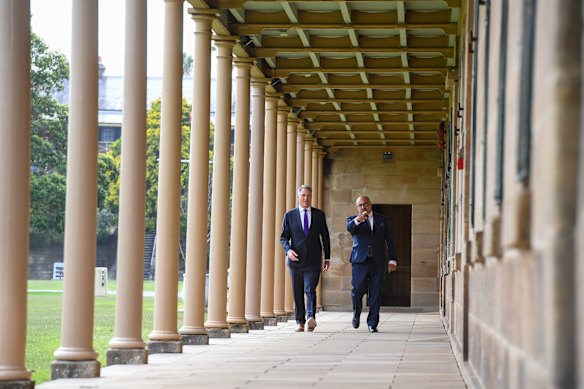
How gratifying it was to read the article by Alexandra Smith (“Cross-party push to keep barracks in public hands”, February 15). It appears to take an issue of national significance to get political parties and independents to row in the same direction. I wish this diverse group every success in preventing the sale. Paul Reid, Campsie
Taylor’s turn-off
That the new Liberal leader Angus Taylor is reportedly poised to bring back exiled conservative figures Andrew Hastie and Jacinta Nampijinpa Price to frontline politics (“Taylor eyes new team with Hastie, Price on frontbench”, February 15) could very well prompt more moderate Liberal voters to switch their allegiances to the teals. Eric Palm, Gympie (Qld)
I would suggest that the Liberal Party has three existential challenges, not two, as per Parnell Palme McGuinness’ article (“Twin challenges await new leader”, February 15). They are: the teals to the left, One Nation to the right and, third, who the hell are they? Because who is the Liberal Party? They don’t know; we, the voters don’t know; and their prolonged infighting confirms the confusion. I don’t believe they actually have any political “ground” to stand in. The real Menzies Liberal Party is now the teals, and in desperation, the Liberals have reverted to the past reliable formula: a conservative, middle-aged white male who will paternalistically save the country. Meanwhile, their party is a rubber ducky spinning around the political vortex, soon to disappear through the reality plughole, never to be seen again. Rowan Godwin, Rozelle
Read the full article here