


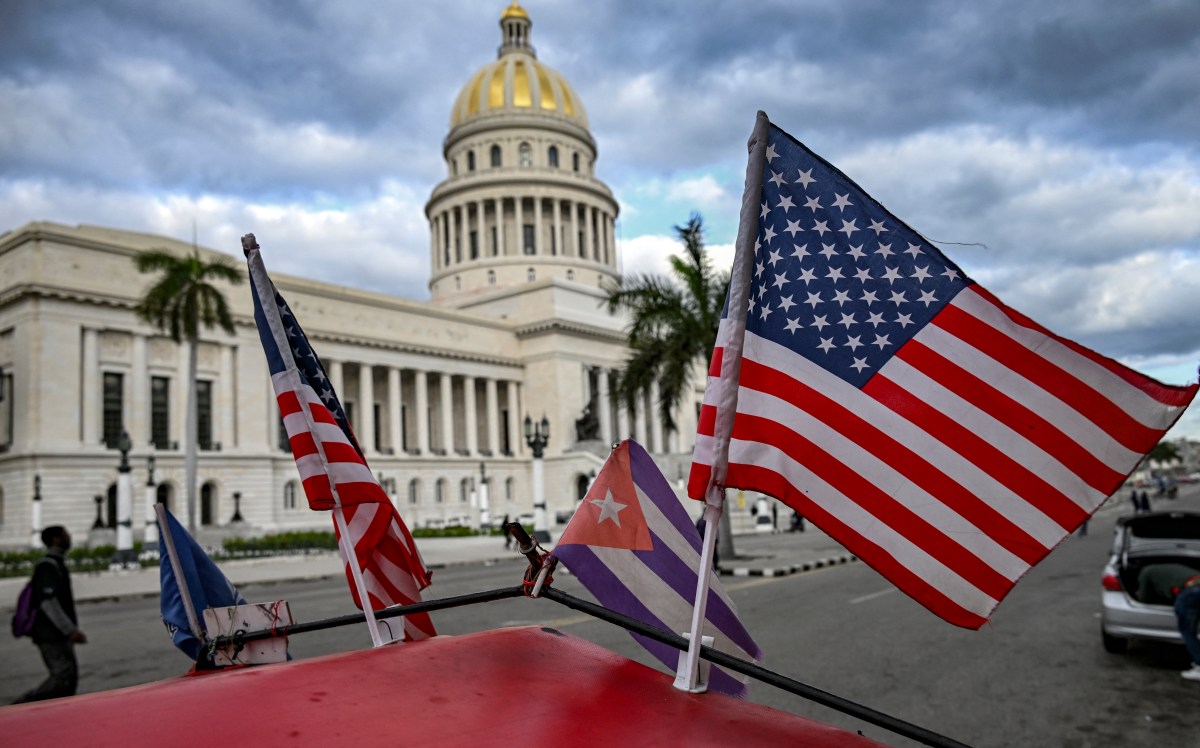
Cuba’s ambassador to the United Nations has shared with Newsweek the areas of cooperation his government is willing to discuss with President Donald Trump as the White House ramps up pressure.
Quoting late Cuban President Fidel Castro, who led the 1959 revolution that first brought Communist Party rule to the Caribbean island nation subject to a U.S. economic embargo since the early years of the Cold War, Cuban Permanent Representative to the U.N. Ernesto Soberón Guzmán told Newsweek that “the best way to win a war is to avoid it.”
“And the best way to avoid it is to prepare for it,” the senior Cuban diplomat continued.
While Trump has yet to signal any overt military action in his recent escalation of rhetoric directed toward Havana, the U.S. leader’s assertive posture in the Western Hemisphere, demonstrated recently through the U.S. Delta Force raid that captured socialist Venezuelan Nicolás Maduro and his wife from their home in Caracas last month, has raised the stakes in a feud that has persisted throughout 15 U.S. administrations.
With crucial oil supplies from Venezuela waning and the U.S. threatening to impose steep tariffs on any nation that steps up exports, “Cuba is ready to fall,” according to Trump. He has said Havana must now reach an agreement “before it’s too late.”
Soberón Guzmán acknowledged serious hardships experienced across the island, where blackouts and shortages of vital goods and services have become a part of everyday life. Yet he also spoke of a culture of “resistance, resilience, innovation, and finding solutions to our problems” that have allowed Cuba to weather decades of punitive U.S. policy.
He also discussed an approach rooted in pragmatism and willingness to engage in dialogue that is set to be put to the test as Cuba finds itself in the crosshairs.
“This has been our consistent position, consistent not just now but for many years that we have stated, and which has now been reaffirmed,” Soberón Guzmán said. “Cuba is willing to negotiate with the United States, to have a dialogue based on absolute respect for our sovereignty and independence without interference in internal issues and on equal footing.”
Finding Common Ground
Much of U.S.-Cuba relations since Castro’s toppling of a military leader who once enjoyed significant U.S. backing has been dominated by tensions, including a failed 1961 CIA-backed intervention, a 1962 nuclear standoff between the U.S. and the Soviet Union and numerous attempts on the Cuban revolutionary leader’s life.
A brief thaw emerged under President Barack Obama, who made the unprecedented steps of engaging in direct meetings with then-Cuban President Raul Castro, brother and successor to Fidel. Under Obama, some restrictions were eased, cooperation in several fields was increased and, for the first time, formal embassies were established between Washington and Havana in 2015.
Trump’s first election victory the following year led to a reversal of many of these measures, once again hardening the U.S. stance. President Joe Biden, upon defeating Trump in 2020, did little to roll back these policies, leaving much of them in place when Trump returned to office early last year.
But Soberón Guzmán identified several areas where he felt renewed cooperation could work in Washington’s favor, addressing some of the core concerns fueling the White House’s declared “corollary” to the 19th-century Monroe Doctrine that set the stage for a dramatically expanded U.S. role across the Americas.
For example, as Trump pursues a crackdown on illegal immigration, with a number of Cuban nationals also being caught up in nationwide raids conducted by ICE, Soberón Guzmán, who previously served as director of consular affairs and Cuban residents abroad, said that “Cuba’s policy is in favor of regular migration, and “therefore, it would seem that this would be an area of agreement.”
On the issue of illicit drugs, which Trump defined as a pretext for seizing Maduro on alleged “narco-terrorism” charges and for ramping up operations against cartel organizations in Mexico and the Caribbean, Soberón Guzmán said, “We are all familiar with, even if we don’t agree with the methods, this government’s policy regarding drug trafficking.”
And while he criticized the U.S. policy of pursuing unilateral strikes against suspected narcotics-carrying vessels in the Caribbean, he also asserted that “everyone knows that Cuba has a zero-tolerance policy regarding drug trafficking, and in the past, we have cooperated on this matter.”
Cuba’s Coast Guard chief Colonel Ybey Carballo told Reuters in December that despite such cooperation ceasing during the second Trump administration, Cuban law enforcement has continued to provide U.S. counterparts with tips and intelligence regarding suspected drug activity in the Caribbean. Cuban Specialized Anti-Drug Enforcement Agency head Colonel Juan Carlos Poey said during a press conference held at the time Cuban authorities had intercepted 72 drug smuggling attempts involving 11 countries between 2024 and 2025.
Meanwhile, Cuba has managed to establish itself as a global leader in the development of legal, pharmaceutical drugs and in the pursuit of various forms of biological medicine. Soberón Guzmán proposed that “another area of cooperation could be health research” should the U.S. and Cuba come to the negotiating table.
Soberón Guzmán referenced how Trump himself claimed Cuba had lower rates of autism than the U.S. and, while the Cuban diplomat would not attest to the science behind the U.S. leader’s associated argument related to Tylenol consumption during pregnancy, he suggested this may indeed be an area “in which we could cooperate.”
Newsweek has reached out to the U.S. State Department for comment.
Red Lines
While Cuba does see room for collaboration, there is a prevailing concern the White House rather seeks to realize a long-held goal of imposing political change through any new agreement. This objective was recognized by Secretary of State Marco Rubio, a fervent critic of the Cuban government, who told lawmakers late last month that “we would love to see the regime change” in Cuba, though “that doesn’t mean that we’re going to make a change.”
The U.S. has consistently called for an end to single-party communist rule in Cuba, alleging a long practice of political oppression and a range of human rights abuses, accusations regularly denied by Cuban officials.
Cuban President Miguel Díaz-Canel, who succeeded Raul Castro as president in 2019 and as Communist Party first secretary in 2021, marking the end of an era of Castro family rule in Cuba, said during a televised press conference on Thursday that “Cuba is open to dialogue with the United States, a dialogue on any topic they wish to discuss.”
But he emphasized that such dialogue “is impossible under pressure” and must take place “without preconditions, on equal footing, with respect for our sovereignty, our independence, and our self-determination, and without addressing issues that are offensive and that we could consider interference in our internal affairs.”
White House press secretary Karoline Leavitt responded to the remarks by telling reporters Friday that “I think that the fact that the Cuban government is on its last leg and its country is about to collapse, they should be wise in their statements directed toward the president of the United States.”
Reacting to Díaz-Canel’s denial that U.S.-Cuba talks had already begun, she stated “the president is always willing to engage in diplomacy, and I believe that is taking place, in fact, with the Cuban government.”
Cuban Deputy Foreign Minister Carlos Fernández de Cossío told CNN on Wednesday that Cuba is “not ready to discuss our constitutional system, just as we assume that the United States is not ready to discuss its constitutional system, its political system, or its economic reality.”
Soberón Guzmán also affirmed that political and economic ultimatums were off the table in negotiations. At the same time, he pointed out Cuba had already begun a wide-ranging series of reforms geared toward expanding private businesses and property away from the strict state-run model instituted when the island first came under communist leadership.
“This is one of the changes, to give you an example, that the Cuban government and people decided to make of their own free will, because we considered it beneficial,” Soberón Guzmán said. “I’m referring to private property, which also coincided with one of the suggestions—not to say conditions—that the U.S. government had put forward, based on their conception of society, which is not the same as ours.”
There is also the matter of Cuba’s foreign ties, particularly as they related to China and Russia, to nations designated as top targets for the Trump administration’s efforts to assert U.S. influence in the Western Hemisphere. Havana has continued to enjoy close relations with its Cold War-era ally Moscow and cooperation with Beijing has increased, with U.S. officials expressing concern over alleged Chinese espionage bases—claims denied by China and Cuba.
“The first thing to understand and acknowledge is that it is Cuba’s right, and Cuba’s alone, to decide with whom it establishes or does not establish relations, just as it is the right of the United States,” Soberón Guzmán said. “I am sure that the U.S. government would never accept someone coming and telling it that it cannot have relations with this country or that one. And no independent country would accept that.”
“Now we come to the other issue,” he added. “One of the pretexts that has been used to justify the adoption of all these measures is that supposedly these relations that Cuba has with China, with Russia, and with others make Cuba a threat to the national security of the United States, which is absolutely false.”
He asserted that “no relationship that Cuba has had, has, or may have in the future with any country is intended to harm or threaten the United States; that would be like shooting ourselves in the foot.” Rather, he argued, “the relations that Cuba maintains with third countries are aimed at mutual benefit between Cuba and that country,” citing examples such as Russian tourism deals, Chinese biotechnological medicine collaboration, food ties with Vietnam and cobalt and nickel trade with Canada among other bilateral arrangements.
Once again, Soberón Guzmán said, “We return to the doctrine: the way to win the war is to avoid it and the way to avoid it is not to give the United States any pretext to take action against Cuba.”
He also offered another quote from Fidel Castro when it comes to U.S. threats, “Cubans do not like being intimidated.”
Next Steps
The White House has yet to announce any specific aims in achieving an agreement with Cuba. In recent press appearances, Trump has only highlighted the dire nature of the conditions the country faces and signaled his hope that Cuban exiles be able to return freely.
“Cuba’s a failing nation. It has been for a long time, but now it doesn’t have Venezuela to prop it up,” Trump told reporters earlier this month. “We’re talking to the people from Cuba, the highest people in Cuba. We’ll see what happens. I want the people that came here that were horribly treated by Cuba to be taken care of, to be able to go back, and do what they have to do.”
“You know, they have their family there. They haven’t been able to see them in years, many, many years,” he said. “So, I think we’re gonna make a deal with Cuba.”
Some reports indicate political change may be on the agenda, as suggested by an article in The Wall Street Journal last month citing unnamed U.S. officials as saying that the administration was eyeing regime change in Cuba by the end of the year.
Soberón Guzmán said he had yet to receive any details regarding what exactly it is the U.S. sought to gain from talks with Cuba but acknowledged the speculation surrounding motivations that may run in contrast to Cuba’s starting position.
“To be frank, I don’t have the information. I’ve heard the same things you’ve heard, expressions like ‘regime change,’ ‘government change,'” Soberón Guzmán said, describing phrases indicating the U.S. effort to rekindle talks “is not going in the direction” he had describe as being potentially beneficial for both sides.
“But I insist, both countries have demonstrated that it’s possible to have a dialogue, that it’s possible to discuss any topic and achieve mutual benefits,” Soberón Guzmán said, “and Cuba has reiterated that it is willing to do so based on the requirements I already mentioned.”
And despite the sharp downturn in ties since the first Trump administration, he argued that “we are in a better position now than 10 years ago,” as bilateral diplomatic ties as well as the embassies representing them remain open.
“The question is how we use them, for engagement or confrontation? That’s a step forward that’s already there and that’s positive,” Soberón Guzmán said. “Cuba also been said that because this exists, an exchange of messages is possible.”
But just as he recalled was his mindset during the brief window of rapprochement under the Obama administration, Soberón Guzmán asserted that after more than six decades of a dynamic largely defined by confrontation, “it’s not possible to change things overnight.”
“It’s about the mindset; you need to prove that what we’re doing is truly serious, that there’s a genuine intention to cooperate between both sides, that it’s something that can last over time and won’t be reversed with the stroke of a pen, as what happened,” Soberón Guzmán said. “So, we have to walk before we run, in terms of objectivity and in terms of understanding the relationship between Cuba and the United States.”
In a polarized era, the center is dismissed as bland. At Newsweek, ours is different: The Courageous Center—it’s not “both sides,” it’s sharp, challenging and alive with ideas. We follow facts, not factions. If that sounds like the kind of journalism you want to see thrive, we need you.
When you become a Newsweek Member, you support a mission to keep the center strong and vibrant. Members enjoy: Ad-free browsing, exclusive content and editor conversations. Help keep the center courageous. Join today.
Read the full article here