


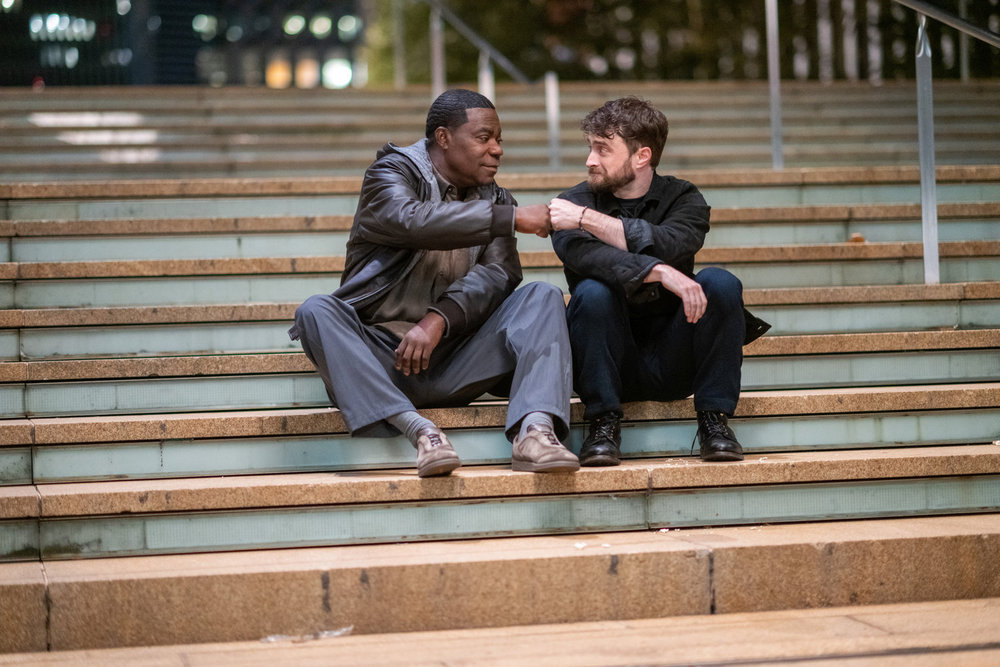
“You can’t compare Tracy [Morgan] to any other actor you’ve ever worked with.”
Daniel Radcliffe on starring with Tracy Morgan in The Fall and Rise of Reggie Dinkins, his Broadway journey and Harry Potter: “I love that people love those movies.”
PARTING SHOT PODCAST WITH H. ALAN SCOTT:
SUBSCRIBE ON APPLE PODCASTS, SPOTIFY,
OR WHEREVER YOU GET PODCASTS.
Editor’s Note: This conversation has been edited and condensed for publication.
I’ve seen you in Merrily We Roll Along, I’ve seen you on Broadway a few times now. And you’re back now with Every Little Thing. You’ve become kind of a Broadway staple. How does that feel?
Lovely. I mean, it’s really, really nice. And whenever somebody talks about stunt casting or celebrities, they kind of go, “Oh, he doesn’t count. He’s here all the time,” which I’m really like, “that’s great. I could not wish that to go better.” To be able to come back to it throughout my career. And it’s honestly been the making of me as an actor, coming to New York, doing Equus, then that led to How to Succeed [in Business Without Trying] and also to Kill Your Darlings, which filmed here. Those things were all so important in terms of…when I was growing up in England and doing the films there, my first movie post-Potter [film] was Woman in Black, and there was a lot of the crew from Harry Potter on that movie because you simply cannot do a film in England without some crew from Harry Potter being on it. And I think there’s something about still being around people who knew you when you were a child that inhibits you from growing up. So coming to New York and suddenly working with people where I’m walking in as a 19-, 20-, 21-year-old actor was really important for me in terms of finding myself as an adult.
It’s so interesting, because you very much could have stayed within the lane of U.K. cinema, but you made a conscious decision to work over here. And it sounds like it wasn’t just about cracking the American market. It was a new challenge.
Yeah, and I really loved it. I loved New York [City] really, really quickly. I loved that the fact that I had done Broadway meant something here in a way that felt different than doing theater in London. I remember when I first came to New York, I went for a run in Central Park, got completely f****** lost, came out somewhere with no idea where I was. I saw a fire engine parked by the side of the road and went up to ask for directions, and one of the firemen was like, “Hey, you’re doing that show about the horse, right?” [Equus.] And just the awareness that New York as a city has of theater meant that because I was doing it here, I was immediately something other than just Harry Potter, and I could feel that. It was really cool. And then I met a girl [Erin Darke] on Kill Your Darlings, and now I have a son who’s American, so yeah, I’m very much here now.
You’re very much pseudo-American.
Yeah, I’ve got a green card, so, you know, for as long as that means what it means, I have a green card.
We’re proud to have you. The American sitcom is a uniquely American art form, and you’re now diving into network television, which has a very different reach and audience than cable or streaming. How does it feel?
It’s really exciting. I’ve done a substantial amount of comedy throughout my career, but I get the question all the time of, “Hey, you’re new to comedy.” And that’s because most of what I’ve done is pretty niche. Miracle Workers was wonderful but not widely viewed. There is something really exciting about doing something that I think is going to be of a very high quality, very funny, and also potentially seen by a lot of people. And I think the challenge with TV in the American system is that you’re potentially signing on for multiple years based on one pilot, which is an insane feeling. So what you have to look for is writers you trust to maintain a certain level of brilliance for many years. And in my opinion, you can’t get much better than Robert Carlock, Sam Means, Tina Fey and this whole group.
You’re staying in the New York lane, too, since they’re known for producing shows here.
The best. We filmed the show in Yonkers. It’s 40 minutes from my house, I get to come home and be with my kid. Both from an artistic and practical standpoint, this show is a real dream.
You’ve worked with producers Robert Carlock, Sam Means and Tina Fey before on Unbreakable Kimmy Schmidt, but a lot of your comedy has been a very unique, niche kind. What is it like working alongside people who have really built their careers together, like Tracy Morgan and Robert Carlock, and keeping pace with them?
I think it got better and better throughout the season. But even as a starting point, they know how to use me really well. They are very good at writing for actors. How they write for Tracy is amazing. The lines, particularly with Tracy’s character, there are line readings that are accessible to Tracy that are inaccessible to 99 percent of actors. Because he is who he is and he is funny in the way that he is, and they know how to use that. And I think similarly with me, they get better and better throughout the series as they find out what my comedic strengths are. But look, ultimately they’re just really nice, good people. They’re a pleasure to be around. From Kimmy Schmidt, and then we did an animated show, Mulligan, where I would see them on Zooms every so often and always think, “Oh man, I would love to do something more substantial with these guys,” because I like their brains. So when this script came through, I thought I probably could not even read it and just say yes, because there’s no way I’m turning down a Tracy Morgan, Robert Carlock and Tina Fey show. And Tracy is crazily optimistic. Tracy was running around on set being like, “We’re gonna run for 10 years!” More optimism than I can cope with. I’m like, “By saying this out loud, we are drawing bad luck to ourselves.” So I had to counteract it by saying, “No, no, we’re gonna be canceled. It’s gonna be terrible.” Hopefully, we land somewhere in the middle, because I would do this show for many years.
I watched the first two episodes; it is so funny. And you’re so right that they write for the actor. There is one line Tracy says about books being movies for the mind…
“Books are brain movies!” I read that line, and I was like, “Right, I can hear him saying it, and it makes sense!”
And your comedic voice seems to be anxiety, the panic meltdown, like what you were just saying about being like, “No, we’re gonna be canceled.” Do you feel that?
A little, totally. I think I’ve realized my comedic voice is a lot about speed and quickness, which is really suited to this style of comedy, which is very snappy, jokey and wordy. I love comedy based around a well-written sentence and real jokes. And I think there are things about myself that when I was a teenager, I’d see them as negatives, like being panicky or nervous. When you’re a teenager, you’re so obsessed with being cool. But growing up, and particularly doing more and more comedy, I’ve learned that leaning into the parts of myself that are very uncool is actually where most of the funny stuff comes from. I think I actually learned it from How to Succeed. There’s something about recognizing that whatever natural weirdness you have, whether it’s in physicality, tone, or expressiveness, is not something to be shied away from. It’s something to be embraced. I was so self-conscious about how I looked as a teenager that at some point I was like, “Well, if I just do nothing with my face and I’m not expressive at all, nothing can go wrong.” Growing up as an actor has been a lot about accepting that your face is gonna do stuff when you’re emoting, and that’s fine.
I started in standup, and there were times I would perform for straight crowds and think they weren’t going to get anything I was doing. But they would laugh, because I was leaning into my differences within that space.
It goes sort of full circle, where there’s actually something really cool about somebody who is fine with looking weird. That kind of self-acceptance is conversely cooler than anybody trying to posture as cool, which I now recognize as the least f****** cool thing you could possibly be doing.
I have accepted I will never be cool in any capacity.
So you have become cool. That’s the paradox.
You play a very high-strung director in the show, and you’ve worked with a lot of directors over the years. Are you mining from that field for this character?
I’ve definitely seen directors get stressed and overwhelmed by blue screen stuff, and I’ve seen somebody have the kind of meltdown that my guy has. But I think he’s more mined from pretentious English film bros that I might have known. And as a documentarian, we were trying to figure out who the real-life parallel is, and it’s sort of Louis Theroux, even though it’s not quite. It’s just hard to think of who a very highbrow documentary director is who also appears on camera a lot. That’s quite rare. Did Nick Broomfield do that, maybe?
A little bit, yeah.
So I feel like it’s those guys. But I don’t want to say it would be disparaging to Louis Theroux that I’m comparing my character to him.
He is fantastic. Tracy Morgan is a really unique individual within the American comedy landscape. He’s created a persona that’s both lovable and undefinable. The characters are always similar but also always different. What is it like creating a story with an actor like Tracy, and how does he compare to others you’ve worked with?
You can’t compare Tracy to any other actor you’ve ever worked with. There’s a wildness and unpredictability to him. I think the ways we overlap are that we both love what we do, we both feel very lucky to be doing it, and we both love the social element of being on set. Somebody, I think it was Tina, said about Tracy that what he does can’t be taught and can’t be learned. It is just completely natural comedy. He is one of the funniest people I’ve ever spent time around. And he will say, every day, five of the most insane things you’ve ever heard a human being say. But then he’s also incredibly sweet and will tell you some story about his childhood that makes you want to hug him and breaks your heart. He’s capable of huge vulnerability and real openness. So very quickly you go from, “Oh, this guy is crazy and funny,” to, “I really care about him, and I want to make sure he’s having a good time,” because of everything he’s been through with the [2014 car] crash and the recovery. You’re like, “Yeah, you should be having a good time now.” There’s a time where you’re building trust, and I think now we’ve gotten to a place where Tracy knows that I really love him and I’m looking out for him. I think we built a really nice relationship through this first season, so if we get to make more, which I hope we do, I’ll definitely be picking up from there.
I definitely think you will. Over the years, you very much could have gone in the direction of being the star of everything, but you’ve leaned into the ensemble, whether it’s Merrily We Roll Along or this show. You’re always a standout talent, but you’re also a part of an ensemble of standout talents. Has that been a conscious choice?
No, I mean, very, very quickly I was like, I want to be good in supporting roles as well. I don’t need to always be the lead. Like, there’s something exciting about the pressure of leading something weird where every day it’s gonna be me singing and dancing and playing the accordion. But I also love building a show with an ensemble. One of the best pieces of acting advice I’ve ever gotten, and I can’t remember who gave it to me, was: When all else fails, try and make the person you’re in the scene with look good. Just make that the focus, because it stops you thinking about yourself. And if you only want to play leads, you cut yourself off from some really fun parts, because the lead very often has to be the still center around which everything is going crazy. And sometimes it’s more fun to be part of the stuff that’s going crazy.
A lot of actors who had career-defining roles as children—I’m thinking of someone like Jodie Foster—have to navigate creating new identities for themselves while not escaping the thing that made them who they are. You’ve done that very successfully. How do you feel about the ongoing legacy of Harry Potter alongside everything you’ve gone on to do?
For me, people were always presenting me with a binary when I was leaving Potter: Either you still respect and love Potter, or you go off and do crazy things, which means you must have hated Potter all along. Whenever I was doing Equus or Kill Your Darlings, the questions would always be, “Are you doing this to put Potter out of people’s minds?” And it’s like, I guess I want people to see me as other things, but it was never in my head that any one job would suddenly make people forget about Harry Potter. And also, I don’t want people to forget about Harry Potter. I love doing those movies. I love that people love those movies. It always seemed much simpler to me than that. I remember reading an interview with Robert Smith from The Cure where he was asked, “Do you feel a bit silly still putting on all the makeup to do the shows now that you’re 60?” And he was like, “No, because somebody is going to be coming to those shows as a teenager for the first time, and I don’t want to see them getting all dressed up and then see me act like I’m ashamed of it.” I’ve always thought that was a really lovely way of viewing it. If people come up to me and want to talk about Potter and what it’s meant to them, I’m always delighted to hear that. That can sit very comfortably alongside all the weird stuff I’ve done since. And I don’t expect people to ever forget about Potter.
Read the full article here