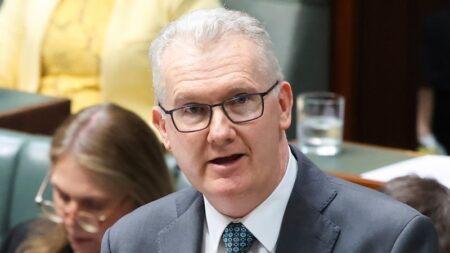




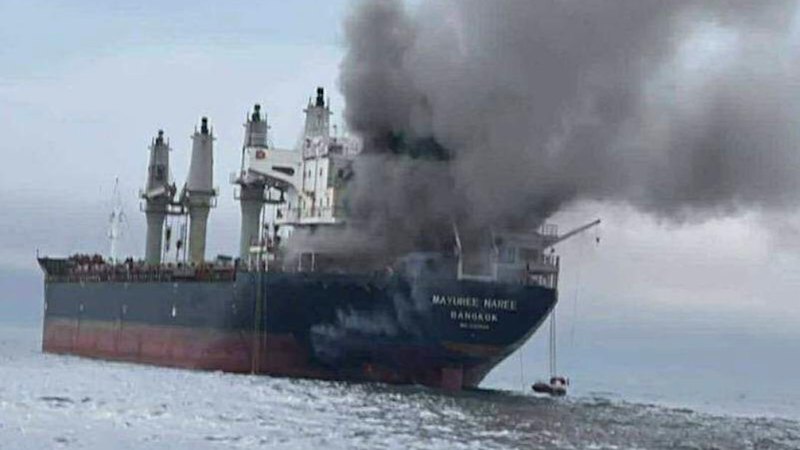
The Herald’s informed reporting and analysis made a sober assessment of the onset of war with Iran and what it means for the future global trade in energy supplies (“Iran has world over a barrel – and there’s no quick fix”, March 13). These critical fuel sources represent the sinews to power modern industrialised economies. The Iranian theocracy knows that. Hence its remorseless hegemony to block the Strait of Hormuz to prevent, if not impede, commercial shipping from flowing liquid wealth to sustain Western democracies. The Hormuz sea roads of our fuel must be defended or Australia will splutter to a halt. Iran has exceeded bounded rationality (“Middle East Crisis”, March 13). Australia has long recognised that imperative. The latest incremental contribution from the ADF will be welcomed by Gulf states. Once again, for those imperilled, Australia is demonstrating good citizenship. God speed its new task. Mike Fogarty, Weston (ACT)
Kim Beazley stood shoulder to shoulder with John Howard following Port Arthur, and Anthony Albanese unequivocally supported Scott Morrison during the worst period of COVID. These shows of political unity engendered a sense of cohesion and trust in the community. However, in the last two national crises – the Bondi massacre and the current oil situation – the Coalition has chosen to take an oppositional stance, causing significant community division. How much more productive would it be if the Coalition supported the government in finding solutions to the scattered oil “shortages” being experienced? One way would be for the Coalition to support the call for people to stop over-ordering and hoarding fuel, rather than just blaming the government for the consequential depletion. Toni Lorentzen, Fennell Bay
The Middle East war is America’s and Israel’s. After 80 years, we can now see what has driven all the wars since World War II: US control of oil and Israel’s grab for dominance over neighbours. Leave them to it, we are going solar and renewables. Ian McNichol, Ultimo
I’ve just heard Barnaby Joyce scaremongering over fuel shortages in regional areas and talking up government inaction, though it appears his constituents are among the biggest hoarders. I’m thinking about the bloke who pulled up beside me at the petrol shop in the central west with his Aussie flag flapping, who proceeded to fill a ute tray jammed with jerry cans. I was left thinking, “Is this my Mad Max moment?” Peter Hull, Katoomba
The federal Coalition’s conduct on transport fuel availability demonstrates a concerning indifference to Australia’s economic and social stability. However, it might be interested in future electoral success. If so, gratuitous advice follows. During COVID, Labor oppositions behaved responsibly, unlike the Coalition oppositions. And the voters’ appreciation was reflected in subsequent federal and state elections. In the current situation of fuel supply challenges, state Coalition oppositions have heeded that lesson. This difference is worth reflection. Responsible behaviour in a crisis is good politics, but irresponsible conduct risks retribution. Carlo Ursida, Kensington (Vic)
War machine has changed
Donald Trump is surprised that Iran has failed to capitulate (“How team Trump misjudged Iran’s response”, March 13). US intelligence knew that the Ayatollah’s son was the heir apparent and as much a hater of the US as his father. Now Iran has a leader who lost his dad and his wife to the Americans and was wounded himself. Let me see. Is that going to make Mojtaba Khamenei more or less likely to escalate the war? Maybe I should be working in intelligence. Neville Turbit, Russell Lea
The so-called miscalculation of the Trump administration is a sure sign of its absolute incompetence running the “war” that’s not a war. All they had to do was ask the Gulf states or pay attention to the war in Ukraine. The modern war zone has changed, and those with big expensive weapons no longer dominate. It takes only one side to start a war, but two to end it. Iran will inflict pain until the US can no longer bear the cost. Trump may declare victory to save face, but the cost to the US and the world economy will be incalculable. Neil Ormerod, Kingsgrove
AI-led job cuts hurt
I was first made aware of Atlassian (″AI outrage: Atlassian boss fires 1600 people via email″, March 13) by an Iranian immigrant who worked in IT. I became, though, like others, intrigued by the backstory – started by teenagers in a father’s garage with very little funding. At the time, Atlassian was operating from a small Sydney office with a moderately sized group of happy and well-cared for employees. Some time later, I was vicariously excited to find a neighbour worked for them. He was later moved, but my peripheral interest in Atlassian continued. Mike Cannon-Brookes seemed to be the epitome of a good corporate citizen – pouring profits into research on and amelioration of climate change and buying property for conservation. I was, hence, sad reading about him firing people. It seems wealth and power get the better of us all in the end. Heather Johnson, West Pennant Hills
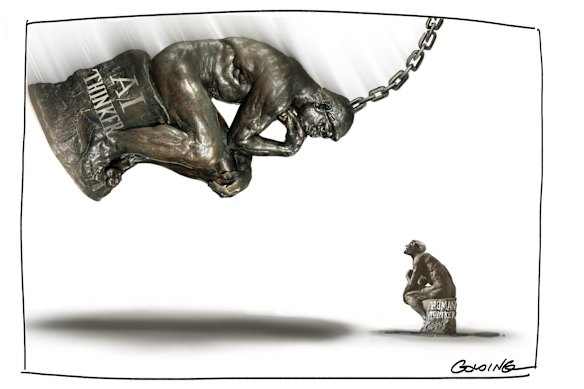
The Atlassian job cuts are the tip of an iceberg. Increasingly worldwide, AI and robotics are replacing workers in many industries. This saves companies massive amounts of money in wages, and increases profits in the short term. It is an increasing trend, but what happens when critical mass is achieved and there are millions of jobless people? In the long term, how are companies that provide goods and services going to sustain their consumer base when those consumers have no income? No income results in no tax revenue to pay for welfare, healthcare, education, aged and disability care, and infrastructure construction and maintenance, and other government services.
Is this the beginning of 21st century feudalism where our master is an algorithm? Barrington Salter, Elanora (Qld)
Robo-debt fallout
I think Scott Morrison was an awful prime minister, possibly Australia’s worst. I think robo-debt was probably the worst case of poor policy, malice and maladministration ever by federal government agencies (Letters, March 13). I have worked in the fields of governance, risk management and fraud control in the federal government, and it has always been clear that robo-debt was not corruption. Robo-debt did not provide any of its initiators and facilitators with direct benefits. None of the public servants or politicians made money or received other tangible benefits from robo-debt. The Liberals thought they were on to a vote winner, but that is a very indirect benefit. The public servants and politicians who ignored the illegality should be pilloried and have administrative action taken against them. But I have not yet seen any explanation as to why some consider robo-debt to be corrupt conduct; they have not pointed to the benefits that were corruptly obtained because there were no such benefits. The referral to the National Anti-Corruption Commission was a waste of time and resources and the NACC’s finding has the downside of letting Scott Morrison claim innocence when he was central to one of the worst breakdowns of governance in our history. Steven Lee, Faulconbridge
Old road needs new solutions
The one-lane each way Chifley Road in Lithgow is now the only route to the west between Goulburn and Merriwa (“How a convict-built crossing closed a lifeline highway in Blue Mountains”, March 13). Mitchell’s Causeway, opened October 23, 1832, has been more critical to NSW than the Sydney Harbour Bridge built a century later. Repairs will surely be made. But the need for a better dangerous goods (fuel, etc) truck route to western NSW means an open-air route is required, not the cancelled 11-kilometre Blackheath Tunnel. The PM’s long high-speed rail tunnels are a lower priority than many regional transport projects across Australia. The Central West needs a 46-kilometre (30-minute) M4 motorway extension under the rugged Blue Mountains from the M4/A44 junction at Emu Plains to the tunnel portal recently built at Little Hartley. Bathurst railway station’s 150th anniversary is three weeks away. A new 120-kilometre (one-hour) Penrith-Bathurst rail line under the mountains is how we should be celebrating it.Peter Egan, Adelaide (SA)
With the closure of the Great Western Highway because of the condition of the Mitchell’s Causeway, the issue of tunnels to “solve” the traffic situation over the Blue Mountains has resurfaced. At the same time the issue of a superfast train to Newcastle has come around again to “solve” poor commute travel times. In both cases, a major cause of the problem is the volume of heavy vehicles or goods trains that share the road or rail corridor. It would be nice to hear some ideas other than building road tunnels or the expensive fast train chimera. What about routing goods trains between Sydney and Newcastle via a new dedicated line crossing the Hawkesbury River around Wiseman’s Ferry, roughly following the route of the original Great Northern Road? Nowhere near as expensive as the high-speed rail proposal but freeing up the existing line for faster travel. And what about getting heavy vehicles off the road over the mountains and onto a roll-on-roll-off train system similar to Europe? Depots at either ends of the mountains loading onto fast trains on a new dedicated line would be better than road works that will merely result in yet more heavy traffic despoiling the unique character of the mountains. Let’s hear some ideas other than tunnels and pipe dreams. Lesley Spicer, Coogee
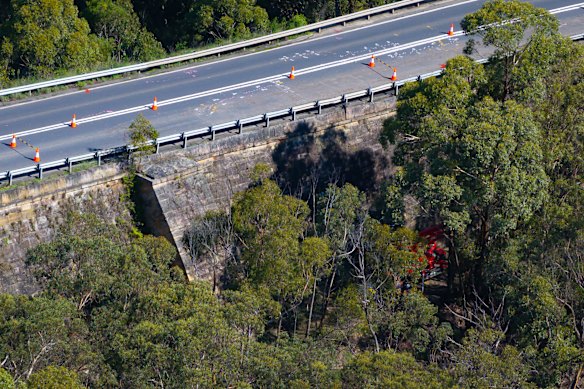
Is it time to think about a new route west from Sydney? The route that goes from Oakdale to Oberon over the back of Yerranderie with a modern route above the catchment area has a lot going for it. It could be a great tourist attraction and would save the heritage villages in the mountains – it would also make it easier for people to get to Canberra, the South Coast and the new airport from this part of the world. The closure of Bells Line of Road is another reason that we need an additional route. We need bold new ideas that create greater access and respect our heritage. Roz Townsend, Queanbeyan East
Transport over the Blue Mountains seems to be highly reliant on 19th-century technology. While experts continue to figure out what to do about the well-designed but ageing 1830s road bridge at Victoria Pass, maybe we need to expand the use of the 1890s rail tunnel to provide a temporary motorail service between the upper Blue Mountains and the west. Doug Walker, Baulkham Hills
Back in the 1830s, many things would have been on the minds of convicts in chain gangs constructing the sandstone causeway over Victoria Pass. What they would never have foreseen, however, was more than 10,000 vehicles per day, including 1000-plus trucks, many weighing more than 40 tonnes, crawling their way over this notorious east-west link. It’s a testimony to the skills of the engineers and the convict labour at the time but highlights an appalling failure of government over decades in failing to plan and construct an appropriate alternative. Terry Wilson, Milton
Canberra cash grab
The collectivists among us are at it again (“Property tax breaks benefit rich electorates”, March 13) – any money we don’t send to Canberra is magically a “cost” to government and therefore a bad thing. No, it ain’t. Framings such as “Property tax breaks will cost the federal budget” and “the cost to the federal budget” seem to be rooted in the view that all money belongs to Canberra, and we should be grateful for whatever of our income and wealth we are allowed to keep. Back around 2001, Australians on average paid Canberra about $10,000 each – that’s now up to about $25,000 a head and still collectivists want to dig deeper into our pockets. Money I don’t send to Canberra is not a cost to anyone, much less the government. Chris Mangan, Bracken Ridge (Qld)
Old chestnut
Your correspondent (Letters, March 13) wants “more wives”. Now there’s a sucker for punishment. David Gordon, Cranebrook
If your correspondent already has one wife, is he still in one piece? In your “I want more” list, in among yachts, travel, apartments etc, he mentioned “more wives”. Does he often like to live dangerously? Pauline McGinley, Drummoyne
Practical planning
Your correspondent (Letters, March 13) is right that more public housing would help address the affordability crisis. But delivering it at the scale required would demand major fiscal reform, which is unlikely in the near term. Meanwhile, planning should also enable smaller, more modest private developments. One practical approach is to keep existing limits on floor space ratios, heights and landscaping, while allowing lower parking provision – such as a maximum of 0.5 spaces per unit and managed on-street parking through resident permits. Without such changes, many smaller projects simply cannot proceed. The result is that most new housing comes in large, expensive developments. If we want more modest and attainable homes, planning rules must make them feasible. Matthew Bartinel, Lemon Tree Passage
Is Senate still relevant?
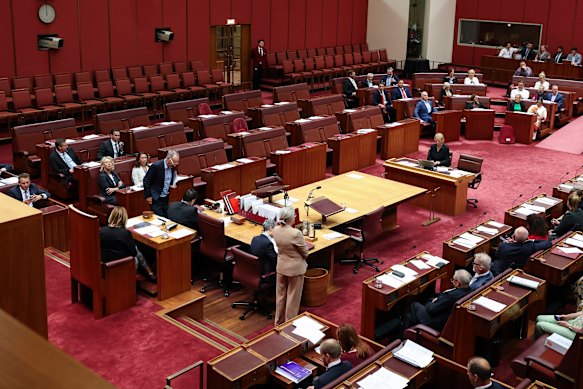
The Letters page this week carried much commentary on the election of Matt Canavan as leader of the National Party of Australia. Yet the arrangement is opaque to many readers: Senator Canavan leads the federal Nationals while holding no equivalent leadership role within the Liberal National Party of Queensland. Confusing? Certainly – and it exposes a deeper constitutional muddle. Senators were conceived as representatives of the states, not as agents of party machines. At the framing of what we still reverently call the Constitution of Australia, the Senate’s purpose was to safeguard state interests within the federal compact. Over time that design has been quietly displaced. Political parties now treat the Senate as a chamber of obstruction or salvage – an arena in which governments attempt to force through their legislative agenda and oppositions attempt to frustrate it. Such a system is hardly a model of effective government. In a functioning democracy, an elected government should be permitted to pursue the program on which it was chosen, with the electorate ultimately judging its success or failure at the ballot box. Australia might be financially, legislatively and administratively better served were we to reconsider the continued relevance of the Senate. Chris Rivers, Port Macquarie
It’s all relative
Grandmas come in all shapes and sizes and have differing personalities and levels of activity (“My schoolmate is about to be a grandma. I’ll get over it”, March 13). Don’t be concerned, Melissa Coburn, about the name given to this person in a family. It is not important, as it’s the relationship with the grandchildren that counts. Grandma Lyn Langtry, East Ryde
Oh Melissa, be grateful you are alive to witness the event. I certainly hope you will be around when your friend becomes a great-grandma. Mustafa Erem, Terrigal
Letters of note
I recommend letter-writing to students studying for a PhD. Even with an approximate 100,000-word limit, word-culling looms large in the process. Nothing hones the writing process more than sending off a short, sharp letter to the editor in the hope of being published. All the better if it is witty, brevity being the soul of wit, according
to Shakespeare. Megan Brock, Croydon
Recent letter-writers have drawn attention to how the Herald Letters page has contributed to their lives. It gives opportunity for people to express views without annoying their spouse, it results in catching-up of old friends, and provides a forum of thoughtfulness. One advantage not mentioned has been my experience of the Letters page, namely an opportunity to express a view, even a grizzle, from a situation where I have no spouse or partner to share my thoughts. Long live the Herald Letters page. Christine Perrott, Armidale
As much as I enjoy their articulate opinions, maybe if the Herald imposed a one-week moratorium on publishing letters from retired teachers, the rest of us could get a word in. Then, the following week, they could indulge in a trip down memory lane, nostalgically providing constructive criticism on our misguided political views and explaining our shortcomings in grammar and punctuation. Col Burns, Lugarno
- To submit a letter to the Sydney Morning Herald, email letters@smh.com.au. Click here for tips on how to submit letters.
- The Opinion newsletter is a weekly wrap of views that will challenge, champion and inform. Sign up here.
Read the full article here