




How to best defrost a large cut of meat is a hot topic around the holidays, especially if you can’t afford the space and time to let it chill out in the refrigerator over a matter of days.
And contrary to what some armchair problem solvers contend, hair dryers, space heaters and heated car seats are not instruments for good on the defrosting front (and yes, people have tried all of that). Don’t be those people. Plenty of web and page space has been dedicated to actual best practices for defrosting large cuts of meat, even when time is limited.
While the holidays put a spotlight on defrosting practices — and problems — the need to defrost quickly and safely haunts us throughout the year. Who among us has not found ourselves with a pound of frozen ground beef in one hand, and a finger on the trigger of a food delivery app in the other, contemplating savings versus speed?
Don’t miss any of our unbiased tech content and lab-based reviews. Add CNET as a preferred Google source.
Step away from social media. There are ways to defrost both safely and quickly — including not defrosting at all — and there are also steps you can take before any food goes in the freezer to speed up the defrosting process for future you.
I spoke with four food safety experts about the best practices for defrosting.
Why safe defrosting is so important
Need to thaw out some frozen meat or chicken for cooking? Slowly in the fridge is your best bet.
We’ve all been guilty of using the “countertop method” when it comes to defrosting; simply taking something from the freezer and leaving it at room temperature until it feels unfrozen enough to cook. To be clear, this isn’t a recommended method in the slightest, but a game of food poisoning roulette.
“Once food climbs above 40°F, bacteria can double around every 20 minutes,” says food scientist Bryan Quoc Le, Ph.D., founder and CEO at Mendocino Food Consulting and author of 150 Food Science Questions Answered. “Keeping food cold during thawing slows that growth, buying you time and safety.”
(“Cold” here means refrigerator temperature. Not cool to the touch, but actually cold. Anything between 40°F to 140°F is referred to as the “danger zone,” or the temperature range where harmful bacteria are happiest.)
Whether you’re talking turkey or talking other frozen foods, “Per the USDA, there are three safe ways to thaw — in the refrigerator, in cold water, or in the microwave,” says Sanjay Gummalla, Ph.D., senior vice president of Scientific Affairs with the American Frozen Food Institute.
The best way to defrost: refrigerator
It takes the longest of any method but thawing slowly in the fridge is the safest method for defrosting meat.
“The safest way to thaw anything is in the fridge, where it stays below 40°F and bacteria can’t multiply,” Le says.
This is, admittedly, the slowest method, in addition to being the safest, which doesn’t always work in your favor if you’re faced with the cooking versus takeout scenario described above.
There are ways to expedite this process, outlined below, but if you can plan ahead by about a day, simply transfer your frozen proteins or meals from the freezer to the fridge, keeping them in their original packaging or containers. Frozen proteins should be kept on a plate or tray, and placed on the lowest shelf to prevent thawed juices from potentially contaminating other items in your refrigerator.
Quicker and still safe: cold water
If thawing meat in water, keep it wrapped to prevent changes in texture.
Cold water works faster than ice alone in chilling a bottle of wine, and the same is true in reverse for helping items to thaw. The circulatory movement of water makes for a faster method than the static environment of the refrigerator. This is the next best method, from a food safety perspective, if you are in a hurry.
“This method works well for smaller items, such as frozen shrimp or small cuts of meat,” says Norman Hunt, executive chef at Sodexo at Nicholls State University in Thibodaux, Louisiana.
“Be sure to start with pieces that are as small as possible, and never let this process take longer than two hours,” Hunt says, stressing to cook whatever your are thawing as soon as it is ready.
For this method, frozen proteins should be sealed in a bag, not submerged without protection, and the water should be changed every 30 minutes, he says. Also ensure that the water to begin with is actually cold, adding ice if needed to keep the temperature below 40°F.
“In the summer, especially in southern areas, the tap water might not actually be cold enough,” says Hunt. “Test it with your fingers to make sure it’s truly cool.”
The fastest, with caveats: microwave
Think of the microwave as a last resort when thawing meat raw foods.
The microwave can take thawing or defrosting from a matter of hours to a matter of minutes, but as with all shortcuts, it doesn’t come without complications.
“The microwave’s defrost setting can be useful, especially for pre-cooked meals or meal prep, however, it’s not ideal for raw foods,” Hunt says. “The thawing tends to be uneven — some parts may start cooking while others remain frozen — and it can keep food in the temperature danger zone for too long.”
Even when it comes to nuking pre-cooked, frozen meals, it is essential to prioritize safety and follow the recommended instructions. “The microwave works by wiggling molecules around to cause friction, resulting in heat,” says Jill Roberts, Ph.D., microbiologist and professor at the University of South Florida College of Public Health.
“What a microwave wiggles best is water, and it’s the uneven distribution of water that causes foods to remain cold in certain spots despite being microwaved,” Roberts says. “Stirring redistributes the water and enables heating. Don’t skip the stir step, and microwave until your item is heated evenly.”
Similar to the cold water method above, when defrosting items in the microwave, ensure you’re prepared to cook them immediately.
Cooking from frozen
The best way to thaw frozen meat is in the fridge overnight.
One of the safest methods for cooking frozen foods is simply not to defrost them, bypassing any time spent in the danger zone altogether.
“Consumers may not realize that frozen vegetables, particularly when thawed improperly, can create conditions for bacterial growth,” says Gummalla. “The ‘do not defrost’ instruction exists because these products are designed to go directly from freezer to heat, maintaining the cold chain until they are cooked to ensure safe consumption.”
The same principle can also apply to frozen proteins, especially those with uniform thickness. “You can also cook certain foods straight from frozen,” Hunt says. “It’s best not to start with something too large, since the inside may take too long to heat properly, but this method works great for foods like hamburger patties and pre-cooked meatballs.”
Depending on the meal you are planning, pieces such as frozen, boneless chicken thighs are also easy to slice or dice when frozen, rendering them into small pieces which will then cook quickly and evenly over the heat of a saute pan.
Consider carefully: defrosting trays
Defrosting trays are popular on TikTok, but do they really work?
Defrosting trays have been around for decades but have gained popularity in recent years, largely due to being spotlighted on TikTok. Such trays are typically made from a material that effectively conducts heat, quickly transferring warmer air to the food and essentially drawing the cold from the food to the tray itself.
But are they safe?
“While these products claim to accelerate thawing, there is no FDA or USDA guidance establishing that they can safely thaw food on the countertop without the outer layers entering the temperature danger zone,” says Gummalla.
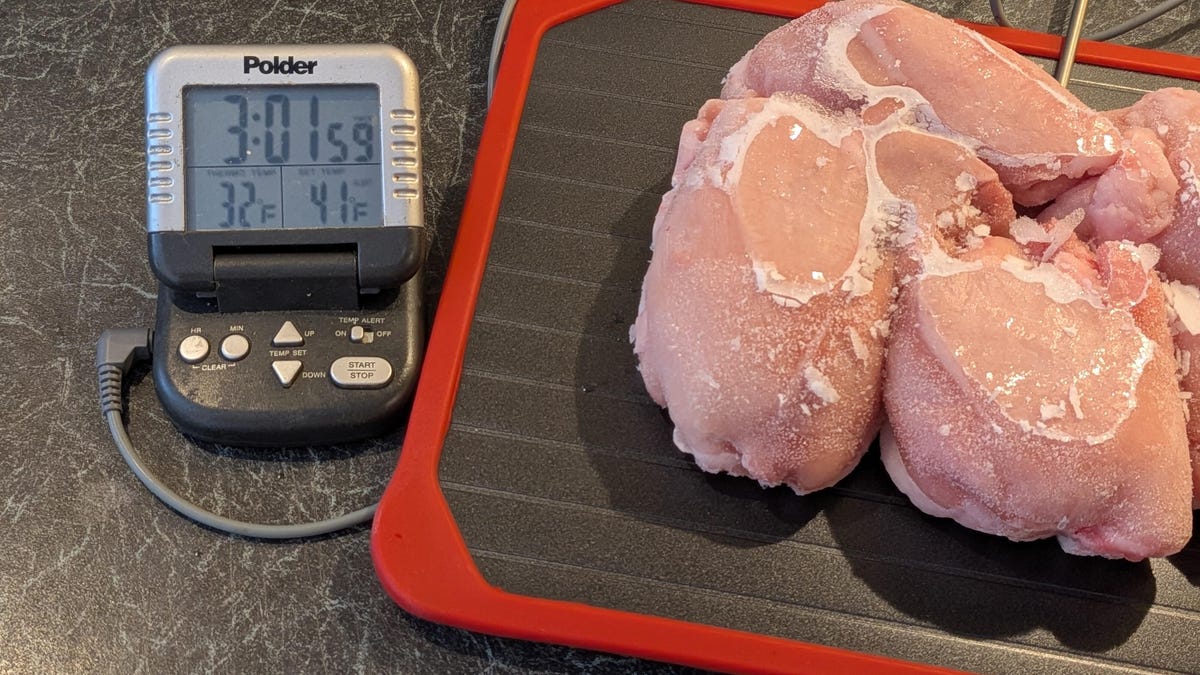
My defrosting tray helped thaw chicken thighs in under two hours without letting the meat reach unsafe internal temps.
I tried this one, using a meat thermometer on a package of frozen chicken thighs, inserting the probe as close to the surface of the meat as possible to see whether the defrosting tray could win the race against time, thawing the thighs while keeping them safely below 40°F. In my experience, the tray thawed the thighs completely in about two hours, without the temperature rising to an unsafe level.
To thaw chicken thighs from frozen in the fridge would take more than 15 hours, depending on the size of the thighs. To thaw them on the counter at room temperature without a defrosting tray takes between three and five hours — a dangerous amount of time to leave raw chicken at such a high temperature.
It’s essential to note, however, that this approach is not recommended by food safety experts, and I acknowledge that my experiment involved several potentially hazardous variables. I chose a medium-sized thigh to measure the temperature, as anything smaller would have thawed faster and possibly entered the danger zone before the piece I was monitoring did.
Despite their effectiveness, food safety experts don’t recommend the method unless it’s done inside a fridge.
I was also presiding over this in such a way that most home cooks wouldn’t, paying close attention to the temperature at all times. For something thicker or less uniform in size, all bets are obviously off.
In short, defrosting trays are potentially effective, especially when used inside the refrigerator, but are not recommended for use on the countertop.
Here’s the defrosting tray I used for my experiment.
Is it OK to leave frozen items at room temperature to defrost?
The best way to thaw frozen meat is in the fridge overnight.
Officially? No. “Leaving food out on the counter is the classic error,” says Le. “The outer layer hits the danger zone while the inside is still icy. To bacteria, this room temperature atmosphere is an open invitation to multiply.”
Unofficially? Still no. Find a way to cook from frozen if there isn’t time to safely thaw.
4 Common defrosting mistakes
Even the most well-intentioned cooks can fall victim to these common defrosting mistakes, according to the experts, at the crossroads of intuition and defrosting science.
1. Not reading directions
“The biggest mistake commonly made when defrosting is not following the cooking directions on a package,” says Gummalla, when it comes to frozen vegetables, pre-cooked frozen proteins, or frozen meals. “If the bag says, ‘do not defrost,’ no matter what kind of food it is, then do not defrost it.”
2. Exposing frozen food to warm temps
“The biggest mistake is exposing food to warm temperatures while thawing,” says Roberts. “It only takes 20 minutes of warm temperatures for some microbes to double in number,” she says, which can easily happen when trying to defrost on the countertop, or by allowing cold water to become too warm during that particular process.
3. Ignoring cooking times
Ignoring the time can also be a big mistake, as frozen foods may seem fully cooked before the recommended cooking time. “Don’t ignore time,” Roberts says. “Exposure to the higher temperatures can kill microbes but they must be exposed for a short while in order to be killed.
“Recommended cooking times also factor in depth. If the pizza says cook for 20 minutes at 400 degrees, that is the time needed for both quality and microbe destruction,” she says.
4. Waiting too long to cook
“Another misstep is microwaving, letting it sit and forgetting to cook it right away,” says Le. Avoid placing foods that have been microwaved in the fridge to keep cool after thawing, as uneven temperatures are likely to occur with the microwave method.
Chef hacks: freeze your food strategically
Freezing raw food in smaller portions will save you a lot of grief later.
There are also ways to speed up defrosting that happen before the defrosting process even begins. Here are a chef’s tricks for ensuring your frozen foods are ready for you as soon as you’re ready.
“Freeze your food in a way that makes it easy to thaw,” says Hunt, by portioning it accordingly, and reducing its thickness and increasing its surface area. “Take ground beef, for example. If you place it in a freezer bag and flatten it as thin as possible — using the entire surface area of the bag — it will thaw much faster and more evenly.
“The same trick works for many other foods,” he says. “It’s also important to only freeze the quantity you plan to use. Once food has been frozen, it typically has a shorter shelf life after thawing. By freezing smaller portions, you’ll be more likely to use everything without waste.”
Read the full article here