



The Samsung Galaxy S26 Ultra has impressed us with its processor performance, camera skills and of course its innovative Privacy Display, which actually works as well as the company boasted it would. It’s a powerhouse of an Android phone and it comes with a price tag to match. At $1,300 (£1,279) it requires a lot of cash to get one into your pocket but there is a cheaper option. Last year’s Galaxy S25 Ultra has many of the same specs and you can pick it up used for around $720 on Gazelle — a whopping savings over the original.
It’s actually extraordinary how much less the S25 Ultra costs when buying a used one, especially when you consider just how similar it is to the latest model. Sure, you won’t get the new Privacy Display, but the camera performance is similar, the displays are the same size and resolution and both have 5,000-mAh batteries. The S26 Ultra is mostly an iterative upgrade over its predecessor, but you’ll have to shell out almost twice as much for it. Of course, if you’re selling your S25 Ultra then that amount of depreciation really sucks. But if you’re looking to upgrade from an older phone, then you have yourself a bargain on a high-end device.
So what difference does one generation make? Can last year’s model still perform like the current flagship? Let’s put these phones side by side and see what we get.
Watch this: Don’t Buy the Samsung Galaxy S25 Ultra. Save Money With a Used S24 Ultra Instead
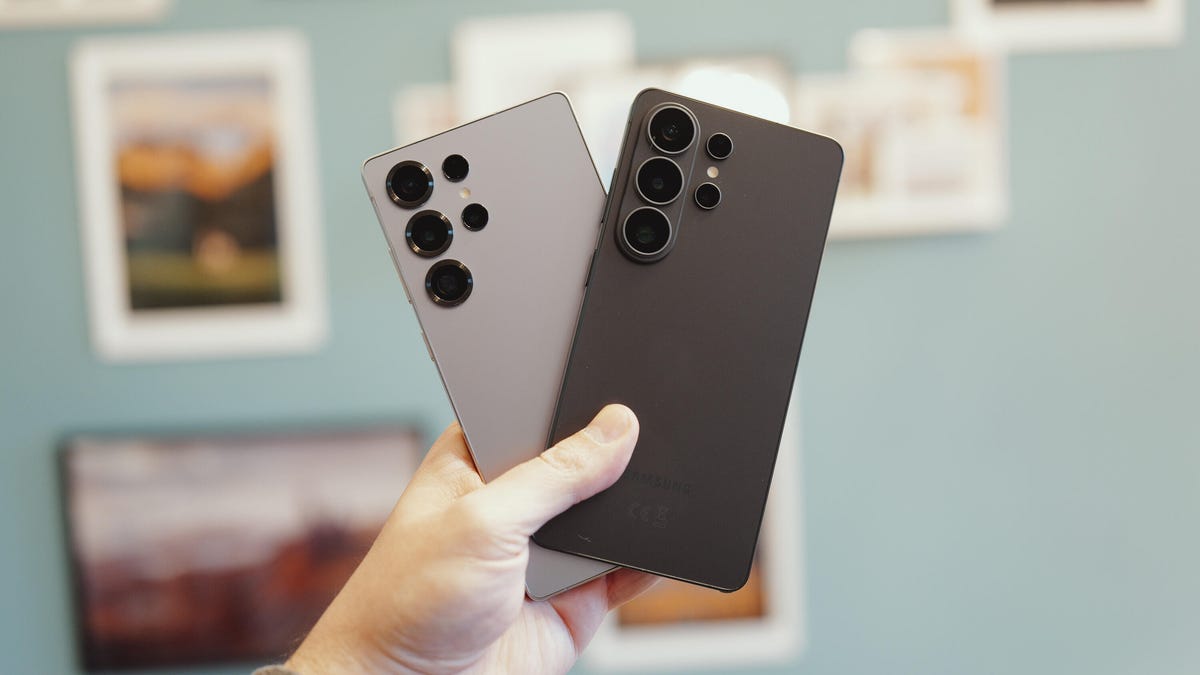
Which one’s which? It’s difficult to tell.
Galaxy S26 Ultra vs. S25 Ultra: Key specs compared
On paper, the key specs are similar. They both have massive displays with identical resolutions and refresh rates. They both have potent Qualcomm processors, 12GB of RAM, 200-megapixel cameras, and an IP68 rating for dust and water resistance. And yes, both have the S Pen stylus tucked inside if you want to doodle pictures while pretending to be working. The S25 Ultra is made from titanium, whereas Samsung opted for Aluminum for the S26 Ultra. That change sheds 4 grams off the new model, which isn’t an amount you’re ever likely to notice, and potentially radiates heat out of the phone more effectively.
From a purely numbers perspective, there’s little to choose between the S26 Ultra and S25 Ultra — certainly nothing that warrants such a steep price difference. So what are they like to use in person? Let’s start with the cameras.
Galaxy S26 Ultra vs. S25 Ultra: Cameras
Camera performance is a central way phone-makers try to upgrade their phones each year, with the latest models typically boasting better imaging skills than previous generations. While there are some upgrades on paper — like the S26 Ultra’s wider f/1.4 aperture on the main camera — Samsung hasn’t really altered its format that much for its last few Ultra models, so the differences in everyday use are negligible.
I’ve taken a variety of photos on both phones and, for the most part, I think you’d struggle to tell much difference, let alone pick a winner. They’re both capable of taking lovely images with wide dynamic range, typically punchy colors and plenty of detail. The zooms on both phones are excellent, and the night modes are superb.
The wider aperture of the main camera should technically help it capture more light for low light shots but side-by-side, I can’t tell much difference as both are excellent performers in this area. The S26 Ultra’s biggest advertised upgrades come in the form of new AI tools with the company’s “AI Photo Assist” tools, which let you do things like change the style of hat someone is wearing. Samsung typically brings most, if not all, of its software features to previous phones though, so it’s likely that even these new tools will become available for S25 Ultra owners.
Galaxy S26 Ultra vs. S25 Ultra: Processor
One of the major upgrades in the S25 Ultra over its predecessor is its processor. The S25 Ultra packs a custom version of Qualcomm’s Snapdragon 8 Elite Gen 5 chip, versus the Snapdragon 8 Elite chip on the S25 Ultra. On our benchmark tests, there’s a roughly 10% increase in processor performance on the new model or a roughly 6% increase for graphics performance. It’s not a huge bump by any means and I honestly doubt you’d ever notice the difference in everyday use.
Galaxy S26 Ultra vs. Galaxy S25 Ultra processor performance
Galaxy S25 Ultra 3,173 10,047Galaxy S26 Ultra 3,578 10,700
- Geekbench 6 (single core)
- Geekbench 6 (multicore)
I found both phones were more than capable of playing demanding 3D games like Genshin Impact and PUBG at max settings while still giving smooth frame rates. Editing photos in Adobe Lightroom was responsive and navigating around the Android 16 interface felt nippy and smooth.
So sure, the latest model might have a bit more power. But do you really need it? A Ferrari might have a bit more power than an Aston Martin, but the Aston Martin is still an exceptionally potent machine that’ll outperform most other things on the road.
Check Out the Galaxy S26 Ultra’s Sleek Design and Privacy Display
See all photos
Galaxy S26 Ultra vs. S25 Ultra: Software
Software-wise, both phones run Android 16 with Samsung’s latest One UI 8 skin over the top. You’ll find the same features across both models, including Samsung’s various AI tools like live translation, audio eraser and drawing assist, which turns your doodles into real pictures. Then you have Google’s AI tools like Gemini Live and Circle to search, which again you’ll find on both models.
Other than the aforementioned AI Photo Assist in the camera, there are no new software features you’re missing out on by going with the last generation. But it’s always important to keep the software support period in mind, especially when buying used. Samsung committed to seven years of security support for both phones. As the more recent model, the S26 Ultra will therefore be safe to use until 2033, but the S25 Ultra will still be good through to at least 2032, which is a huge lifespan.
Both phones are more than powerful enough to play games like Genshin Impact at max settings.
Galaxy S26 Ultra vs. S25 Ultra: Battery life
Both Ultras pack 5,000-mAh batteries but through various software optimizations, the S26 Ultra performed slightly better on our various battery rundown tests. After 3 hours of YouTube streaming the S26 Ultra had dropped to 87% while the S25 Ultra was down to 81% after the same time. Similarly, after 45 minutes of mixed use the S26 Ultra dropped from full to 95% while the 25 Ultra went from full to 92%. Is it a massive difference? No, not at all and your usage will depend entirely on how demanding you are of your phone, but for those who really want to squeeze every minute of use out of your phone the S26 Ultra technically wins.
If you’re buying a used S25 Ultra, the battery may have aged slightly but I wouldn’t expect it to have degraded much in just one year of use.
Galaxy S26 Ultra vs. S25 Ultra: Which should you buy?
When I started writing this piece, I assumed that there would be more differences between the S26 Ultra and the S25 Ultra. But there’s hardly any changes made between models; they even look basically the same. Sure, the Privacy Display is kinda cool, but is it really something you’d need to spend big on? Are you really plagued that much by people peering over your shoulder in elevators as Samsung’s ad suggested?
With processor and camera performance being pretty much on par, and Samsung bringing so much of its new AI skills and software to previous generations, there’s very little to choose between them, except for the huge difference in price. All in all, choosing last year’s model on the used market is a smart way to save a lot of money on a capable device that would otherwise be too expensive.
The logic here isn’t limited to Samsung’s phones. With almost all companies, including Apple, Google, OnePlus and others offering hugely powerful devices with long software support periods, it’s possible you may never need to buy a new phone ever again.
The S25 Ultra isn’t much different to the S24 Ultra either, so buying the even older generation might be a great way to save yet more cash.
Galaxy S26 Ultra vs. S24 Ultra: Save even more money
Here’s an extra spanner in the works for your decision-making: Why not consider the older Galaxy S24 Ultra? My first version of this article compared the S25 Ultra and S24 Ultra and for the most part all I’ve needed to do here is change the numbers each time I mention the product name. The reason is that Samsung hasn’t truly overhauled its products in a long time, instead each time adding a little bit more processing power or another tiny tweak here and there.
The S24 Ultra absolutely holds its own against the S25 Ultra and will even put up a fight against the S26 Ultra, especially when it comes to price. On the used market you can pick the S24 Ultra for only $536 — almost $800 less than the new S26 Ultra. The camera setup is much the same and while there’s a fair step up in processor performance, the S24 Ultra still has more than enough power for almost anything you’d likely want to throw at it.
Its battery life is on par too (it scored better than the S25 Ultra, putting it more alongside the current model) and its seven years of security support means it’ll still be safe to use until 2031. The price difference on the used market between the two older models might not be as dramatic as it is against the new model, but if you’re after a high performance phone and wanting to squeeze every dollar you can out of your purchase, my money would go on the S24 Ultra.
Samsung Galaxy S26 Ultra specs vs. S25 Ultra vs. S24 Ultra
| Samsung Galaxy S26 Ultra | Samsung Galaxy S25 Ultra | Samsung Galaxy S24 Ultra | |
|---|---|---|---|
| Display size, tech, resolution, refresh rate, brightness | 6.9-inch AMOLED; 3,120×1,440 pixels; 1-120Hz adaptive refresh rate | 6.8-inch AMOLED; 3,120×1,440 pixels; 1-120Hz adaptive refresh rate | 6.8-inch AMOLED; 3,120×1,440 pixels; 1-120Hz adaptive refresh rate |
| Pixel density | 500 ppi | 501 ppi | 501 ppi |
| Dimensions (inches) | 6.44×3.07×0.31 | 6.41×3.06×0.32 | 6.40×3.11×0.34 |
| Dimensions (millimeters) | 163.6×78.1×7.9 | 162.8×77.6×8.2 | 163x79x8.6 |
| Weight (grams, ounces) | 214 g (7.55 oz.) | 218g (7.69 oz.) | 233g (8.22 oz.) |
| Mobile software | Android 16 | Android 15 | Android 14 |
| Camera | 200-megapixel (wide), 50-megapixel (ultrawide), 10-megapixel (3x telephoto), 50-megapixel (5x telephoto) | 200-megapixel (wide), 50-megapixel (ultrawide), 10-megapixel (3x telephoto), 50-megapixel (5x telephoto) | 200-megapixel (wide), 12-megapixel (ultrawide), 10-megapixel (3x telephoto), 50-megapixel (5x telephoto) |
| Front-facing camera | 12-megapixel | 12-megapixel | 12-megapixel |
| Video capture | 8K | 8K | 8K |
| Processor | Qualcomm Snapdragon 8 Elite Gen 5 for Galaxy | Qualcomm Snapdragon 8 Elite for Galaxy | Qualcomm Snapdragon 8 Gen 3 |
| RAM/storage | 12GB RAM + 256GB; 16GB RAM + 512GB, 1TB | 12GB RAM + 256GB, 512GB, 1TB | 12GB RAM + 256GB, 512GB, 1TB |
| Expandable storage | None | None | None |
| Battery/charging speeds | 5,000 mAh | 5,000 mAh | 5,000 mAh |
| Fingerprint sensor | Under display | Under display | Under display |
| Connector | USB-C | USB-C | USB-C |
| Headphone jack | None | None | None |
| Special features | Aluminum frame; 7 years of OS and security updates; IP68 water and dust resistance; wireless PowerShare to charge other devices; integrated S Pen; UWB for finding other devices; 60W wired charging (charger not included); 25W wireless charging; no magnets for accessories; Galaxy AI; Gorilla Glass Armor 2 cover glass; privacy display | Titanium frame, 2,600-nit peak brightness; 7 years of OS and security updates; 5G (mmWave); IP68 water and dust resistance; wireless PowerShare to charge other devices; integrated S Pen; UWB for finding other devices; 45W wired charging (charger not included); Galaxy AI; Wi-Fi 7; Gorilla Glass Armor cover glass; ultrawideband | Titanium frame, 2,600-nit peak brightness; 7 years of OS and security updates; 5G (mmWave); IP68 water and dust resistance; wireless PowerShare to charge other devices; integrated S Pen; UWB for finding other devices; 45W wired charging (charger not included); Galaxy AI; Wi-Fi 7; Gorilla Glass Armor cover glass |
| US price off-contract | $1,300 (256GB) | $1,300 (256GB) | $1,300 (256GB) |
| UK price | £1,279 | £1,249 (256GB) | £1,249 (256GB) |
| Australia price | AU$2,149 (256GB) | AU$2,199 (256GB) |
Read the full article here