



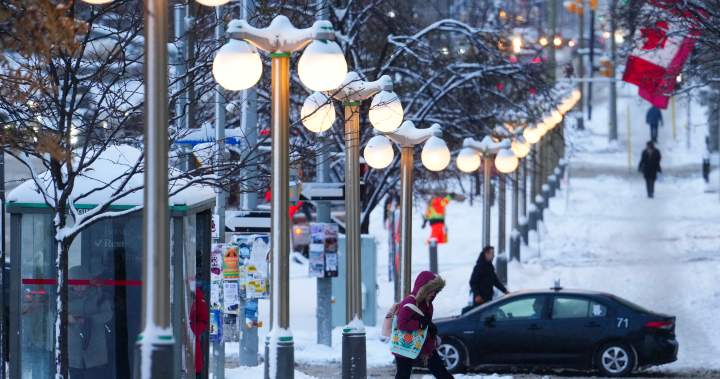
Cold weather has come early to many parts of the country as Environment Canada released its winter outlook for the coming months.
After a “remarkably mild” fall almost everywhere in Canada, the “abrupt start” to the winter felt “especially sharp and much colder than Canadians have become accustomed to in recent years,” said Environment Canada meteorologist Jennifer Smith.
Over the next three months, Canadians are likely to see above-average temperatures across the eastern Arctic, around Hudson Bay, across Northern Quebec and Labrador, Smith said.
Some regions, like parts of Yukon, the Northwest Territories and western Nova Scotia, could see below-seasonal temperatures. Others, such as the west coast of British Columbia, eastern Nova Scotia, and central and eastern Newfoundland, lean closer to near-average temperatures this winter, she said.
“Day to day, Canadians will still experience the full range of winter weather,” she said.

Get breaking National news
For news impacting Canada and around the world, sign up for breaking news alerts delivered directly to you when they happen.
“When all the days are averaged together at the end of the season, the clearest signal is a milder eastern Arctic. Beyond that, uncertainty takes over,” she said.
Canadians living in the Rockies, the Prairies and the western Great Lakes region are expected to get snowy weather this season, with winter storms tracking down from Yukon bringing “above average” chance of precipitation.
“Further east, things are less clear,” Smith said.
The forecast for Eastern Canada shows equal chances of above, near, or below average precipitation.
“Something else to keep in mind is that the Great Lakes and Hudson Bay, James Bay all started the season warmer, meaning there is ample moisture to feed into snow squalls,” she said.
“Those events are highly localized but can be intense, especially early in the season before the lakes and bays begin to freeze over.”
Winter storms from Colorado, Texas and the Carolinas could also make their way north of the border.
“Depending on the exact track, they (winter storms) can bring major impacts to southern Ontario, southern Quebec and Atlantic Canada,” Smith said.
“All in all, Canadians are no strangers to winter. And while this one is off to a classic cold and snowy start across much of the country, it’s a complex season with a lot of competing forces,” she added.
© 2025 Global News, a division of Corus Entertainment Inc.
Read the full article here