



For Toni Campbell, the most wonderful time of the year has been screwed by scammers.
The Queens native, a 63-year-old loving aunt to a flock of nieces and nephews, sprinted out of the office early — with sweat dripping from her brow, her heartbeat racing and her stomach in knots — on the afternoon of Dec. 5.
Minutes before making a dash, Campbell received a FedEx package at her job, which she believed contained the $200 Beats by Dre Powerbeats Pro earbuds she’d purchased from a third-party vendor on Walmart.com as a Christmas gift for her teenage nephew.
But upon opening the parcel, rather than a pair of hate headphones, she found 500 sheets of printing paper.
“I was, like, ‘Wait! My stuff isn’t in here,’” Campbell, an administrative assistant at an Upper East Side non-profit organization, exclusively recalled to The Post. “I showed my coworker, Marife Garcia, and she said, ‘Oh my God, they scammed you!’”
The words sent a thunderbolt of terror through Campbell, rendering her physically ill.
She’s now in the groaning, growing number of New Yorkers who’ve recently been victimized by scam artists and fraudsters.
It’s a trap that routinely ensnares locals at Christmastime.
“Sadly, Santa’s big season is also prime time for cons who woo unsuspecting innocents — such as Campbell — with too-good-to-be-true sales, bogus websites mimicking those of legitimate companies, phony travel deals, and AI-generated phone calls or messages,” said Darius Kingsley, head of consumer fraud and scam prevention at JPMorganChase.
“Scammers are especially active during the holidays, using tactics like fraudulent travel offers, fake delivery notifications, and deceptive charity appeals to exploit the holiday season and people’s generosity,” he told The Post. “If it seems too good to be true, it probably is.”
Still, citizens of the Big Apple — a city known for its sharp-witted, no-nonsense inhabitants — are falling prey to swindles at alarming rates.
New York, as a whole, recorded an average of 140 quarterly fraud reports per 100,000 residents over the past three years, according to a new analysis based on data via the Federal Trade Commission (FTC).
Researchers determined that a whopping 336,894 fraud claims have been issued throughout the Empire State since 2021, with victims losing a median of $553.77 per report — a startling 6% higher than the national average loss of $522.55 per report.
Campbell, like most 9-to-5ers, isn’t in a position to lose a single penny to crooks.
“I work hard for my money, and I don’t have another $200 to buy a second pair of earbuds,” sighed the Gothamite. “You see this stuff happen on TV, but you never think it’ll happen to you.”
She bought the earbuds from 6AVE Electronics, a vendor featured on Walmart’s site.
Representatives for 6AVE Electronics did not immediately respond to The Post’s request for a comment. However, a source close to the alleged incident claimed that the company advised Campbell to contact local law enforcement.
Walmart told The Post that “the customer has been in contact with both customer care and the third-party seller to resolve the issue.”
Campbell has not been issued a refund by either 6AVE Electronics or Walmart.
FedEx provided a statement regarding the incident, saying, “We are working directly with the customer to resolve this issue.”
Garcia, 26, Campbell’s colleague — who spotlit the scam in a trending social media post — warns holiday shoppers that Grinch-like bad guys are targeting folks of all ages and walks of life.
“Toni is an aunt who’s rewarding her nieces and nephews for getting good grades with nice Christmas presents,” she told The Post. “These scammers and thieves don’t think about the lives they’re impacting when [they commit fraud].”
“It’s inhumane, unethical and a form of disrespect.”
And it’s happening nationwide.
The fake site strike
Vanessa Tingey thought she’d hit the jackpot after stumbling upon a sweet online sale offering those chic, sleek Owala water bottles — which typically cost around $40 — for a cool $14.
“I remember thinking, ‘Oh, this is such a good deal, and it’s on the official website,’” said Tingey, 28, a married mom of a toddler, based near Orlando, Florida. “I wanted to get a bottle for my daughter as a little Christmas gift.”
Dazzled by the apparent validity of the site, Tingey loaded it up with her credit card information and clicked “submit payment.” But the avid online shopper found it strange that she never received an order confirmation number or a “Thank you for your purchase” message.
Tingey then took a closer look at the web address and noticed an extra “a” at the end of Owala. She immediately realized it was a hoax.
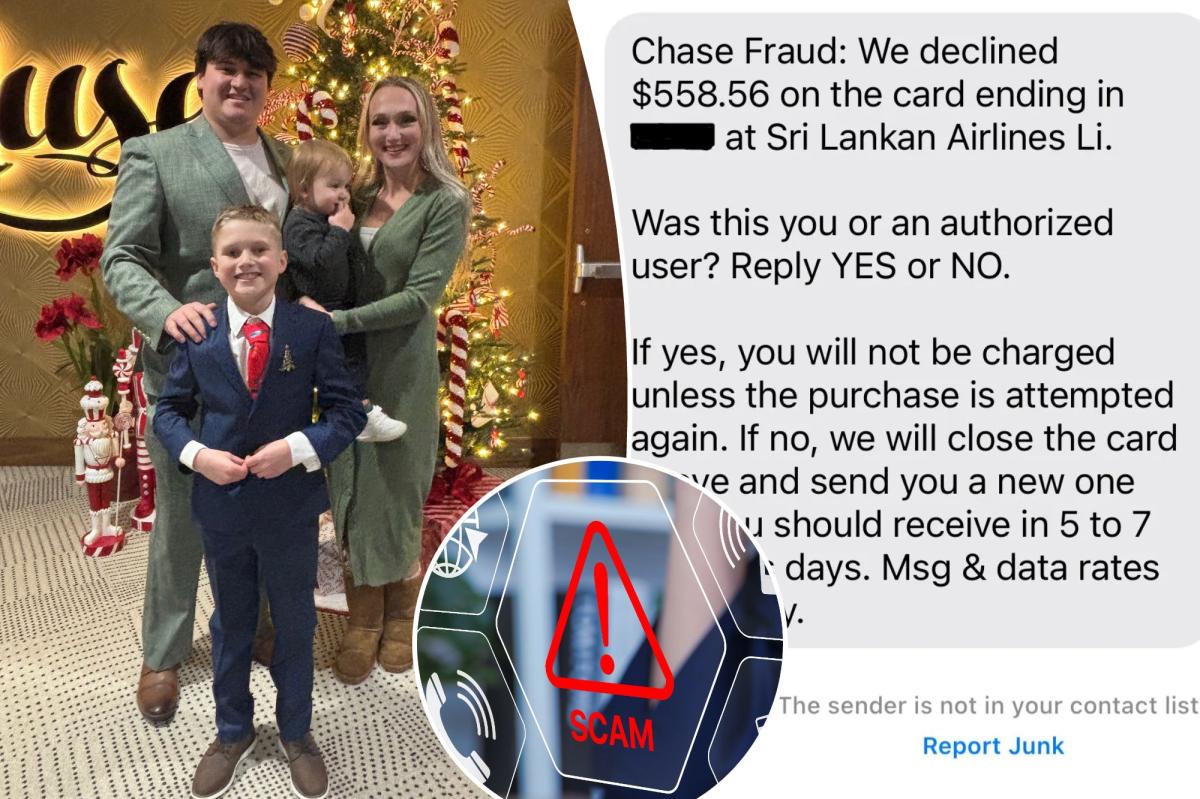
Hoping the transaction didn’t go through, Tingey shrugged it off until a few days later, when several Chase Bank alerts popped up on her phone, notifying her of a $500 fraudulent purchase with Sri Lanka Airlines.
“I was so scared. I was panicking. I immediately called Chase and they canceled my card and the transaction. So luckily, the money wasn’t lost,” said Tingey, whose husband is in a medical residency. “Money is tight. We’re on a budget, and being that it’s the holidays, the budget is already stretched.”
“Getting scammed out of $500 would have [gravely] affected our budget,” she told the Post. “I would have felt so bad, and I don’t think I would have had my husband buy me anything for Christmas.”
“I was just a little bit too trusting and too eager for a sale,” Tingey admitted. “That’s how they get you.”
The ho-ho-ho hack attack
Rhonda Hadden, a single mother of three from San Antonio, Texas, told The Post she hadn’t shopped at Walmart in weeks.
So, she was stunned to receive a bank notification alerting her to an in-store purchase of two $150 gift cards, made via her debit card — which is not stored to her Walmart app — in Hollywood, Florida, over the weekend.
“A scammer was able to log into my Walmart account and make purchases by scanning a QR code linked to my account and make a $313 transaction,” Hadden, 33, a marketing pro for an automotive company, told The Post. “I have the actual physical receipt that they were given. It has a register number, terminal and the exact amounts they spent.”
But when she phoned the Florida-based store for help, the mom claimed her calls went unanswered. Hadden said she then called Walmart headquarters, but was given the runaround by several customer care support members, who each “refused” to escalate the issue to a supervisor.
“In situations like this, the customer is advised to contact the bank associated with the payment method used for the transaction,” a Walmart spokesperson told The Post.
“They should also update any saved passwords on all online accounts where that payment information may be stored,” continued the rep. “If an unauthorized transaction is identified, we recommend notifying the bank immediately, confirming that the purchase was not authorized, and requesting that the transaction be stopped.”
Hadden said she’s tried filing a report with law enforcement in Hollywood, but was advised to file the complaint at her local police station.
The Texan has filed the report and is awaiting the launch of an investigation.
But she’s out more than $300 until further notice.
“I have three daughters under age 13, one who has severe health issues, and two who still believe in Santa Claus,” said Hadden. “That $300 may not seem like a lot to some people, but it is a lot of money when you’re living paycheck to paycheck in this economy.”
“When scams like this happen, it’s just, it makes things so much more difficult to be able to have holiday cheer,” she griped. “This has just added so much stress.”
The holiday flight heist
Star Friisval claims The Grinch, disguised as a “scammy website,” stole Christmas away from her 9-year-old son on Dec. 14.
His big present was meant to be a 1,300-mile round-trip airplane ticket from their home state of Wisconsin to visit family in Arizona.
But Friisval said some funny business with Trip.com — an online global travel agency, which she recently discovered via TikTok — has left her boy with neither a flight nor a gift.
Trip.com did not immediately respond to The Post’s request for a comment.
Friisval, 28, a stay-at-home mom of two, however, said, “I found round-trip flights for two adults, one child, and a lap child, who flies free, for $1097.14, which is a steal considering tickets for [Christmas travel] on airline websites cost over $1,400.”
“I went through the process of filling out all my information, passenger information and payment information [on Trip.com],” she told The Post. “But only took credit cards, not debit cards — my red flags went up.”
The alarm bells notwithstanding, Friisval made the hefty purchase and immediately downloaded the travel brand’s app. But mere seconds after completing the transaction, she received an in-app notification that her flight had been canceled.
A frantic Friisval claimed she then spent hours talking to a revolving door of customer service representatives over the phone, desperately seeking a full refund. To date, she has only reissued $140.17.
“With the funds not being issued back before Christmas, we’re unable to buy anything to replace his present now,” moaned the millennial, adding that the incident had lit an internal firestorm of “sadness and confusion and a deep, burning rage.”
“My son has grown up knowing that Santa and parents work together on big gifts like this, so he doesn’t understand why Santa’s magic failed,” said Friisval. “My best advice is to triple-check the websites you’re [patronizing].
“While it may cost more to book flights, hotels and rent cars directly [from a source rather than a third-party site],” she said, “it’s your safest option to ensure you don’t fall victim to this.”
Kingsley’s best tips to avoid getting scammed during Yuletide time:
- Online Deals that are Too Good to be True: Stick to reputable websites when shopping online. If you’re unfamiliar with a store, complete a search with their name along with terms like “scam,” “complaints” or “reviews” to uncover any red flags. If purchasing on a social media platform or marketplace, stay on the platform to complete transactions and communicate with sellers, as protections often only apply when you use the platform.
- Verify Website URLs: Scammers can create fake websites that look like legitimate retailers. Ensure the URL starts with https:// — the “s” stands for secure — and avoid clicking on links from unsolicited emails or texts.
- Beware of Unrealistic Deals: Scammers lure buyers in with massive discounts on popular or sold-out items. If a deal seems too-good-to-be-true, it’s likely a scam.
- How you pay matters: Consider using credit cards and debit cards to make purchases so you can dispute the charge if you don’t get what you pay for. And remember, only use Zelle to pay others you know and trust.
- Use Digital Tools: Chase Credit Journey offers free credit and identity monitoring, including alerts to let you know if your data is exposed in a data breach or on the dark web. You don’t have to be a Chase customer to use it.
Read the full article here