




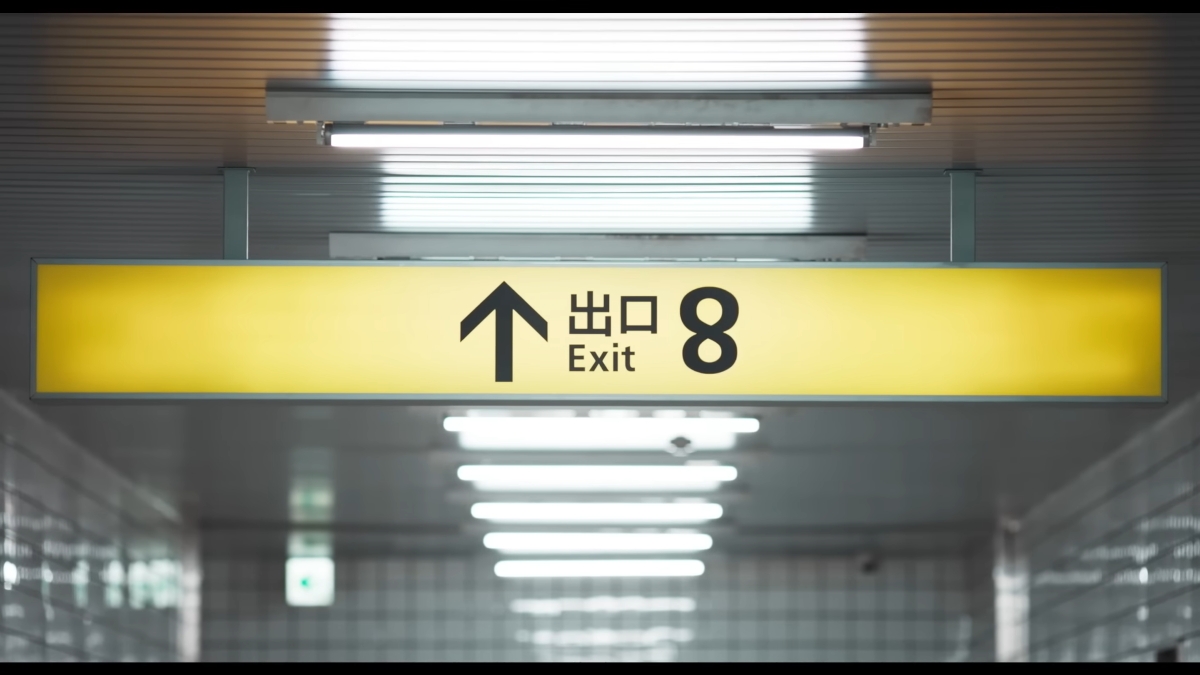
Back in 2023, “The Exit 8” took the world by storm. An indie video game from solo developer Kotake Create, “The Exit 8” put players in a nondescript subway station and tasked them with walking to the eponymous Exit 8. As the game puts it, “Don’t overlook any anomalies. If you find anomalies, turn back immediately. If you don’t find anomalies, do not turn back.” The game is essentially a high-tech version of “spot the difference” like you might find on the back of a cereal box. Some of the differences are subtle, and some of them manifest in the form of spooky jump scares, giving the whole game a particular mood of unease and discomfort.
Fast-forward to today, and we have a cinematic adaptation, “Exit 8.” It might be the first movie that’s longer than the video game on which it’s based. My first playthrough of the video game took about 45 minutes, and the film is about double that length, clocking in at a svelte 95 minutes. Directed by Genki Kawamura, “Exit 8” expands upon the non-existent story of the original, adding characters and depth while remaining true to the video game’s aesthetic and sense of tension. I’d even go so far as to say the movie is more accessible and mainstream than the game. By pragmatically creating an emotional core for viewers to embrace, the filmmakers have crafted a horror-adjacent thriller with an emotional thematic resonance.
More News: ‘Project Hail Mary’ Is a Near Perfect Adaptation – Review
More News: ‘Hoppers’ Shows Pixar Remains on Top for Animation – Review
Kazunari Ninomiya stars as the nameless protagonist, “The Lost Man.” The whole first scene of the movie is presented in first-person, like the game, but depicts a brand new scenario. He’s on a crowded subway train, listening to music and ignoring a cruel man who yells at a woman and her crying baby. As he enters the subway tunnel, his girlfriend calls him and informs him that she’s pregnant. He’s going to be a father. And that’s when he enters the loop, with the events of the prologue informing the character (and the audience) as he ventures deeper and deeper into the tunnel.
The movie eventually swaps to more traditional cinematography, but utilizes lots of long takes and exceptionally well-hidden secret cuts (eat your heart out, “1917”) to convey the claustrophobia of the loop and the geography of the subway tunnel. Speaking of the tunnel, while the initial hallway is nigh-identical to the one from the game, the film’s version has an extra wall featuring a set of lockers and a photobooth machine… Alas, there is no photobooth montage, but that’s probably for the best.
The original game didn’t feature any kind of narrative or characterization at all, and players could project meaning onto the vague and abstract events. For the movie, they’re telling a more specific story with bespoke themes and messages, so the experience feels more guided and less free-form than the game. The movie plays to the strengths of the medium, just as the game plays to its strengths as a game.
There are some unsettling moments in the film, but it’s not outright scary, save for one particularly exciting anomaly. In the game, by contrast, I’d get goosebumps every time I spotted an anomaly. In the film, most of them are presented a bit more matter-of-factly, which can be less impactful, but the process of watching the characters look for anomalies is compelling in a way that evokes watching someone stream a game on Twitch.
Another way the film expands upon the game is by featuring other characters trapped in the loop. The older Japanese man who became something of a cult icon in the original game gets his own chapter here, where the film follows him on his own loop, as well as a young boy who crosses in and out of the loop. Still, while the story takes some unexpected detours, it never loses focus on the core appeal of the premise, and it manages to maintain a sense of mystery and unnerving anxiety throughout.
I won’t spoil anything, but while the game ended with an ambiguous sense of open-ended mystery, the movie is much more satisfying in its ending, and even uplifting in its message. While it’s less of a straightforward horror movie than you might expect, it’s still a delight when a horror-adjacent story ends on anything other than a last-second jump scare, and the third act in general helps elevate “Exit 8” above the likes of typical Blumhouse fare (not that there’s anything wrong with typical Blumhouse fare, of course).
All told, “Exit 8” succeeds as a movie because it doesn’t twist the source material into something it isn’t. Rather, it is faithful to the core conceits of the premise while adding elements that turn the story into something that works as a film. It’s not as outright scary as its source material, but it’s not attempting the impossible task of being as tactile as a video game. Instead, it successfully translates the experience into film while offering one possible answer to the question every “The Exit 8” player has: “What was that all about?”
“Exit 8” releases in theaters on April 10, 2026.
Read the full article here