



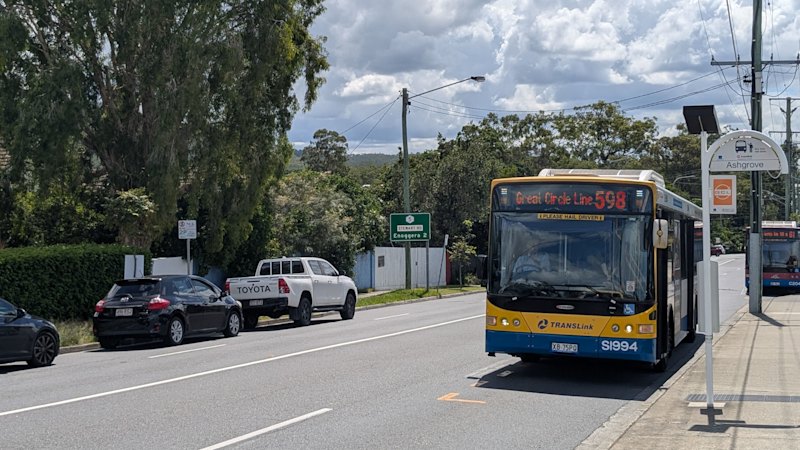
Kelly Stothard can catch a bus from near her home to all of Brisbane’s biggest shopping centres: Chermside, Carindale, Garden City and Indooroopilly.
But the Great Circle Line – 598 anti-clockwise or 599 clockwise – is a slow-moving beast.
It takes three hours to do a loop, arriving about every half an hour on weekdays, every hour on Saturdays and not at all on Sundays.
“The Great Circle Line is a great bus service,” Stothard said, adding she had used it since she was a child.
“The only issue I have … is that it doesn’t run on Sundays or public holidays, which leaves you either having to find an alternative or driving to your location.
“I’d love to be able to catch it on a Sunday with the kids and take them to other places or even just do the round trip.”
The Stafford Heights resident is just one of thousands of Brisbane residents who would like to catch public transport within the suburbs more often – an option that has become even more attractive since the introduction of 50¢ fares.
But cross-suburb buses are far less frequent than services heading to and from the CBD.
Analysis by David Hayward, from Aptura Consulting, shows bus routes travelling into the Brisbane CBD were already more popular, and then had a bigger uptick in patronage than suburban cross-town services on both weekdays and weekends after the introduction of 50¢ fares.
One explanation was those CBD routes were about two-and-a-half times more frequent in peak periods on weekdays and almost three times more frequent on weekends, Hayward said.
That was despite data indicating about 70 per cent of daily trips in Brisbane – using any transport mode – were for education, shopping and leisure, while about 30 per cent were for work purposes.
Of those, only about one-third were travelling towards the CBD for work.
That means only about one in 10 of all trips on a given day in Greater Brisbane are work trips that travel towards the CBD.
Hayward said research showed a five to 10-minute frequency was most effective in enticing public transport use.
An even bigger factor was the cost of car parking, with rates in the inner-city much more expensive than in the suburbs, he said.
Analysis by Ray White Corporate in 2024 showed Brisbane had the most expensive off-street parking of any CBD in Australia, whereas major shopping centres in the suburbs allow customers to park for the first few hours for free.
During consultation for Brisbane’s bus network shakeup, people said they wanted more Great Circle Line services on weekends, higher frequency, extra destinations and better transfers between the bus and train services.
People also asked for the route to be split into sections or to follow a more direct path to improve on-time running and reliability. But no changes were made.
Busfluencer Aidan Ameer said on a Sunday, with no Great Circle Line running, a bus trip from Acacia Ridge to Sunnybank Hills Shoppingtown would take more than an hour and require a change at Mater Hill. Driving would take just 10 minutes.
Hayward said a trial of increased frequency on the Great Circle Line would be worthwhile. If that was too expensive, it could have truncated services added along the route where there was demand for travel to places like schools and shops.
“Increasing the frequency of cross-town bus services has the potential to slightly relieve suburban traffic congestion over the short term,” Hayward said.
“It can also ease the pressure and stress placed on suburban shopping centre car parks while increasing the transport capacity for people to access local shops.”
Council transport chair Andrew Wines said the new bus network delivered the “biggest boost to bus services in generations”.
“While encouraging people to use cross-suburb services can be a challenge, we’re constantly assessing our bus network and working with Translink when there are opportunities to improve services,” Wines said.
Council data showed patronage on some services more than doubled after the new timetable boosted frequency and extended hours.
A Transport Department spokesman said public transport use was growing since the introduction of the new bus network and Metro last year.
“Brisbane now offers some of the most frequent bus services in Australia, with many core routes operating every 10 to 15 minutes or better, and Metro services running as often as every five minutes on weekdays,” he said.
“While CBD-focused services experience the highest demand, cross-town and suburban routes play an important role in connecting communities to local destinations and high-frequency Metro and BUZ corridors.”
Start the day with a summary of the day’s most important and interesting stories, analysis and insights. Sign up for our Morning Edition newsletter.
From our partners
Read the full article here