



Canadians are feeling the pinch in their wallets as the oil shock from the Iran war has raised energy prices worldwide, with some unions calling for grocery and fuel rebates.
“When global instability drives up fuel and transportation costs, it doesn’t just show up at the gas pump. It raises the cost of groceries, heating, and everyday essentials. And it’s working families who are feeling it most,” the Canadian Labour Congress said in a statement Thursday.
The group, which counts dozens of unions across Canada among its ranks, is calling on the federal government to “expand supports targeted at working-class Canadians, including the Canada Workers Benefit and grocery-related affordability measures.”
The statement also called for the introduction of a “fuel rebate” to help Canadians deal with higher prices at the pump.
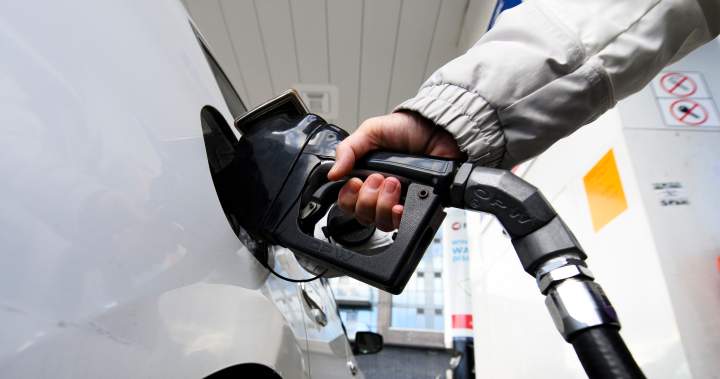
Canada’s national average for regular gas is sitting just below $1.70 a litre as of publication, according to CAA, and a month earlier it was closer to $1.28.
For an average passenger vehicle, that might mean paying roughly $20 to $25 more to fill up every time.
Higher fuel costs also threaten to raise grocery bills for Canadians; however, some economists say a rebate would be little more than a short-term measure.
“If we gave a rebate to Canadians for fuel prices, that would only deal with the symptom, which is higher prices. It would not bring down fuel prices and it would not bring down grocery prices,” University of Guelph food economist Mike von Massow said.

Get breaking National news
Get breaking Canada news delivered to your inbox as it happens so you won’t miss a trending story.
The U.S. and Israel’s war on Iran and Tehran’s subsequent blockage of the Strait of Hormuz – a key global shipping choke point – has raised the price of crude oil beyond US$110 per barrel in international markets.
While rebates might help for short-term crises, there’s no telling how long this conflict will continue, von Massow said.
“What remains to be seen is how long-term these fuel price increases are. I think we’re probably seeing this turn into a longer and longer horizon,” he said.
Many provinces are reporting huge deficits, leaving little money for governments to give more rebates, Concordia University economist Moshe Lander said.
“Let’s say that we had $1,000 per person per month. That’s not going to pay the bills. That’s not even going to come close to paying the bills, that’s not even going to pay rent,” he said.
“One thousand dollars per month per person for 40 million Canadians is $480 billion. We lost our minds during the height of COVID when the government came forth with a $300-billion deficit for locking us all down,” he added.
Canada also already has a grocery rebate, von Massow said, referring to the new Canada Groceries and Essentials Benefit, which received royal assent last month.
“Not long ago, the federal government announced rebates for food prices. The truth is, we have something that is responding to the significant price increases we’ve seen in the food space last year,” he added.
In the short term, there isn’t much the Canadian government can do to end the Iran oil crisis, Lander said.
“That’s the long and short of it. You can’t fix this, because unfortunately, it’s something beyond our control,” he said.
“This is just one more supply shock that we’ve experienced in the last five to 10 years, that we haven’t experienced for about 40 years prior to that,” he said.
Countries around the world are dealing with the higher energy costs by encouraging citizens to implement energy-saving measures.
In Thailand, an order for civil servants to work from home for the foreseeable future came with another request, as well – the Thai prime minister also ordered measures including suspending overseas trips and using stairs instead of elevators.
Sri Lanka introduced fuel rationing on Sunday to extend the life of its supplies. Under the new system, motorcycles will be allocated five litres, cars 15 litres and buses 60 litres of fuel per week.
Federal, provincial and municipal governments in Canada can do so by encouraging the use of public transport and strengthening alternative means of transportation such as walking or cycling, Lander said.
“Now is the time to start considering getting rid of that car and considering public transportation, moving closer to where you work, biking, walking, taking public transport, carpooling,” he said.
Over the longer term, however, he said the fossil fuel economy should be reconsidered in light of the multiple oil shocks the global economy has suffered this decade.
“This is why we need to invest billions of dollars in solar and wind and nuclear and think imaginatively about how we’re going to reduce that carbon footprint,” he said.
Canadians should prepare for an “almost immediate increase” in fresh produce as a result of the oil crisis, von Massow said.
“We will see, almost immediately, increase in the prices of fresh fruits and vegetables because we import them at this time of year. They’re a perishable product. Transportation represents a larger proportion of the retail price than for some processed products,” he said.
The higher prices, however, will be mitigated by the growing season starting in Canada, as produce will be trucked over much shorter distances.
“As we get into the next several months, we were expecting to see a decrease in the price of fresh fruits and vegetables as we get into Canadian production season,” he said.
“We’ll start to see Canadian produce — asparagus in May and June, strawberries in June, and some lettuce.”
Read the full article here