


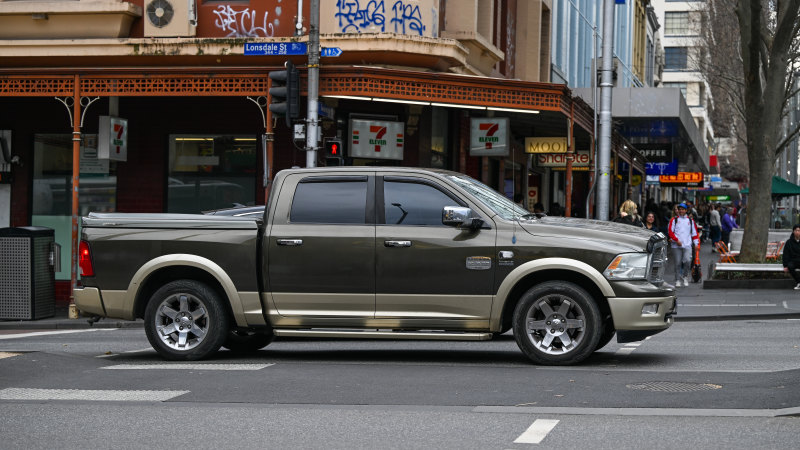
Those vehicles are 44 per cent more likely to kill an adult pedestrian or cyclist in a crash compared with a sedan, and 82 per cent more likely to kill a child, a recent UK review of 24 academic studies found.
As well as being heavier, many are being designed with high, blunt front-ends that further endanger pedestrians and cyclists.
“If you stand next to them, you see that you’re at eye level with the bumper,” Haghani said.
“That means it’s not your lower body extremities that are getting hit. It’s your upper body, chest or head. And if it’s a child, the most likely point of impact is going to be the head.
“Combined with a heavier weight, that means a significantly higher risk of the crash becoming fatal.”
A Chevrolet ute in St Kilda West on Saturday.Credit: Joe Armao
Victoria Police assistant commissioner Glen Weir said inattention from both pedestrians and drivers was contributing to serious crashes. Larger vehicles were also a problem, he said.
“They are large vehicles, designed for a certain specific task that are being used on roads that perhaps aren’t fit for that task,” he said. “So people need to adapt to the changing conditions of roads and vehicles.”
Weir said the risk to pedestrians would grow as more Melburnians moved into apartments and suburbs became denser, leading to more pedestrians, cyclists and scooter users on streets that once only carried cars.
“People need to realise that where they’ve driven for a long time is going to change and [they need to] start adapting their behaviour,” he said.
Haghani called for government action to reverse the trend of motorists buying larger vehicles than they needed, in the same way a suite of initiatives is in place to encourage lower-polluting vehicles.
But current policies did the opposite, he said. For example, a two-tonne American pick-up truck is exempt from the 33 per cent luxury car tax that applies to a sedan costing $80,567 or more.
“There is incentive for people to not pay that extra tax and just pay towards the price of the car, and that means they get a bigger car,” Haghani said.
He said Victoria should also join other states in charging higher registration fees for larger vehicles.
Loading
Victoria Walks chief executive Sarah Pilgrim said many vehicles now had such high bonnets that it was impossible for drivers to see a pedestrian in front of them.
“You’d think with vehicle technology getting safer, we should be getting less pedestrian deaths but we’re getting more, and definitely the bonnet heights are a part of that,” she said.
Pilgrim said arresting the growth in pedestrian deaths would require more investment in infrastructure so people could cross streets safely, along with lower speed limits around schools, shopping strips and on local streets.
Australasian New Car Assessment Program (ANCAP) chief executive Carla Hoorweg said good vehicle design made a significant difference to whether pedestrians survived a crash. But it was not mandated in Australia.
Loading
“Pedestrian impact protection has been part of vehicle regulation in Europe and Japan for many years,” she said.
Weir said a greater share of fatal road crashes happened on rural roads this year, accounting for 154 of the 285 fatalities, and generally on single-lane, non-separated sections of country road.
“Single acts of non-compliance” – such as basic driving errors or inattention – caused about 60 per cent of fatal crashes, he said.
“Everyone thinks it’s the really high-end speeder or someone who’s really way over the limit or off their head on drugs. And whilst that is a contributor, that’s the exception rather than the rule,” he said.
The average size of new light vehicles sold in Australia has grown 0.7 square metres since 2006, and utes and pick-up trucks have grown 1.6 square metres since 2003, according to the National Transport Commission.
Start the day with a summary of the day’s most important and interesting stories, analysis and insights. Sign up for our Morning Edition newsletter.
Read the full article here