


Paul McNamee, later a Davis Cup stalwart and Wimbledon doubles champion, tells a story from 1976 when he was in his early 20s and frustrated by his lack of progress. After a chance meeting with Lew Hoad, he poured his heart out to the Australian tennis legend. How could he improve his backhand? Should he be a serve-volley player or a baseliner? Which surface would best suit his game?
Hoad listened for a while, then stopped him. “Why are you making it so complicated?” he asked. “Tennis is simple. On the first short ball you go to the net. It doesn’t matter if it’s the second ball in a rally, the fifth or the 50th.”
Tennis is simple. Bill Tilden, the US champion of the 1920s and ’30s, thought so, too. Matches, he insisted (ignoring women players altogether), “are won by the man who hits the ball to the right place at the right time most often”. Tennis was simple … until it wasn’t any more.
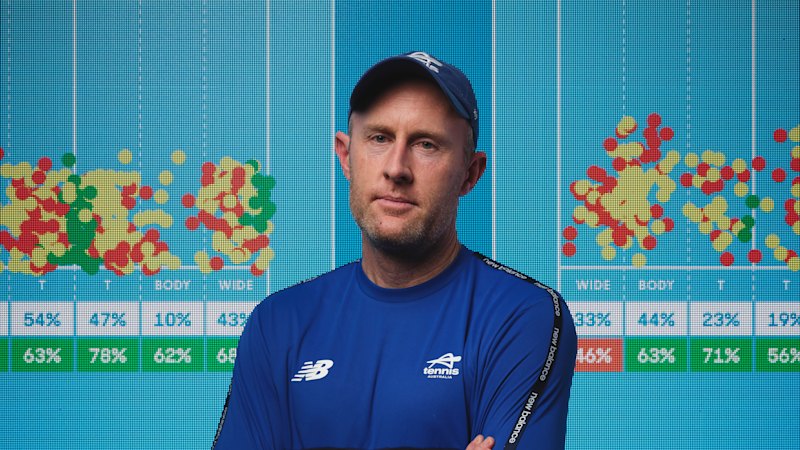
Welcome to the era of tennis data analytics, where people discuss scientific performance and leveraging technology for optimal player development. It’s the book and film Moneyball, only with more graphs and charts and real-time stats on tablets and laptops at courtside.
In February 1926, when Helen Wills played the “Match of the Century” against French star Suzanne Lenglen in Cannes, the young American recited a basic mantra to herself: every shot, every shot, every shot. Simple. Today she would walk on court having been briefed on Lenglen’s stats for pressure points and early breaks converted. Good luck with all that.
It’s not only tennis that has gone down this high-tech track. Baseball managers – captured in Moneyball, the Michael Lewis book turned into a Brad Pitt film – were the earliest and most enthusiastic adopters. American football coaches similarly employ technology to a dizzying degree. Basketball, too, has gone bananas, now quantifying not only points and rebounds but also abstruse, seemingly incidental things like deflections. Closer to home, former Australian cricket captain Greg Chappell pondered data from the past 35 years before nominating his preferred openers for the Ashes. He also cited a paper, An Investigation of Synergy Between Batsmen in Opening Partnerships, published in a journal of applied statistics. And look closely whenever TV cameras focus on the coaches’ box during an AFL match: there will be more heads down, peering at screens, than heads up watching the game unfold.
Unsurprisingly, some coaches are more enthusiastic than others about embracing this brave new world. One reason given for the European golfers’ defeat of their American rivals in the Ryder Cup last September was their superior data analysis, which influenced things such as pairings. Europe’s victorious vice-captain Edoardo Molinari – an Italian who earned a degree in engineering before becoming a pro golfer – was lauded for his number-crunching.
Tennis Australia has a Molinari. His name is Simon Rea, head of game analysis. He leads a team of six people, with numbers boosted by data-adept casuals over summer. Now 43, Rea, born in New Zealand, was a professional tennis player who then spent time as a coach – for players as different as Sam Stosur, late in her career, and Nick Kyrgios, early in his – but now humbly accepts the title of tennis nerd. His various roles are connected: his coaching was shaped by his experience as a player; now his work with data is all about streamlining and simplifying information to make it useful and digestible for a coach and their charge.
In his own racquet-swinging days – starting as a promising junior, then playing college tennis in the US, Davis Cup matches and tackling the likes of a young Andy Roddick – there was precious little info to draw on when preparing for a match, other than word of mouth: Hey, has anyone seen this guy play? Roddick won the US Open in 2003 and reached three Wimbledon finals; for Rea, it was a slow but inexorable realisation that his dreams of cracking the top 100 or hoisting trophies were just that: dreams.
Why? He is brutally honest. “Ultimately, I learnt I wasn’t good enough.” The best in any sport make time slow down; they execute without apparent exertion. Think Roger Federer in full flight, AFL veteran Scott Pendlebury waltzing out of a pack or Ariarne Titmus stroking the last lap of an Olympic swimming final. Rea seldom experienced that calmness. “Against good players, I always felt like I had no time on the ball,” he says. “I felt pressured, I felt panicked, I felt leant on. Smothered.”
Loading
Rea says tennis players “need to embrace the arm-wrestle, because that’s what it is”. The slightest edge – something as simple as predicting an opponent’s serve on big points – can be crucial. That’s where data helps. Rea talks of the gladiatorial nature of singles tennis: it’s one-on-one combat, like boxing without the blood. Knowing where the next punch is coming from may mean the difference between victory and defeat.
Singles players are also less lonely on court than they were. Changes in the rules of tennis in recent years have made it legal for players to interact with support staff during matches. It had been happening anyway – coaches giving not-so-subtle signals to a player changing ends or calling out in a language an umpire might not understand – but now it is acceptable for courtside portable devices to be monitored during matches and players to be fed crumbs of wisdom distilled from real-time data. It’s more scientific than when Brad Gilbert was coaching Andre Agassi at Australian Opens a quarter of a century ago and could be heard calling out: “Right here, Rock. Right now!”
The data that coaches, players and tennis geeks now access has flowed from the technology that made most line judges redundant. Because Roland Garros clay shows ball marks, the French Open is the only major tournament that still has people calling shots in or out. Others use electronic line-calling. (The French stance still provides for the finest theatre in tennis: umpires descending from their high chairs to ponder a mark like Inspector Clouseau studying a bloodstain before – voila! – signalling their decision.) As Rea explains it, when tennis transitioned to the era of electronic line-calling, the same cameras that show precisely where the ball lands also track its trajectory. Clever people realised it was now possible to tabulate things like ball speed and spin and how much ground a player covers in a match. All this provides an abundance of information.
Rea says Australians led the way in performance analysis, with people working in the area from about 2010 – first chasing down and saving all available vision of Australian players and potential opposition players, then banking match data. But any competitive advantage Australia might have had soon disappeared as the rest of the world closed the gap. For a while it became a highly competitive commercial industry; now data is available to all players, not only the best (and most wealthy) players with sizeable support teams.
The slightest edge – something as simple as predicting an opponent’s serve on big points – can be crucial. That’s where data helps.
But every player is different. So are their coaches. Some are hungrier for data than others. Alex de Minaur has described himself as someone always open to getting information, especially if it means he can tweak a game plan for his next opponent. Alexei Popyrin is best known for booming serves, but Rea noticed that his hot streak in 2024 was due largely to better returns. At the Canadian Open, which he won, his second-serve returns improved from 49 per cent in the third round to 65 per cent in the final.
Davis Cup captain Lleyton Hewitt is hungry for intelligence on opponents in the lead-up to a tie. What are you seeing there? What can we expect from X? What about Y and his recent hardcourt matches? What is their likely doubles combination? And Rea says of Craig Tyzzer, Ash Barty’s former coach: “Craig definitely had an eye for detail. So did Ash. And I imagine what happened there was a cross-pollination of notes.”
There is one name that keeps coming up in any conversation about people who love a deep-dive into the data: Pratty. Queenslander Nicole Pratt was a pro player from 1989 to 2008 (the top-ranked Australian woman in 2001) and has coached the national women’s team since 2015. In November, she was acting captain for a Billie Jean King Cup tie in Hobart. Players she has guided include Kimberly Birrell and Storm Hunter. Rea lauds her appetite for detail: “She wants the nth degree and she’ll back herself to filter out excess information. She wants to know if there’s a chance that I’ve missed something; doesn’t want to be caught short.”
Like Rea, Pratt recalls a time when there would only be basic information available on players, perhaps just first- and second-serve percentages, and little available vision of her own matches, let alone somebody else’s. “You often had to scout your next opponent,” she says. “In my day, that’s just the way it was.” Now, a player can relax in a hotel room, chill with Netflix and zip through recent vision of a rival on YouTube. Pratt considered herself a student of the game. “I would stay at the courts. I just loved to watch tennis matches. You’ve got to know what the top level is; the level you’ve got to rise to.”
Once, an Apple iPod Touch was regarded as a high-tech gizmo for coaches such as Pratt. Then came websites and/or apps such as ProTracker and tennisstats.com. She still uses these, plus whatever Rea’s team offers. Match data can show if a player is losing momentum, which might suggest a loss of concentration. Pratt says it is not good enough to tell a player to focus on someone’s backhand or forehand: too vague. Data suggests exactly where on a court the opponent may be most vulnerable. “You can be as precise as possible, because your player has the ability to hit those areas.”
True, but can they do it under pressure? “The player has got to execute,” Pratt says. “They’re the one who has to hit the stroke.” As a coach, she tries to make information targeted and tailored. Probably a maximum of three things to work on. “Too much information is a recipe for disaster. Paralysis by analysis.”
Rea mentions a second-round match at last year’s Australian Open between world No. 1 Jannik Sinner and Australia’s wildcard recipient Tristan Schoolkate. Rea worked in advance with Schoolkate’s coach, Andrew Roberts, whom he describes as being “from the Nicole Pratt school of thought. He wants all the detail. He wants to dive in.” Preparation went like this: “OK, we have the toughest task in tennis. There’s no shortage of data and information on what Jannik is doing well; things he is looking to do. Andrew and Tristan wanted to do things differently: use Tristan’s sliced backhand and his willingness and readiness to come forward. Therein lies the beginning of a plan to play on Tristan’s terms more than Jannik’s.”
But Schoolkate still had to walk out on Rod Laver Arena, with the world watching, and try to execute. All available data had been analysed but, Rea says, “the unknown is: how do they handle that environment, first time ever? To his eternal credit, Tristan looked comfortable, looked at home, against the hottest hand in tennis. I was in awe how he handled the first 30 to 45 minutes of that contest.” Schoolkate won the first set, which shocked both commentator John McEnroe and Sinner himself.
Loading
Sinner readjusted, prevailed in four sets and went on to win the tournament. Plus Wimbledon in June. But he lost both the French Open and US Open finals to Carlos Alcaraz. After the New York defeat, Sinner commented: “I was very predictable on the court today … You are facing Carlos and must leave your comfort zone.” All the data, all the stored knowledge from previous clashes, meant Alcaraz was reading him like a book.
Alcaraz also has the X-factor: the ability to come up with a shot so surprising, it can short-circuit a statistician’s screen. Coco Gauff has her magic moments, too. Data points can look pretty, but there is always a human factor in sport. English golfer Tommy Fleetwood commented that while stats played a big role in deciding Ryder Cup pairings, “you need some emotional connection” in any team event. Rea suggests that the next frontier in tennis science and on-court cameras involves tapping into players’ skeletal data and biomechanics through the use of wearable technology, then analysing how this correlates with performance.
Before performance, however, comes preparation. Legendary American player Ellsworth Vines had his own ideas about that – if you can believe a 1930s contemporary, George Lott. He claimed that once, before playing British champion Fred Perry, Vines tucked into a lunch of cream of tomato soup, cucumbers, pork chops, vanilla ice-cream with chocolate sauce and grapefruit juice. He lost. Lott’s verdict: “Perry could have eaten Elly’s lunch that day and still won.” Five years earlier in Cannes, Helen Wills also questioned the value of preparation. After losing her much-hyped match in straight sets, young Wills conceded: “I had no definite plan of strategy or attack because it was so difficult to find any way of attacking Mademoiselle Lenglen’s game.”
She should have paid more attention to one of the quaintest aspects of tennis: the pre-match hit-up. (Is there another sport in which rivals help each other prepare?) “Big Bill” Tilden was a great believer in the importance of the hit-up, stressing: “You are looking for the type of game he will probably elect to play against you, any weakness in stroke production.”
As Lew Hoad said to Paul McNamee: simple.
Get the best of Good Weekend delivered to your inbox every Saturday morning. Sign up for our newsletter.
Read the full article here