



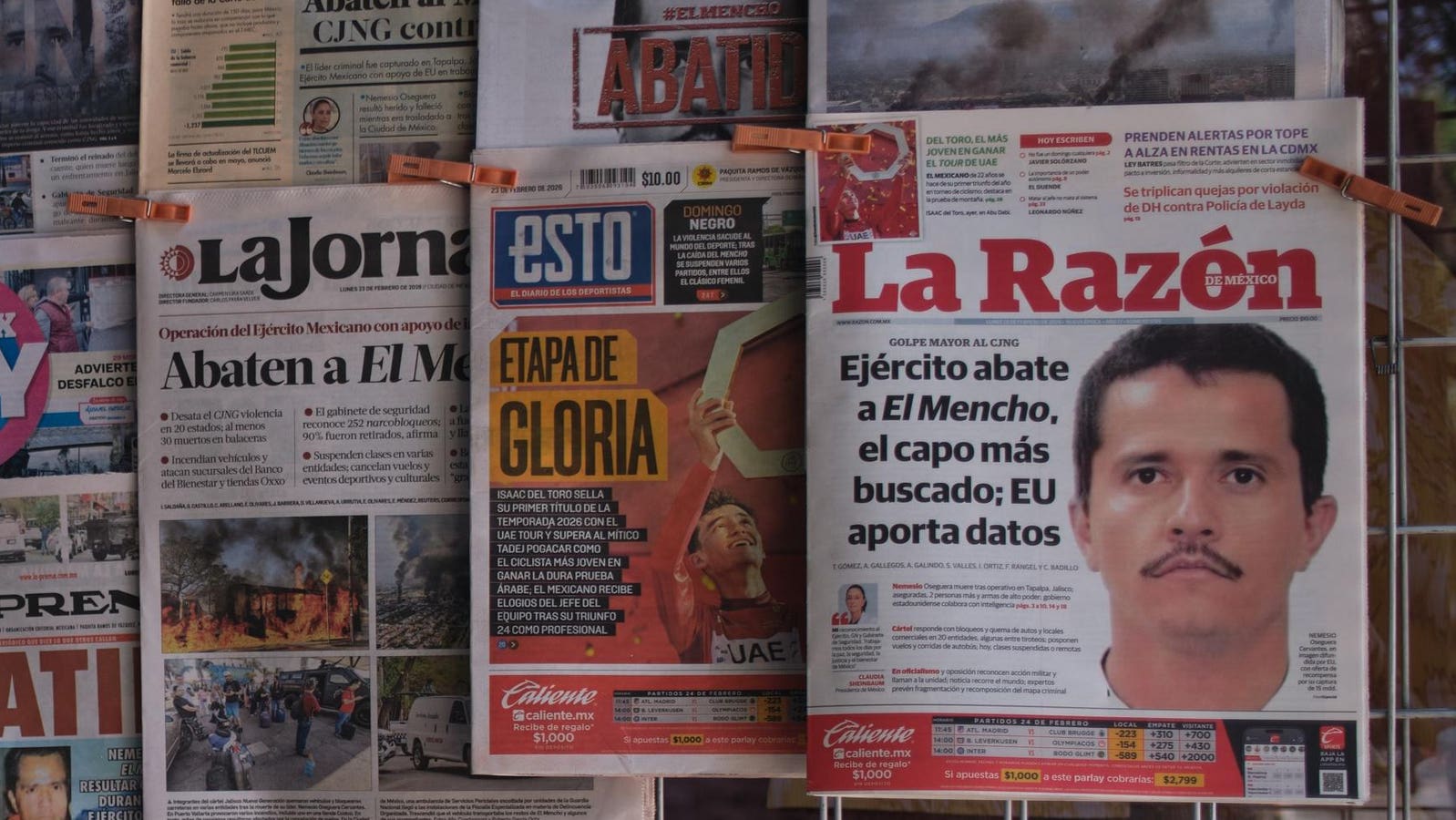
On Saturday evening, Nemesio “El Mencho” Oseguera was enjoying himself in a luxury cabin nestled in the pine-covered hills of a resort community in Tapalpa, a popular tourism destination in the Western state of Jalisco. Early Sunday morning, a squadron of Mexican security forces gunned down the 59-year-old drug lord in a five-hour fire fight. The feds had found Mexico’s most-wanted man by tracking the movements of the lover whom he had traveled to meet for the weekend.
El Mencho leaves behind the Jalisco New Generation Cartel (known as CJNG), one of Mexico’s two largest drug trafficking organizations, along with the Sinaloa Cartel, formerly led by Joaquin “El Chapo” Guzman, 68, who is serving a life sentence in a U.S. prison. A former Jalisco state policeman who lived (and was incarcerated) in the U.S. as a young man, El Mencho founded CJNG in 2009 as an offshoot of the Milenio Cartel, following the arrests and deaths of Milenio’s leaders and a vicious power struggle. With his combination of organizational efficiency and psychotic ruthlessness (like dumping dozens of tortured bodies in the streets of Veracruz one evening in 2011), El Mencho grew his outfit into a diversified criminal enterprise beyond just drug smuggling, with interests in human trafficking, large-scale extortion, fuel theft, and financial scams.
In all likelihood El Mencho was Mexico’s richest kingpin at the time of his death. Mexican officials estimated in 2017 that CJNG enterprises held roughly $50 billion in assets. In 2019, Kyle Mori, an agent at the Drug Enforcement Agency who investigated him for years, told Univision that he believed the kingpin was worth between $500 million to $1 billion. In the last seven years CJNG has grown its share of Mexico’s illegal drug trafficking industry amid the continued splintering of the Sinaloa Cartel and weakening of regional players, while also pushing into other illicit cash streams.
What happens to El Mencho’s billion-dollar criminal empire now that he’s dead? CJNG’s business operations will likely pass into the hands of family members and close associates. Even if there’s a power vacuum, the enterprises will continue operating, churning out cash. “It’s like if the manager at Target fell ill, Target’s not going to stop operating,” says David Tyree, a 25-year veteran of the DEA. “They’re used to it—and there’s certainly demand.”
The fate of El Mencho’s personal estate is a trickier question. According to former U.S. agents and prosecutors with experience investigating narcos and seizing their assets, the kingpin likely held a massive investment portfolio—not unlike a legitimate billionaire’s—divided between cash-filled bank accounts, upscale cars, luxury properties, private planes, stocks, crypto, and even legitimate businesses set up to help launder money, dispersed across Mexico, the U.S., and even further afield in Europe and Asia.
“I wish it was as simple as the bad guy with the cool car and the spinning rims but it’s so diversified,” says Tyree. “He’s got investments. He’s got hotels. He’s got networks [with] different forms of passive income, whether through rental properties, through exportation and importation of real goods and services from China and even Europe.”
U.S. and Mexican law enforcement, in collaboration with banks tracking suspicious activity reports, will now be hunting for El Mencho’s physical assets ( properties, cars and planes), as well as his drug money laundered through U.S. banks, which the feds have statutory authority to seize. The issue is untangling the money trail, which narcos like to snake through a web of shell companies and transactions. Much of the cartel’s financial infrastructure was long associated with Los Cuinis, a closely allied network led by El Mencho’s in-laws that U.S. authorities have described as CJNG’s financial arm, specializing in money laundering and international investment vehicles.
“They create shell companies. They move the money into the names of relatives. They use cryptocurrencies. They engage in trade-based money laundering to convert their money into something legitimate,” says Stefan Cassella, a former federal prosecutor, who recalls one drug trafficker that squirreled money away through a llama farm. “There’s no one way.”
Even if El Mencho had been captured, prosecutors would struggle to convince him to forfeit his wealth. The U.S. ordered former El Chapo to pay $12.6 billion in restitution in 2019 after he was convicted on numerous criminal counts, but there’s no indication the druglord ever paid a cent. (His lawyer Mariel Colon said at the time that it was “insane to think that Guzman would have all that money.”) That hasn’t stopped the U.S. from chasing down Chapo’s and his associates’ assets. To date they have seized numerous luxury homes, sports cars, a flotilla of helicopters, and a collection of rare jewels—but all of that amounts to less than 1% of money judgement levied against El Chapo. Guzman’s former partner “El Mayo” Zambada, 75, pleaded guilty in the U.S. last year after being extradited by the Mexican government. He was ordered to pay a $15 billion restitution. It’s also unlikely to ever get paid.
“What is the government going to do? They can’t do anything,” says Michael Vigil, a 31-year veteran of the DEA who spent time chasing narco traffickers in Mexico and Colombia. “When they give them a life sentence, why would they cooperate in providing that money? I wouldn’t.”
For drug kingpins, the richer you get, the less you get to live like a carefree billionaire. Once you can afford the yachts and vacation homes and private jets, you’re likely already on the radar of U.S. and Mexican investigators. El Mencho had been on the run in Mexico since 2011, when Mexico’s federal prosecutor’s office first issued an arrest warrant for him. He has evaded capture for so long because of his willingness to hop between cabins in remote, mountainous regions, running his empire through verbal commands. “They’re living out in horrible places. Places where you don’t have television or access to doctors. The food is rustic,” says former DEA agent Vigil. “It becomes a hard life for them.”
Other narcos and their next of kin will risk capture to maintain their opulent lifestyles. These daring criminals use fake passports and elaborately constructed identities, just so they can continue to enjoy the high life. El Mencho’s son-in-law Cristian Fernando Gutierrez-Ochoa did just that in 2023 when he faked his death, adopted an alias and moved into a $1.2 million home in Riverside, California. Federal authorities arrested him a year later.
El Mencho met his demise precisely because he gave into temptation. Tapalpa Country Club, where he was staying last weekend, overlooks a serene lake and pine-covered hills. The villa he was staying at with his lover, a two-story cabin with stone walls and a red-tiled roof, boasts an outdoor porch with wood beams and a modern kitchen with an expansive island countertop and a massive refrigerator. The comforts El Mencho rarely allowed himself were the ones that finally cost him.
Read the full article here