



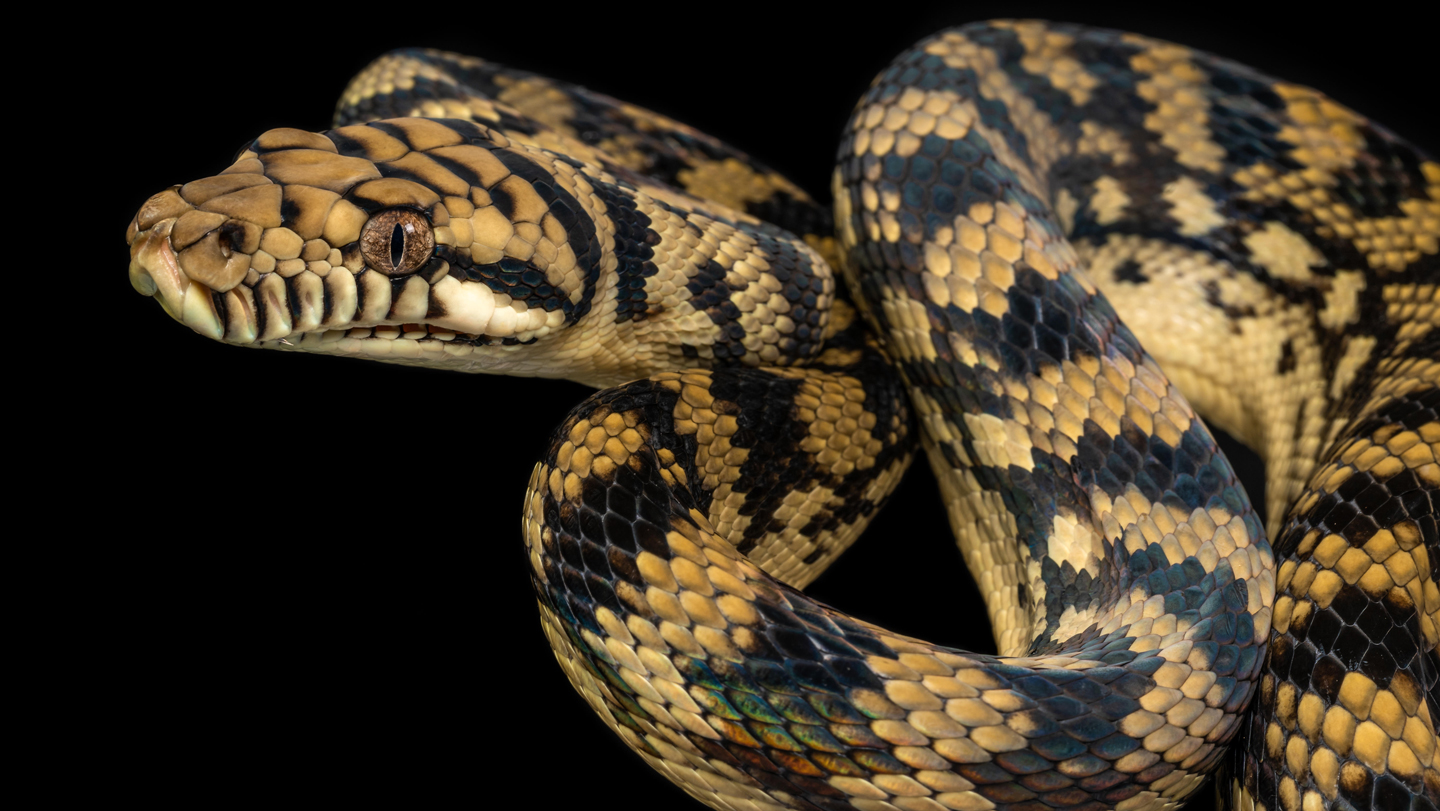
As a long and wiry scrub python slithers its way from branch to branch on a tree, it can effortlessly lift itself upright to climb onto a higher perch. But how does it do it? With no arms and legs to hold itself up, how does it not topple over? It controls only the part that matters.
Instead of exerting a huge effort to stiffen their entire body to stand upright, tree-climbing snakes may concentrate their bending energy and muscle activity within a small region at their base, researchers report February 25 in the Journal of the Royal Society Interface. The team’s mathematical analysis suggests that pairing such a strategy with whole-body muscle coordination might help snakes stand while expending as little energy as possible.
“Snakes are kind of like muscular ropes,” says bioengineer and roboticist David Hu of Georgia Tech in Atlanta, who was not involved in the study. “And they can basically perform magic tricks, flexing their bodies and preventing [themselves] from falling.”
In an earlier study, zoologist Bruce Jayne of the University of Cincinnati and a colleague showed that as gravity-defying snakes move upward, they activate a muscle along their spine. In the new study, Jayne and collaborators examined how snakes manage this limbless lift-off without buckling under their own weight.
The team videoed four snakes — three brown tree snakes (Boiga irregularis) and a scrub python (Simalia amesthistina) — vertically crossing gaps between perches in the lab. The footage showed that the creatures reliably contorted themselves into an S-like shape to do so, especially if the gap was large. The snakes were maximally curved close to where they were perched. Above that, they were nearly vertical, like a tall pole standing straight — with little to no tilt, gravity had almost no leverage to topple them.
To understand the forces involved, the physicists modelled the creature mathematically as an active elastic filament — a soft structure that can sense its own shape and activate muscles in response — and explored two strategies of how the snake might stand up. In one, each part of the body responds locally to its own curvature. In the other, muscle activity — while still focused more at the bottom — coordinates across the body to minimize the energy needed to stand.
Both approaches reproduced the S-shape, with most of the bending concentrated near the perch. But the global coordination strategy required less force. And in that scenario, the bending force dropped as more of the snake rose into the air. Given that the second approach minimizes both force and energy, the researchers suspect that even real snakes employ a similar strategy to make standing up tall as energy efficient as possible.
The math also suggests that while the snakes may use relatively little force to strike the pose, they spend considerably more energy staying upright. In the videos, the snakes that stand taller sway a little from side to side — suggesting they are actively exerting their muscles to maintain their balancing act.
The findings could help in the design of snakelike robots, which can be used in space and underwater explorations and in surveying disaster sites. “It would be interesting to see if these ideas of control and feedback can be used to build robots that you can control more easily or use less electric energy to bring into the shapes that you want,” says study coauthor Ludwig Hoffmann, an applied mathematician at Harvard University.
Read the full article here