



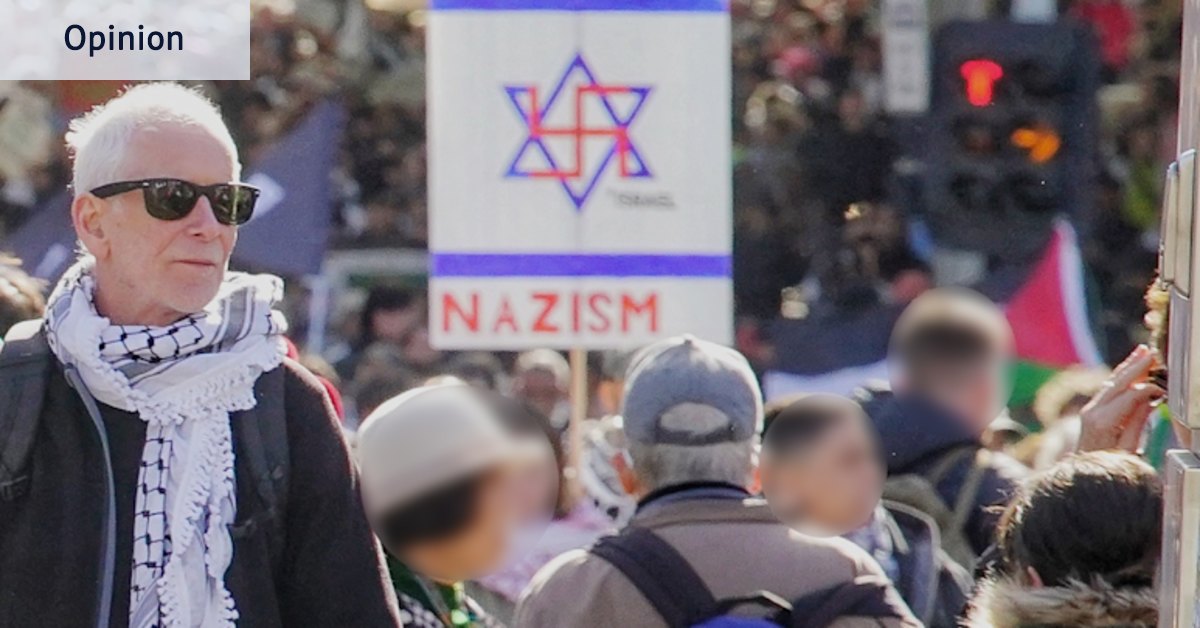
At protests against Israeli President Isaac Herzog’s visit to Australia, some demonstrators directed their anger not only at Israel’s policies but at “Zionists” themselves – accusing them of malign influence in the media and government. At other recent rallies, Zionism has been equated to Nazism and terrorism.
Victor Klemperer, a Jewish academic who survived Nazi Germany, warned that words can act like tiny doses of arsenic – swallowed unnoticed, accumulating slowly, until their poison takes hold. His insight was not about shouted slogans, but about respectable language that can normalise contempt. “Zionist” has entered this territory over the past two years.
In the wake of the Bondi attack, I was involved in a public campaign for a federal royal commission into antisemitism. My role prompted a message from someone I have known for more than 20 years. Had I been paid by Israel for my advocacy, he asked. It was an offensive question. The answer was no.
What followed was more revealing. “Zionists have always been morally bankrupt with a superiority complex,” he told me.
I asked him two simple questions. Did he believe the state of Israel should continue to exist? Yes. Did he believe it should exist as a Jewish state, provided Jews, Christians, Muslims and others were given equal rights? Yes.
By the standard definition, he qualified as a Zionist. He either did not understand the term – or he was deliberately repurposing it.
That exchange mattered not because it was especially aggressive, but because it was ordinary. It was delivered calmly, with moral certainty, and without any sense of contradiction. It revealed something that has become increasingly common: the use of the word “Zionist” not to describe a belief, but to impugn a target.
Zionism, properly understood, is not complicated. It is the belief that the Jewish people have the right to self-determination in their ancestral homeland. In practical terms, it is the idea that Israel should exist as a Jewish state. In Australia, Zionism has long been openly supported by mainstream leaders from across the political spectrum as a legitimate expression of Jewish self-determination.
Zionism does not dictate borders. It does not prescribe military policy. It does not require allegiance to any government, leader or political party. It does not exclude any race or religion from Israeli citizenship. It does not preclude criticism of Israel and nor does it demand support for all actions taken by the Israeli state. Expansionism is not intrinsic to it, and nor does it require opposition to a two-state solution. To be clear, criticism of Israel that is similar to that levelled against any other country cannot be regarded as antisemitic.
Like any national movement, Zionism contains a wide spectrum of political views. Many Zionists oppose Israel’s current government. Many Israelis have protested against it for years. Some of the fiercest critics of Israeli policy are Israeli citizens, who nonetheless consider themselves proudly Zionist.
This clarity matters because once a word’s meaning is hijacked, it becomes available for misuse – or abuse.
In recent years, “Zionist” has increasingly been deployed as an insult. The term Zionist is no longer used to identify an idea, but it is spat to assign blame. “Zionists” are held responsible for a wide range of evils, often without definition or limitation. In many instances, “Zionist” is used synonymously with “Jew”, while maintaining just enough ambiguity to deny that Jews are being targeted at all. So why does this substitution occur?
Because openly targeting Jews is no longer socially acceptable. “Zionist” becomes the workaround – broad enough to encompass most Jews, yet elastic enough to provide moral cover. It allows hostility to be expressed while preserving plausible deniability.
We are repeatedly told that hostility toward “Zionists” is merely political critique. But if that were true, the criticism would be of policy. Instead, “Zionists” are accused of supremacy, immorality, or inherent evil. That is not political criticism. It is collective character assassination.
This matters because Zionism is not an abstract ideology for most Jews. It is bound up with history, vulnerability and survival. For many Jews – including those deeply critical of Israel – Zionism represents the belief that Jews should not again be stateless, dependent on the goodwill of others for protection. To insist that “anti-Zionism has nothing to do with Jews” while knowing that the overwhelming majority of Jews identify in some way with Zionism is disingenuous.
At best, it ignores how the word is actually used. At worst, the ambiguity is used intentionally as cover. This is why the definitional battle matters. Hijacking the meaning of Zionism allows hatred to masquerade as politics. The federal royal commission into antisemitism must grapple with these subtleties if it is to understand Jew hatred in Australia.
Existing legal frameworks are poorly equipped to deal with language that is technically deniable yet socially corrosive. They miss the cumulative effect of rhetoric that repeatedly singles out a group under a different name.
If the commission is to be meaningful, it must confront this linguistic sleight of hand directly. It must be willing to ask whether “Zionist” has become a socially acceptable stand-in for “Jew” – a way to legitimise hostility while denying responsibility for its impact. Because when words are repurposed to disguise prejudice, history suggests the damage rarely stops with words.
Danny Berkovic is a Sydney businessman and an organiser of the bondiresponse.com petition, which pushed the Albanese government to announce a royal commission into antisemitism.
 Danny Berkovic is a Sydney businessman and an organiser of the bondiresponse.com petition, which pushed the Albanese government to announce a royal commission into antisemitism.
From our partners
Read the full article here