




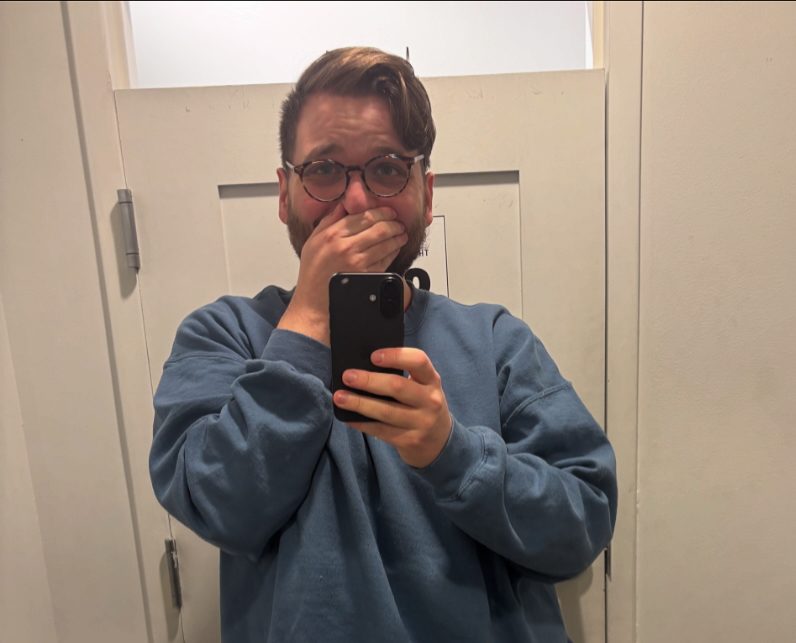
Lately, I find myself staring in the mirror, grabbing at the loose skin on my arms that makes me feel like I have tiny wings, feeling cheeks that are more prominent than they used to be and lead to a jaw line that has only one chin. I notice the sharp indent in my thighs where there once was a puff of fat, and how my tattoos have shifted subtly toward the floor. I notice the way that my stomach hangs only slightly over my belt, which uses notches it never did before. I used to hate the mirror, but now I find myself there not in some vainglorious celebration of thinness, but in a space of pensive studying. My body feels different, and I’m not completely sure how I feel about it.
I am part of the growing group of Americans using a GLP-1 to alter their relationship with food. The medication has been life-changing for me. Without hyperbole I say that I used to spend about 60% of each day thinking about food—when was the next meal? What was I going to eat? Would it be healthy enough? Was the last meal I ate healthy enough? What about the meal after this one? When was the last time I had a salad? Do I have snacks in the car? I could be reading a book and really be thinking about food, food, food.
These days I barely think about food. I enjoy eating, and eat plenty, but I’m not fixated on it. If the medication caused me to lose zero pounds, I would still take the shot every week because of how it alters my mindset. I have spent my whole life as a fat person. My newfound thinness is a side effect.
The problem is that I don’t feel like I’ve earned this thin body. I haven’t had to strain myself. Things are supposed to be hard. I’m supposed to struggle. But I’m not.
The problem is that I don’t feel like I’ve earned this thin body. I haven’t lifted any weight heavier than 20 pounds and haven’t walked any more than I did before. I haven’t had to strain myself. I always assumed weight loss would make me feel better about my body; it hasn’t. I don’t love my body more because it’s smaller. I don’t feel hotter. I’m thinner than I’ve ever been and I’m also eating better than I ever have, but I’m not tracking my macros, and there are days when I don’t hit my step goal. Because I used to emotionally eat, I never kept any food in my house, but now my shelves are stocked. Things are supposed to be hard. I’m supposed to struggle. But I’m not.
I also have mixed feelings about taking a GLP-1 in the first place because I know it is a privilege. I feel guilty that I have the money for the drug, guilty that my parents, one of whom is bigger than me, cannot currently afford it themselves. I’m feeling grief over the bevy of cruelties inflicted on me as a fat child and adolescent. I’ve wondered how my life would’ve been different if this medication had existed earlier. This has all shaken who I thought I was: When I was big, part of my identity was my size. I’m trying hard to love this version of my body, but I get caught in spirals about all this often.
Recently my partner expressed concern about the hanging skin on my arms; she’s worried I’m losing too much muscle as my body changes, or that I’m losing too much weight too quickly. What scared me was that I hadn’t noticed that physical change. I am so inundated with newness that I didn’t even register my GLP-1-induced wings of loose skin until she pointed them out. It’s frightening to feel like you’re losing control, or awareness, of your body.
Growing up, I was always the fat kid. Kids taunted me on the playground: “Look at that fatty.” Before I was out of grade school, I was wearing shirts that had an X in the size, growing from one X to three Xs by the time I graduated high school. All my doctors’ visits centered around my weight. Drink a glass of water before every meal, doctors told me. Make sure you go for walks multiple times a day, they’d implore. No pain I had was real; nothing about my personage mattered to my doctors. I once went in for migraines and was told they would subside if I’d just lose 50 pounds.
There are a thousand indignities to being fat that have been written about exhaustively and never written about enough. Being fat means reaching to the back of any clothing rack and praying that the size goes up big enough for you to wear what you like. When you board an airplane, you see the relieved faces as you walk past people and don’t sit in their row. Going out means eating not how much you want to eat, but how much you think others think you should eat. Existing in the world as a fat person means always keeping spatial awareness of where you are and who is around you. It means a lot of small apologies for merely existing.
Over the years, I tried to join movements to gain confidence in my fatness. In college I attempted body positivity. I read books, met with likeminded people, and apologized less. I stopped weighing myself. I tried to stop caring about what people thought of me. After positivity, I sought neutrality: “I am at peace with my body even if I don’t love it.” Nothing ever stuck.
For ten years I refused to go to a doctor because I hated being told all the things that were wrong with me because I was fat. These days I see a doctor every month, and a dietician every other week, or every month, or whenever I need to. They start by asking me how I’m feeling, instead of jumping right to my weight. Now I’m excited to hear how my measurables have changed. With each visit there’s a chance that I’m going to check a box of health that I haven’t yet experienced in my adult life. At my 3-month check-in, I stopped needing the extra-large blood pressure cuff. My 6-month blood panel showed that my A1C was no longer pre-diabetic and my cholesterol was in the normal range. No matter how I feel about my new body, these are objectively good things, things I feel like I should be celebrating.
For now, I try to embrace the dualities of my current self and my past self, even when that’s hard. I can love the fat, mullet-clad boy I was in grade school, and still feel grateful that I no longer carry that weight around every day. I can believe in intuitive eating and health at every size, and also feel grateful that my brain doesn’t orbit constantly around food these days. I can want, desperately, to know the body I see in the mirror and still have a long way to go before I do.
Sam Prince is a writer and educator living in Portland, Oregon. More of his writing can be found here. More info on working with him as an educator can be found here.
All views expressed in this article are the author’s own.
Do you have a personal essay you want to share with Newsweek? Send your story to MyTurn@newsweek.com.
Read the full article here