




Opinion
“Going for a swim?” It had been a stinking hot day’s work, and Manly beach was metres away, but the tradie wasn’t interested. “Not a chance, not even up to my ankles.”
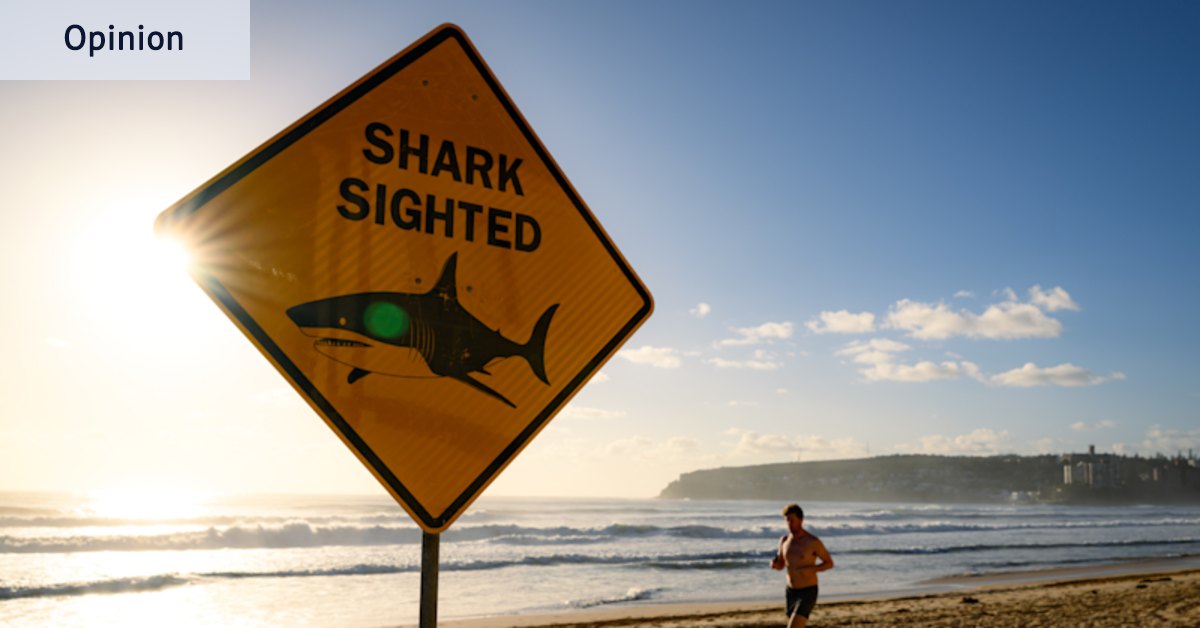
The Manly stretch has been a sobering sight since January 19 when, in the third Sydney shark incident in barely 24 hours, a surfer was pulled from the waves at North Steyne with critical injuries. Andre de Ruyter would lose his lower leg, and the previous day at Nielsen Park in Sydney Harbour, 12-year-old Nico Antic suffered fatal injuries. Between those two events, a surfer’s board was bitten at Dee Why, not far from where, a few months earlier, Mercury Psillakis died. If we are lucky, 2025-26 will be marked out as the freak year when people in Sydney became too scared of sharks to go into the water.
Gradually, they’re creeping back. No Nippers yet, but the heat has propelled a handful of swimmers into the water at South Manly. The Queenscliff ocean pool, warm with weed and wee, has been doing brisk business. In the last few days some swimmers, sticking tight and staying close to shore, have tested the open water.
The patrolling jet skis and rubber duckies have eased off. Sirens, set off by electronic signals from tagged sharks, go off at their usual three or four times a week. If there were surfable waves (there haven’t been), boardriders would be edging back.
Fear isn’t meant to be logical. One headland north, normality resumed quicker at Freshwater. South of the harbour, beach life was only momentarily interrupted, as if bull sharks only knew to turn left at Sydney Heads.
There has been a widespread sense of loss, as if people have had their territorial rights to their ocean summer rescinded. Warm days have heightened this feeling that an entitlement has been taken away. As one proponent of shark culling asked, “Sharks can have the whole ocean. Can’t we just have the first hundred metres?”
While understandable, these sentiments are based more in emotion and habit than evidence. It hasn’t taken long for humans to get used to the idea that they own this fringe of littoral water, and that sharks, like those other beach infringers, the cabana builders, have violated their free space. I’m not saying that selfish cabana people are any smarter than sharks, but regulation and negotiation can at least modify their behaviour. Sharks tend not to listen to reasoning.
If a positive can be taken from this year’s shark incidents, it will be to reverse some assumptions and restore respect for the ocean. It’s not our swimming pool. It was never ours to take away.
There has been an alarming, and frankly astonishing, divergence between Australians’ use of the ocean and their respect for its risks. A March 2025 study by Royal Surf Lifesaving Australia found that among year 6 students, nearly half cannot swim 50 metres and tread water for two minutes. Only one in six 17-year-olds can swim the national benchmark distance of 400 metres. Swimming lessons in schools are in decline, a quarter of schools have no swimming carnivals, and Australians’ swimming ability shows “little improvement” after year 7. Each of these indicators had worsened since the COVID-19 pandemic, and yet the public, of all ages, is gravitating to the beach more and more.
Notwithstanding efforts to educate people on swimming in rips, particularly from Rob “Dr Rip” Brander, there were 357 drowning deaths in Australia last year according to the National Drowning Report, 84 of them at beaches, a 27 per cent rise on the 10-year average.
Shark incidents are different, of course, but they also involve assessing risk. Calls for improved education are thrown into sharp relief by the incident at North Steyne. I was there that day. The waves were ordinary but, Manly being Manly, in normal late-afternoon conditions there would have been dozens of surfers out. Days of rain had left murky water, so there were only three surfers on the entire stretch. The rest had weighed up the chance of an infection, and the two other shark incidents, and decided not to surf. Possibly de Ruyter and the two others saw a rare chance for empty North Steyne waves. They measured the odds. The chance of a shark incident was minuscule, if well above the normal. De Ruyter was incredibly unlucky – and also incredibly lucky that the two others were there to pull him from the water.
These complex calculations of risk can be inbuilt through years of experience and grounded in respect for nature. But they’re still new in the scale of things. It’s easy to forget how recently the coastal ocean has come into non-Indigenous use. For colonial Australians, beach swimming began only a century ago and escalated to mass popularity in the last 50 years. In a blink, society has escalated the ocean environment from something unknown to a feature of cultural identity as Australian as the quarter-acre block. Irrational fear to reckless overconfidence in two generations.
The high prevalence of beach drownings among inexperienced swimmers underscores how long it takes to even begin to understand the ocean. Education of this kind is not a one-day course; it’s a lifelong accumulation of knowledge, of trial and error.
If there is one hope to take from the sad sight of this January’s empty beaches, it’s that respect for the ocean must be rebuilt. Not fear. Fear is not going in above the ankles one day, then diving straight into a rip the next. Respect, on the other hand, is a matter of acquiring skills, calculating probabilities, figuring out when the odds are with you and when they are against you, learning from experience, and above all not taking the ocean for granted as if it’s your personal playground. Being in the ocean is always a game of odds. Learning how to swim, learning rips and learning about sharky conditions are not guarantees of safety; they’re only ways of tilting the odds in your favour.
The decline in swimming education, coinciding with an increase in beach use, is a snapshot of irrational entitlement. Its flipside is irrational fear, Amity Island in Jaws. Fatalities on our beaches shouldn’t terrify us; they should make us more humble in our approach to the ocean, more respectful, and more willing to learn. If absorbed in this way, the grim misfortunes of the past months can leave a positive legacy.
Malcolm Knox is a journalist, author and columnist for The Sydney Morning Herald.
 Malcolm Knox is a journalist, author and columnist for The Sydney Morning Herald.
From our partners
Read the full article here