

While Alberta and the federal government have struck a pact to lay the groundwork for a pipeline to the B.C. coast, Indigenous nations in Alberta remain mixed in their reception, even as one group has been named a key partner.
The Alberta Indigenous Opportunities Corporation was named a key partner in Ottawa and Alberta’s memorandum of understanding last week.
Channa Martineau with the AIOC says it’s a first step.
“This is an opportunity to start with the way you mean to go on,” she said.
The memorandum says Ottawa’s approval of the pipeline would be based on whether the project is seen as being in the national interest and “provides opportunities for Indigenous co-ownership and shared economic benefits.”
To date, the corporation has helped provide approximately $745 million in loan guarantees to projects affecting 43 First Nations.
But it’s not without difficulty, as the pipeline is unlikely to go ahead without sign-off from Alberta and British Columbia’s First Nations. And Martineau worries that consultation is often done too late.
“A lot of it (consultation) happens after a lot of the design work has been done,” said Martineau.
“Where you want that Indigenous participation is at the very beginning. I always say those conversations might be hard, they’re not easy conversations, but you’re better to have them up front than to get mired in quagmire when you’ve already invested in a project that isn’t workable from an Indigenous perspective.”

Get daily National news
Get the day’s top news, political, economic, and current affairs headlines, delivered to your inbox once a day.
Though the AIOC is involved, some First Nations are concerned about the project, including the Confederacy of Treaty 6 First Nations.
On Friday, the Confederacy said it expects collaboration with both Ottawa and Alberta to discuss future economic opportunities, but is “disappointed” it was not included at the decision-making table.
“We require a seat at any table where decisions are made that impact our People,” the Confederacy said in a statement.
The Confederacy’s treaty covers much of a likely pipeline route.
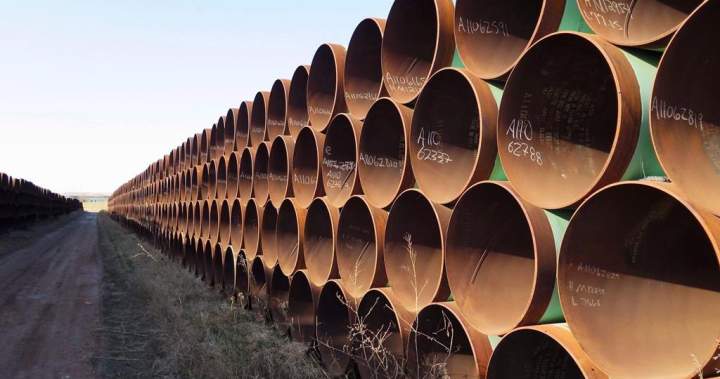
The proposal in the MOU is aimed at establishing a bitumen pipeline from Alberta to the West Coast and would carry an additional 300,000 to 400,000 barrels per day destined for Asian markets.
The MOU also notes that there could be an “appropriate adjustment to the Oil Tanker Moratorium Act,” if necessary.
The act, often referred to as a tanker “ban,” was first introduced by the federal Liberal government in 2017 and became law two years later. It prevents tankers carrying more than 12,500 metric tonnes of oil from docking on B.C.’s North Coast. The affected area stretches from the northern tip of Vancouver Island to the Alaska border, and encompasses the archipelago of Haida Gwaii.
Then-transport minister Marc Garneau, who sponsored the bill, defended it at the time by citing the “navigational hazards” of the region, which he said would make responding to an oil spill more challenging.
A potential oil spill remains a concern, especially as the groundwork is laid for this potential pipeline, with the Exxon Valdez as one such disaster on the mind of Rick Steiner.
Steiner was one of the first on scene of the disaster and has studied its aftermath closely.
“It’s a very ill-conceived proposal,” said Steiner in an interview. “It w0uld be the wrong choice by the Canadian government. No matter how safe you make a tanker terminal and an export of crude oil, which is a very hazardous chemical substance via tankers, no matter how safe you make it, there is still risk of a catastrophic grounding or collision or oil spill.”
An estimated 260,000 barrels of crude spilled into the Prince William Sound off the Alaska coast, according to the U.S. National Oceanic and Atmospheric Administration, though some groups estimated as many as 760,000 barrels spilled.
For a future bitumen pipeline to get an export facility, it would require an exemption from the tanker ban or a boundary change to allow oil tankers through the Dixon Entrance to carry oil to Asia.
In a statement, Coastal First Nations in B.C. have made it clear an exemption is not an option.
“I do understand that their trepidation as well and part of my job – what the premier has entrusted me to do – is to make sure that I’m having really authentic, open and transparent conversations,” said Alberta Minister of Indigenous Relations Rajan Sawhney.
Martineau, a member of Frog Lake First Nation within Treaty 6, says industry and Indigenous groups need to modernize their relationships, saying each may hold a differing viewpoint.
“Many in corporate Canada, I think, have a view of the stand-off First Nations person in warpaint with a sign,” she said. “First Nations often still have a view of the energy companies that might be anchored in the 80s and 90s about a Lorax-type situation.”
Sawhney said a recent meeting with Chief Kelsey Jacko of Cold Lake First Nation was “productive.”
“I had the opportunity to listen to his concerns and we had agreed that we are going to walk this path together,” Sawhney said.
As of Sunday, there has been no industry partners expressing interest in the potential project.
—with files from Global News’ Sean Boynton, Uday Rana, Drew Stremick and The Canadian Press
© 2025 Global News, a division of Corus Entertainment Inc.
Read the full article here