



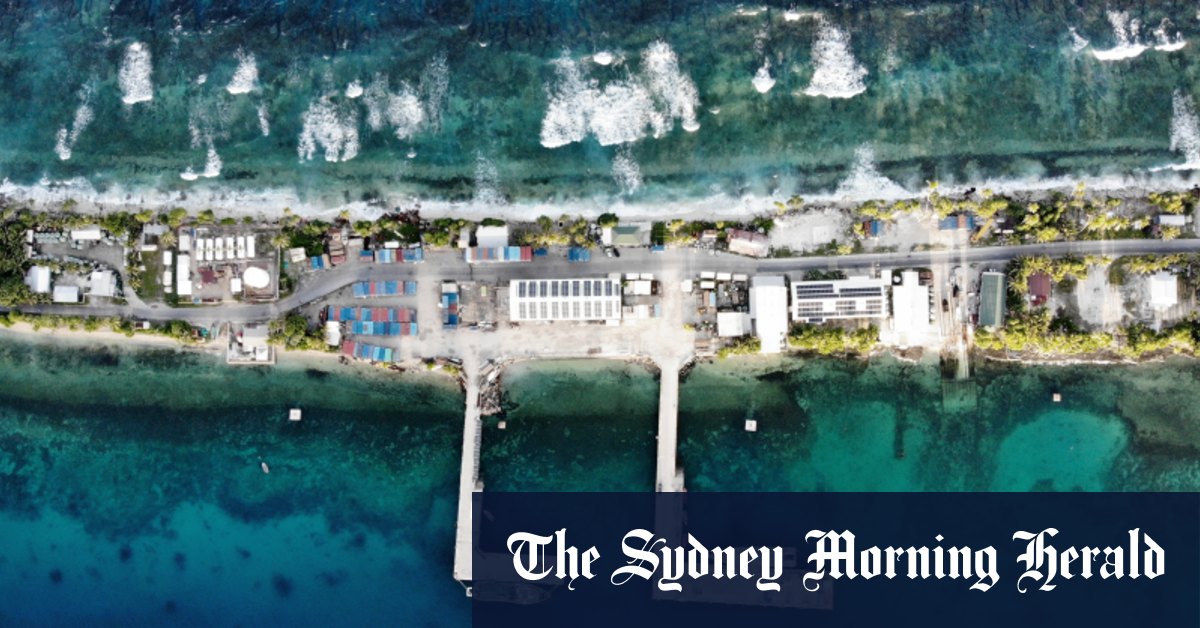
It is very disheartening to read of the effects of climate change on the tiny Pacific nation of Tuvalu (“Difficult choices as the ocean swallows Tuvalu”, May 19). But the measures being taken by our government to address this do not tackle the root cause of the problem. The nation is literally drowning as rising sea levels threaten to cover most of its land within 50 years unless drastic action is taken. Then why is Labor promoting gas as a primary energy source for decades to come in its Future Gas Strategy? The extraction and use of gas is a major contributor to global warming. Surely, a show of genuine friendship would be to phase out this heavy pollutant for export and domestic use, keeping only a small amount as a reservation fuel. Anne O’Hara, Wanniassa ACT
One solution would be for France, Australia or New Zealand to offer countries such as Tuvalu territory status. They lose political independence but remain self-governing locally and get to be represented in Paris, Canberra, or Wellington. Their citizens gain access to the larger nation which would support their efforts to manage rising sea levels and relocate people as needed. David Neilson, Araluen (NT)
Mental health needs action
The mother of a victim of the Bondi Junction attack (“Mum’s plea after Bondi Junction tragedy”, May 19) has highlighted the fact that there are an estimated 58,000 people with severe mental health needs in our society. Politicians should be taking action to remedy this shocking situation instead of arguing over the detention of illegal immigrants. But there aren’t any votes in mental health, are there? Ian Adair, Hunters Hill
Climate cost of clothing
With all the focus on energy generation, transportation and heavy industry, it’s easy to forget that clothing is responsible for 10 per cent of greenhouse gas emissions – higher than steel, cement and aluminium, and four times that of aviation (“Inside fashion’s addiction to fossil fuels”, May 19). It’s also an industry where CO2 emissions can be cut relatively easily if people can be persuaded to change their buying habits. After all, while we absolutely need the building materials mentioned above and have limited alternatives to aviation, do we really need wardrobes full of clothes and to turn those clothes over so rapidly? Surely, the answer is no. We need to buy fewer clothes and make greater use of natural fibres in the ones we do buy. That’s a quick, painless way to get emissions down. Ken Enderby, Concord
Screen time a gold mine
Changing to e-books will be a gold mine for optometrists and ophthalmologists (“Parents plump for paper ahead of digital books”, May 19). Already, those who are spending hours in front of a computer screen are suffering the consequences of dry eyes, requiring daily medication. In all probability, this will now start at an earlier age, with youngsters learning to read on their digital devices. Patricia Warren, Brunswick Heads
JayRose Garcia (L) and Sienna Thea (R) and the fun of reading.Credit: Joe Armao
The hardest change
Read the full article here