

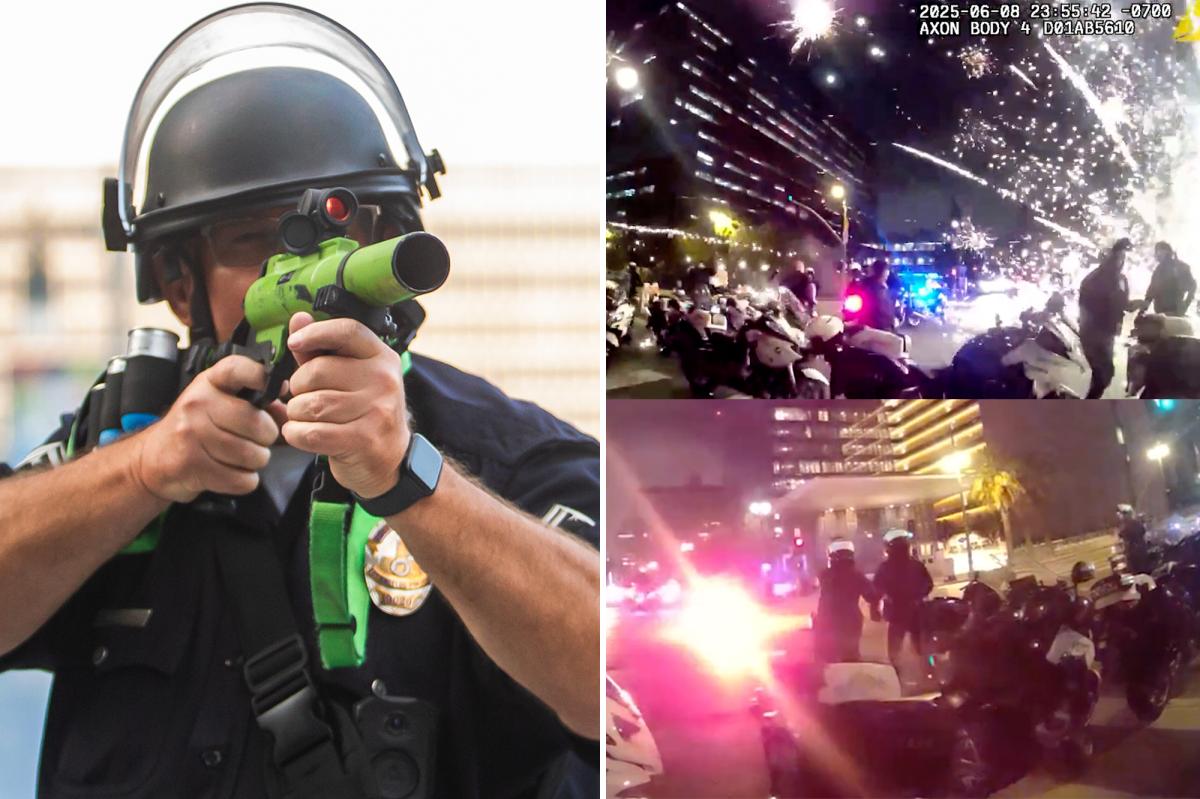
Police have been banned from using a powerful, non-lethal weapon to control protests in an extraordinary federal court decision.
Judge Consuelo B. Marshall ruled on Thursday the Los Angeles Police Department violated a standing court injunction by deploying the 40mm and 37mm projectile launchers against protesters who did not pose an immediate threat of physical harm.
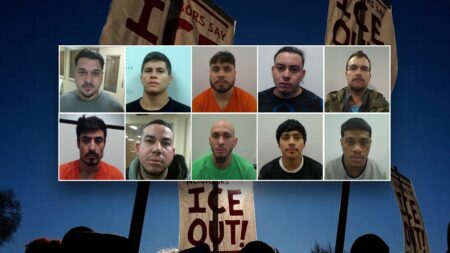
The ruling arose from protests in Los Angeles during the summer of 2025 following immigration enforcement raids carried out by the U.S Department of Homeland Security.
It comes as video, obtained by The Post, shows LAPD using the non-lethal weapons while under fire from protestors using fireworks against them. The videos were recorded during anti-Trump and anti-ICE protests in Los Angeles in June 2025.
Police believe using the projectile launchers is essential for officers facing fast-moving, unpredictable situations. They say they prevent more dangerous confrontations one-on-one confrontations, which increase danger not only to police, but to protesters and innocent bystanders during large-scale unrest.
While those demonstrators were not part of the original order, which was made after Black Lives Matter protests, the court said the incidents were relevant in determining whether the city was complying with existing federal laws.
In a sharply worded order issued by the U.S. District Court for the Central District of California, Judge Marshall found that LAPD officers fired 40mm munitions without providing required warnings and struck protesters in areas of the body explicitly prohibited under the court’s earlier injunction.
“Here, Plaintiffs provide evidence that Defendants used 40mm munitions on protestors who did not pose an immediate threat of violence of physical harm, did not provide warnings before using the munitions, and hit protestors in restricted areas of the body,” Judge Marshall wrote.
The injunction at the center of the contempt ruling dates back to May 2021, when the court imposed strict limits on LAPD’s use of so-called “less-lethal” weapons following widespread protests in Los Angeles in 2020 after the murder of George Floyd.
That order barred officers from targeting sensitive body areas, required warnings before use when feasible, and restricted deployment to situations involving immediate threats of violence.
Judge Marshall found the city failed to take all reasonable steps to comply with those requirements and rejected arguments that the violations were technical or inadvertent.
Marshall held the city in civil contempt and ordered an immediate ban on the LAPD’s use of the weapons for crowd control.
The judge cited multiple incidents involving LAPD officers’ use of the weapons against protesters and the press in 2025.
One involved an LAPD officer shooting a man filming police, which caused facial injuries that required surgery. The court also cited another incident in which a woman was shot while crouched behind a chair, on the ground, and a third time in the back.
After that shooting, the court said an attorney who asked an officer for identification was himself shot twice in the groin.
The judge also cited an incident where a man in the back of the head as he attempted to leave a protest. Another was firing at a registered nurse treating injured demonstrators and wearing a visible medical symbol.
The court also granted plaintiffs permission to seek attorneys’ fees related to the court action, but stopped short of appointing an official to oversee LAPD compliance with the ruling.
The contempt finding follows earlier judicial restrictions imposed during the same wave of immigration-related protests.
In December, Hernan D. Veran banned LAPD officers from using the weapons against journalists and nonviolent protesters, which the city appealed.
That appeal, now before the U.S Court of Appeals, challenges the scope of restrictions arising from the same protest activity cited in Judge Marshall’s contempt ruling.
City attorneys and federal officials previously argued that the restrictions were too broad and impractical, arguing journalists are not always immediately identifiable during active demonstrations.
Read the full article here