



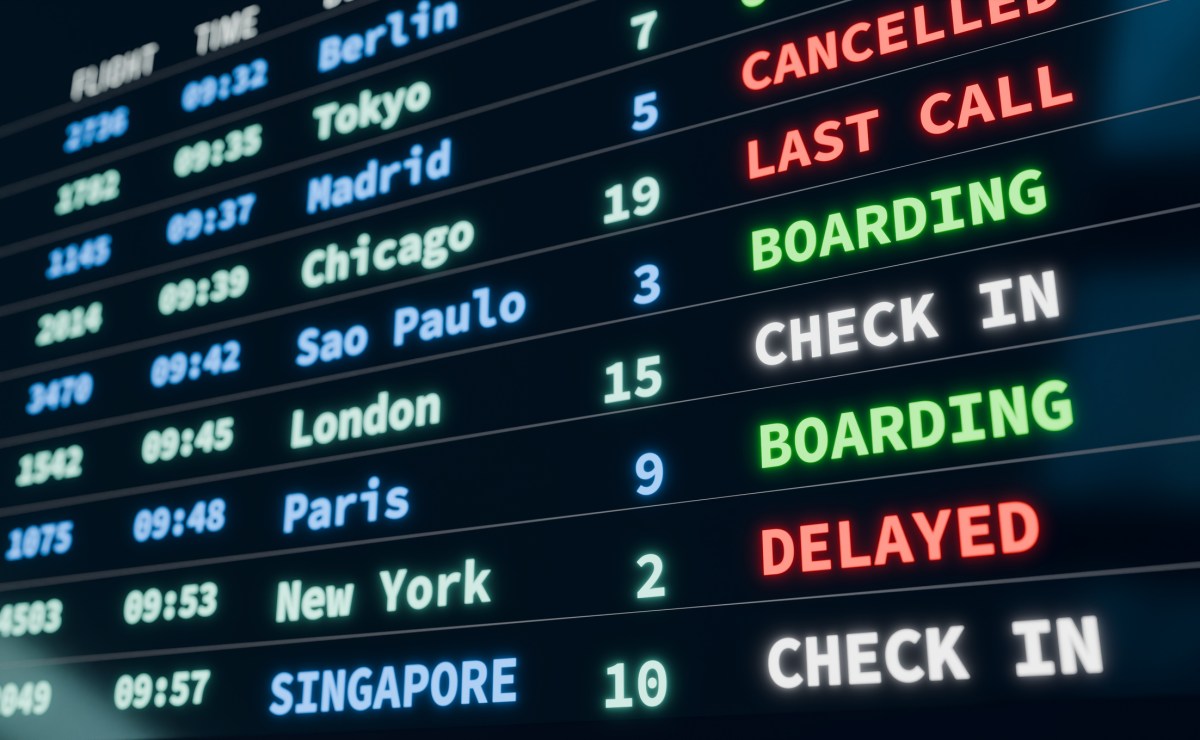
Passengers traveling through some major airports in Texas and Florida may be far more likely to experience extreme flight delays than they realize, according to a new study.
Analysis by AirAdvisor, a flight and baggage compensation service, examined flight data from January 1, 2025 through December 31, 2025, focusing on 47 U.S. airports with the highest number of flights delayed by at least three hours. The study assessed both how often long delays occurred and how severe those delays became once the three‑hour threshold was crossed.
AirAdvisor measured what it calls “LD180+” delays, defined as arrival delays of 180 minutes or more on flights departing from a given airport. The LD180+ rate represents the percentage of those severe delays out of all flights operating from that airport. The study also calculated the average long-delay time, which refers to the average number of minutes flights were delayed once they exceeded the three‑hour mark.
According to AirAdvisor, higher values indicate longer delays and a greater likelihood of significant disruptions occurring in the first place. The airports were ranked from 1 to 47, with 1 representing the worst performance. For the overall ranking, the study weighted the LD180+ rate at 70 percent and the average long delay time at 30 percent.
“From this, we now have the 10 worst airports in the US for significant flight delays,” the study said, noting “the results emphasize 180+ minute delays but also take into account the average delay time, which often has a dramatic travel impact.”
Austin‑Bergstrom International Airport in Texas emerged as the worst airport overall for significant delays, the study found. It was followed by Chicago O’Hare International Airport, Jacksonville International Airport, Southwest Florida International Airport, and Virginia’s Norfolk International Airport in the top five ranking of the worst airports for significant delays of more than three hours.
AirAdvisor also highlighted several airports where average long-delay times tend to be especially severe. “Charlotte Douglas, Austin Bergstrom, and George Bush (Houston) all have average delays of over six hours,” the study said, adding that “when significant delays happen, it can be catastrophic.”
The analysis showed that high passenger volumes can amplify the impact of delays, even when delay rates appear relatively modest.
“Airports with very high flight volumes, like Los Angeles, generate large numbers of severely delayed flights even when their delay rates are moderate (1.09 percent),” the study explained. “Smaller percentages applied to massive traffic volumes still affect thousands of passengers.”
At the same time, AirAdvisor found that airports with lower traffic levels are not immune to ranking among the worst performers.
“Airports like Southwest Florida (RSW), Norfolk (ORF), and Lambert St. Louis (STL) still appear in the top 10 despite having lower traffic volumes,” the study said.
One airport stood out for its particularly high likelihood of long delays. Florida’s Palm Beach International Airport recorded the highest rate of 180‑minute‑plus delays, according to the study. It was also identified as the worst airport in the U.S. for delays lasting 60 minutes or more.
10 U.S. Airports Most Likely to See Flight Delays
- Austin‑Bergstrom International Airport in Texas
- Chicago O’Hare International Airport in Illinois
- Jacksonville International Airport in Florida
- Southwest Florida International Airport
- Norfolk International Airport in Virginia
- Palm Beach International Airport in Florida
- St. Louis Lambert International Airport in Missouri
- Washington Dulles International Airport in Washington, D.C.
- Dallas Fort Worth International Airport in Texas
- Philadelphia International Airport in Pennsylvania
Source: A study by AirAdvisor, which analyzed flight data from January 1, 2025, through December 31, 2025, focusing on 47 U.S. airports with the highest number of flights delayed by at least three hours.
Do you have a travel-related story to share? Let us know via life@newsweek.com, and your story could be featured on Newsweek.
Read the full article here