




Among all the depressing news this weekend, there was one ray of sunshine – the US public has finally awoken from its Trump-induced coma and is taking to the streets (“Millions of Americans rally against Trump”, March 29). Hopefully, this will lead them to the polls for the November mid-term elections to commence the exorcism of this evil administration. It will take many years, but my hope is that the US will return to a true democracy with all its institutions rehabilitated and re-empowered. I also hope Trump will be called to account for his appalling conduct in and out of office and that a jail cell awaits. My other hope is that in a post-US based world order, Australia becomes a more resilient and independent country, able to forge its own path and international relationships, no longer meekly following in the US’s shadow, especially into war. Rowan Godwin, Rozelle
Your columnist Bruce Wolfe charges Donald Trump with having “invented a radical opposite to the fog of war: the fog of peace”, with his rambling and contradictory claims about the progress of the Iran war (“In his fog of peace, Trump’s lost sight of truth. That means more war,” March 28). Given his narcissistic nature, Trump might well be pleased to be credited with such an invention and perhaps he might even feel he deserves a Nobel Prize for it. But he’s long been beaten to the punch by his co-adventurer in Iran, Benjamin Netanyahu, a consummate conjurer in the craft of dissimulation who makes Trump look like a novice. Netanyahu’s skill in this dark art has deflected attention away from Israel’s continued killings in Gaza and the withholding of humanitarian aid in defiance of the so-called ceasefire there. He has also managed to keep out of view the increasingly common assaults by rogue settlers on Palestinians in the West Bank. To paraphrase Wolpe’s conclusion, the fog of peace means relentless war. Tom Knowles, Parkville (Vic)
“Trump Derangement Syndrome” is alive and well in the Herald’s letters pages. You’d be forgiven for thinking that Trump is the most hated man on the planet, such is the disdain for him expressed daily by regular correspondents. It makes me wonder how many of the Trump-haters are actually hoping that the Iranian regime wins this war so they can have the satisfaction of celebrating a Trump defeat. Obviously, this matters more to some people than the Iranian people being freed from the oppression of their tyrannical government. No interest at all in Iranian women getting the opportunity to live fulfilling lives and to embrace the benefits of education and a career. The supposed concern for human rights is obviously a selective one. Evan Parsons, Thornleigh

So it’s come to this. I’m hearing two differing versions of the same story, one from the leader of Iran, supposedly a despot, and another from the American president, supposedly the leader of the free world. For some strange reason, I’m tending to believe the Iranian leader’s version. Terry Thelwell, North Ryde
US not innocent
”If I have to choose between the United States, Israel and Iran, I’m going to choose democracies rather than a murderous regime which has ambitions to build a nuclear weapon and potentially use it against Israel and the US and allies,” says Liberal MP Andrew Hastie. He clearly needs to bone up on his history. Which country dropped two atomic bombs on Japan, after Japan had agreed to surrender? (Hint: it wasn’t Iran.) The US isn’t yet as murderous a regime as Iran, but ICE’s deliberate killing of two US citizens and its detention of thousands more is certainly taking it down that slippery slope. Does Hastie have anything to say about that? David Gordon, Cranebrook
The Liberal Party via Andrew Hastie now recognises that Australians may be losing faith in the alliance with the US. It’s great to see the party getting up with the times and articulating what most Australians have known since the 1970s after the debacle of Vietnam. And the Liberals wonder why they are fast becoming a fringe political party. Philip Dowle, Wickham
Off-road diesel
David Fickling’s opinion piece on diesel fails to state one of the most basic facts of the supposed “diesel rebate” that mining companies get (“Fuelled by subsidised diesel, Australia is running dry”, March 28). Heavy vehicles pay a “road user charge” tax on fuel use. It’s a cost that is meant to be a proxy for road use and road wear. Mining companies and others like farmers get this tax rebated because they are not driving their vehicles on public roads. It’s also not a subsidy – they are paying for the fuel, just not the extra tax charged by the government for road use. Facts matter. Ash Roth, Sydney
David Fickling succinctly summarises the mess Australia has created by its over-dependence on diesel. With the craven government throwing buckets of taxpayers’ money at diesel users, why is anything likely to change? Our governments have been too timid to tell them that better, less polluting options are available, let alone remove the apron strings of subsidies that keep them from bothering to look at other options. The diesel users will keep on doing what they are doing until we finally get a government with the spine to tell them things have to change. But judging by governments’ unwillingness to upset the industry – even taxing the rampant gas industry is a bridge to far – nothing is likely to change. Author Donald Horne was being far too generous when he wrote: “Australia is a lucky country run mainly by second-rate people who share its luck.” Ross Hudson, Mount Martha (Vic)
When the Sydney markets were moved to Flemington in 1975, electrified railway sidings allowed fresh produce to be delivered into the complex using electric locomotives. Today, the overhead wiring is long gone and the sidings have been lifted, leaving Sydney entirely dependent on road freight for fresh food, a system that depends on oil produced in the Middle East. Even when using diesel locomotives, rail transport is three to four times more fuel-efficient than trucking, yet road transport now dominates freight haulage. The Iran war has put the supply of diesel at risk, which shows the folly of our complete dependence on road transport for Sydney’s food supply and the abandonment of electric railway freight. The National Heavy Vehicle Regulator says electric trucks will not be available in numbers for years, so don’t count on that for relief. The only sustainable alternative to diesel-fuelled road freight is electric rail freight but that has been abandoned in NSW and the electric locomotive fleet has been cut up for scrap because it was supposedly “inefficient”. Stephen Bathgate, West Pennant Hills
Bright sparks
Someone should remind Angus Taylor, Matt Canavan and Bridget McKenzie who actually pays their salaries of about $1 million a year combined. On Friday, while the rest of Australia’s millions of workers were busy teaching, nursing, building and doing a whole host of other productive jobs, these Coalition bright sparks thought it was acceptable to spend their day travelling to a petrol station to fill up a car in front of the television cameras and then each do interviews, parroting the same lines while waffling on about the government’s so-called failure to deal with the fuel crisis. Phil Peak, Dubbo
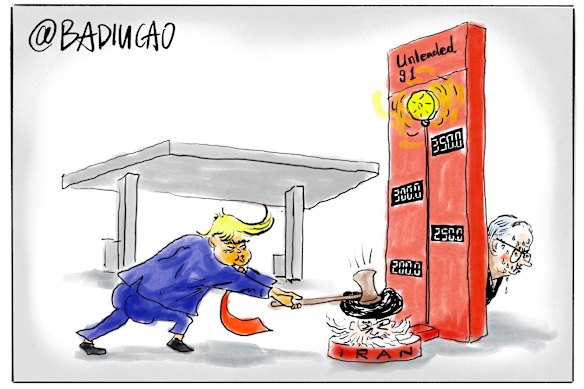
So the Coalition’s solution to the fuel crisis is to significantly wind back federal support for electric vehicles and solar batteries. Yes sir, that’s clearly a government in waiting … for quite a long time. Barry Ffrench, Cronulla
Call for maturity
The solution to the predicament described by Peter Hartcher is simple (“The times suit Hanson, not Albo”, March 28). We can either behave like adults and vote for politicians with credible policies, or we can behave like small children, throw the toys out of the cot and vote for One Nation. If we need any further example of how badly the latter option pans out, look at America. Phil Bradshaw, Naremburn
Help, don’t harm
As the cost of living rockets, it’s challenging for Australians to be reminded that we could and should be giving more to our neighbours (“We’re stingy on this global ranking”’, March 28). Matt Wade draws a comparison between our spending as a nation on alms, and arms, and sets out pragmatic reasons to increase the former. Over and above any self-interest, our foreign aid is based on an old-fashioned but still relevant principle of contributing to not only the survival, but also the dignity and justice for those who pay the price for the economic privilege that we enjoy. Philip Cooney, Wentworth Falls
Matt Wade reminds us that we need to rebuild Australia’s overseas aid program. He points out that aid isn’t charity but a smart strategic investment demonstrating our commitment in helping to strengthen communities in neighbouring countries, which in turn would help prevent problems that might threaten Australia. Josephine Piper, Miranda
Matt Wade puts forward a strong case for foreign aid. He is right to highlight the role Australia should play, particularly as other donors reduce their commitments. There is, however, a good news story for developing countries in the form of something called “impact investing”. This allows people and foundations to contribute to businesses and projects that aim to generate both financial returns and measurable social or economic benefits, for example affordable housing, sustainable agriculture, renewable energy and micro-financing. Impact investment funds have grown to $US1.6 trillion, a 16-fold increase in just seven years and seven times global foreign aid. Clay O’Brien, Mosman
No accountability
Originally, the NACC (National Anti-Corruption Commission) was produced to create the impression it would root out corruption at the highest levels (“Secret identities revealed, Morrison cleared of corruption in robo-debt investigation”, March 29). Something important was being done, we were told. We would hear that corruption at the political level would be exposed and acted upon. Public outrage about Scott Morrison and his government needed to be addressed, we were told. But what we’ve got is no politicians being exposed and, importantly, none made accountable. Nil consequences for them, nil consequences for robo-debt. Because of the way the NACC is regulated, the body has failed, in the largest case of political and bureaucratic malfeasance, to hold politicians to account. Bob Konig, Shell Cove
Vital trackwork
A letter from Marie Belcredi to the Herald last week asked “do those managing Transport for NSW truly appreciate the scale of disruption these repeated outages are causing?” (Letters, March 24). Perhaps Ms Belcredi doesn’t know this, but the reason we have trackwork of the frequency and intensity that we do is a direct result of the shortcomings that led to the 1977 Granville train disaster, in which a commuter train derailed and crashed into a bridge, which collapsed onto two carriages killing 83 people and injuring 213. The Dictionary of Sydney notes that a government investigation launched under judge James Staunton found a combination of poor trackwork, supervision and maintenance had contributed to the accident. Justice Staunton said “derailment of some vehicles was almost inevitable so long as the poor condition of the track remained uncorrected”. As a result, the NSW government announced a $200 million track upgrade project, and heavy emphasis has been placed on safety ever since. Perhaps those who are so quick to criticise Transport for NSW might like to suggest alternative times and dates for trackwork to take place? No matter what they suggest, some sections of the community will be always be inconvenienced. But surely that is a small price to pay if it prevents another train wreck of Granville proportions. Gary Glover, North Willoughby
Outlaw lies
It is an open secret that fossil fuel corporations have poured large amounts of money into campaigns against climate science, climate scientists and renewable energy. We see the results of their efforts coming from think tanks, media outlets and politicians, yet we are seemingly powerless to stop organisations intentionally telling lies to the Australian public. If I made false claims in an advertisement for a product, I would suffer the consequences of the law, but lying about something as important as having liveable planet goes unpunished. Political advertising laws must require the content to be true. Lying cannot be protected as “free speech”. Graeme Finn, Campsie
Loose change
In his article (“Interest-free ice-blocks: How a five-year-old beat the big banks”, March 28), Richard Glover asks, “Is there any moment sweeter than finding a $20 note in an old pair of jeans?” Yes Richard, there used to be anyway. It was finding a $20 note blowing gently down the footpath, or on a shop floor, or lying by the bar unobserved by the inebriates. Maybe the “moolah” was hiding behind grandma’s lounge cushion, or wedged down the front seat of a car. When cash was king we always kept our eyes peeled to the ground, and it often paid dividends. Purses or wallets were, of course, handed in, but loose paper money and coins spotted on the commons was fair game. What larks. Today’s sad reality is that there’s no such thing as loose change on the interweb. Phil Haberland, Claremont (WA)
Sorry to laugh
It’s hard to maintain a sense of humour these days, so I must thank Kyle Sandilands. Launching a legal fight to retain his $100 million radio gig because he has “a family and mortgages to pay” gave me a laugh-out-loud moment on a very dreary day. Perhaps he could downsize to just one mortgage and one car (“Sandilands kicks off court battle over his $100m contract”, March 28)? Caroline Davies, Annandale
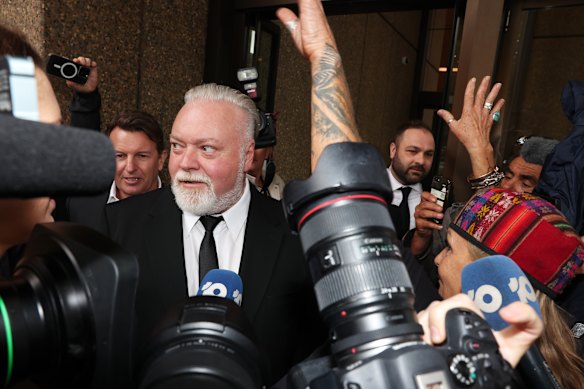
Oh, cry me a river! Kyle Sandilands tells reporters that he faces the same problems as everyone else, including “mortgages” to pay. On a wage of $10 million a year? Sure, Kyle … we can all empathise. Toni Lorentzen, Fennell Bay
Tiger’s mighty drive
I’d have thought Tiger Woods would have been better at driving than that (“Tiger Woods arrested on suspicion of DUI after crash”, March 28). Bill Gillis, Hallidays Point
- To submit a letter to the Sydney Morning Herald, email letters@smh.com.au. Click here for tips on how to submit letters.
- The Opinion newsletter is a weekly wrap of views that will challenge, champion and inform. Sign up here.
Read the full article here