




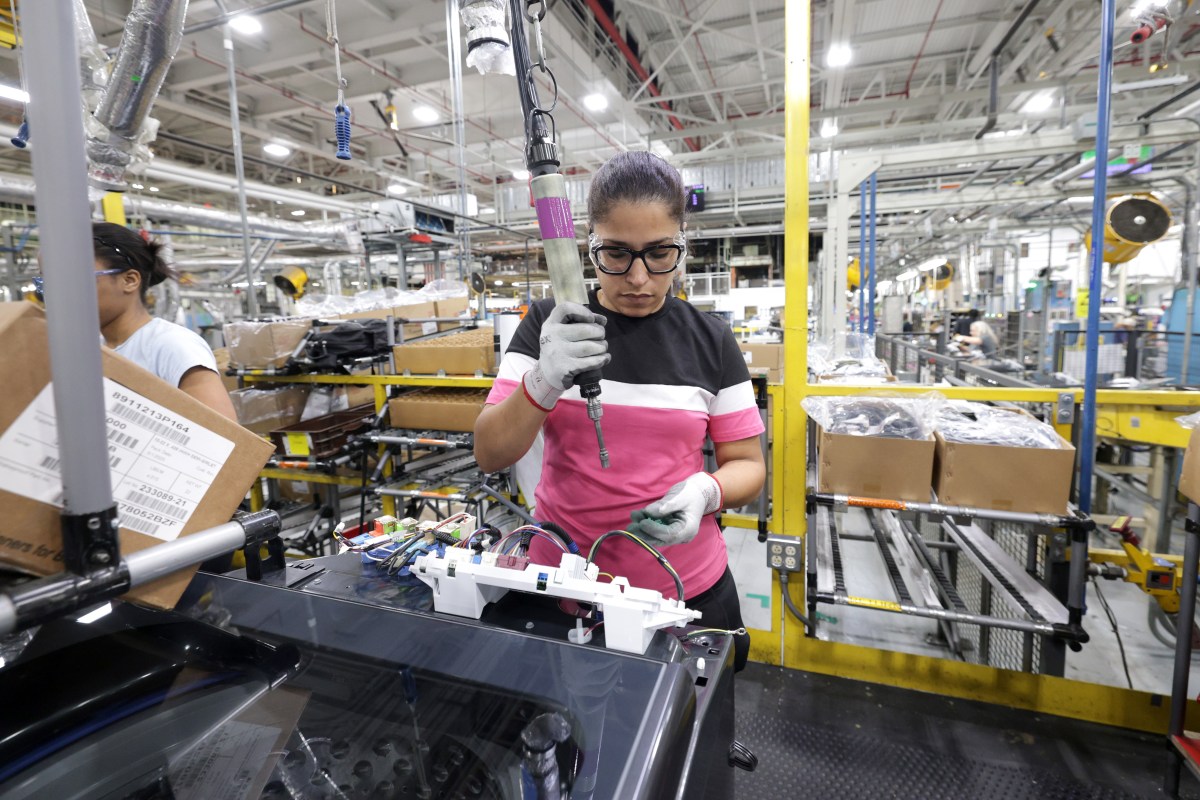
A report has warned that millions of blue collar jobs are highly “vulnerable” to automation, adding to prevalent fears that the development of robotics and artificial intelligence will usher in a major shakeup for the U.S. labor market.
According to new research from Oxford Economics, despite being “a significant driver of productivity growth in the coming decades,” robotics and automation will cause disruptions spanning the workforce.
“Across the U.S. economy, approximately 20 percent of jobs are ranked as having a ‘high’ vulnerability,” the author writes, “meaning that the technology that replaces most or all the functions of the occupation already exists and is commercially available.”
Why It Matters
Numerous reports have issued similar such warnings about the impact of automation, as well as AI, on the U.S. workforce over the next few decades. And last year, several companies cited their adoption of AI—and the resulting need for fewer workers—when announcing mass layoff decisions.
Many of these discussions have centered around the forecast effects on white collar employment, particularly in the tech space, but as the new “sobering” research from Oxford Economics highlights, the effects may be at least as pronounced for America’s blue collar workers.
What To Know
In the report, entitled, “Robotics and Productivity—the Incremental Revolution,” Oxford Economics noted that automation across several sectors is already “well underway,” but said that the impacts on employment are likely to be concentrated in a few areas over the next two decades.
“These jobs are not evenly distributed across the economy; they are, in fact, concentrated in a number of sectors where they make up an extraordinarily high amount of the workforce,” the report read.
Drawing on Labor Department data and analysis of over 800 occupations, Oxford Economics assessed each by their susceptibility to replacement by robotics or automating technologies, considering both the nature of the role and whether tech capable of carrying out its tasks already exists.
Around 60 percent of jobs in transportation & logistics are considered at “high vulnerability” to at least partial robotic replacement. Others include manufacturing, accommodation & catering, retail, wholesale and trade & extraction.
Nico Palesch, senior economist at Oxford Economics and author of the report, told Newsweek that the impact of automation on these professions has “flown a bit more under the radar” than the headline-grabbing effects of AI on the tech space.
While obviously disruptive to these professions, he added that the prospect of robots being able to carry out more “human” roles “also heralds a significant opportunity for productivity increases, i.e. getting more output with less inputs, in these sectors.”
“Given economic growth is fundamentally driven by productivity (especially at a time of slowing population growth and a political turn against immigration) this is quite significant,” he said.
And his report notes that the assessments for labor market impacts are not predictions, and that “incremental” shifts in the employment outlook are more likely than one “big bang.”
“High sectoral vulnerability should…not be interpreted as predicting an imminent jobs collapse or productivity boom,” the report read. “The existence of technology, even the commercial availability, is not on its own enough to immediately transform how a sector produces its output.”
What People Are Saying
Oxford Economics senior economist Nico Palesch wrote: “Like most technologies—even big revolutionary ones—we expect that the adoption of robotics and automation will be a gradual, continuous, and incremental process. Rather than a big bang, we expect that adoption will first emerge in the sectors where there is greatest potential…in the places where it is most obvious, viable, and cost-effective. Over time, adoption in that sector will deepen as technology becomes cheaper and better, and simultaneously, implementation will broaden to other sectors as those same improvements to the technology and cost make other not so immediately obvious use cases viable.”
What Happens Next
Palesch told Newsweek that there will be certain industries and professions in which “cohabitation” with new technologies is possible—i.e., introduced alongside human employees—and that for jobs that are more abruptly replaced, this process will also create some employment opportunities.
“With the rise of these new technologies, new roles and careers will also spring up—technical roles related to the design and manufacture of robots, maintenance and repair, physical management of fleets, that kind of thing, which is its own kind of adaptation,” he said.
Read the full article here