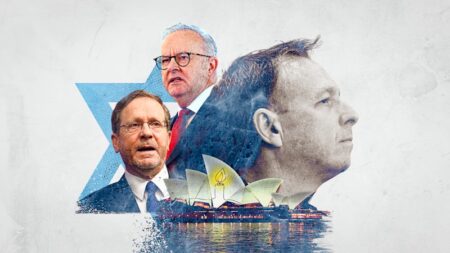



The NSW government has invoked special powers related to major events ahead of Israeli President Isaac Herzog’s visit to Australia next week, giving police additional powers to separate and move on crowds across the city.
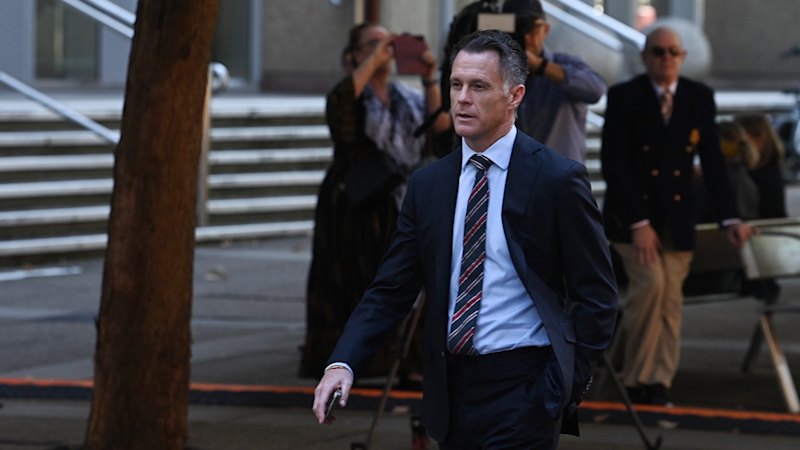
Premier Chris Minns called for calm on Saturday and said it was “really important that there’s no clashes or violence on the streets of Sydney”.
“We can disagree without it resorting to clashes or violence … In fact, that would be devastating for everybody, regardless of your cause,” Minns said at a press conference in Sydney.
“We reiterate our call that if you don’t need to be Sydney’s CBD on Monday afternoon, unless it’s absolutely essential, we ask that you not stick around in that area.”
The government said it had declared the visit to be a major event under the state’s Major Events Act.
The legislation may be invoked in a range of cases, including for the management of crowds during the Vivid Sydney festival.
The declaration comes as pro-Palestine activists prepare for a nationwide day of protests on Monday against Herzog, who was invited by Prime Minister Anthony Albanese to visit Australia after the Bondi terror attack in December.
Minns said there would be a “massive policing presence on Monday afternoon” and police would have the power to “move somebody on if they’re acting in a disorderly way during this presidential visit”.
The declaration covering the presidential visit was made by Tourism Minister Stephen Kamper on Friday. The powers extend from Monday to Thursday and cover a “major event area” across Sydney’s CBD and eastern suburbs.
“This is an important visit for our country, and it matters deeply to the Jewish community of NSW as they continue to mourn and recover from the horrific terrorist attack on 14 December,” Minns said in a statement.
“[We] cannot allow a situation where mourners and protesters come into close contact on city streets without strong police presence.”
Police Minister Yasmin Catley said that “we lost 15 people at the end of last year in the worst terrorist event that this country has ever seen”.
“The Israeli president is coming over here to mourn with our Australian Jewish community,” she said.
“We believe that that is the right thing for them to do, and I really plead with the people of NSW to also join with that community and respect their grieving period.”
The area covered by the major event declaration was placed under an additional 14-day protest ban by NSW Police Commissioner Mal Lanyon last week.
Under those arrangements, police may blanket-refuse all applications for protest marches within the area.
Lanyon said he was aware the Palestine Action Group was proposing a rally from Town Hall through the Sydney CBD, in an area unauthorised for a march. He said police had offered to facilitate a march from Hyde Park north through to the south of Sydney.
“We are very keen to ensure a safe and responsible protest,” he said.
“We are less than two months from what is the most significant terrorist incident in NSW targeting Jewish Australians. It’s important that we allow [the Israeli president] … to meet with his community to mourn and to support.”
Lanyon said the declaration gave police greater powers to “give directions to people to move out of an area, restricting people from coming to an area, restricting vehicles and people, and the ability to search people”.
“We don’t intend to use those powers largely unless we need to. They’re an adjunct to the public assembly restriction declaration … [and] the legislation we already have as police.”
The government said the additional powers would allow police to “maintain separation between different groups, and reduce the risk of confrontation in busy parts of the city”.
“These arrangements are not a ban on protests or marches. People retain the right to express their views lawfully,” it said in a statement.
“However, the government is clear that we cannot allow a situation where mourners, visitors and protesters are brought into close proximity in a way that risks conflict, violence or public disorder.”
Under the legislation, police may “limit the number of persons who may enter a major event area”, or any part of it, and prohibit “categories of persons from entering, or limit categories of persons who may enter” the area.
“Anyone who fails to comply with lawful police directions may face penalties, including fines of up to $5,500 or exclusion from the major event area,” the government said.
From our partners
Read the full article here