


“Thus far, investigators have identified $508,051 deposited into accounts opened in the name of Ms Hachem,” a police fact sheet reads.
“Investigators have identified the source of almost all of these funds as coming from scams.
“Victims have been identified in multiple states across Australia.”
Deposits were in the tens of thousands, $30,000 from one woman, $96,000 from another, $59,800 from one man, $50,000 from another.
Some of the stolen fortune was converted into cryptocurrency using Hachem’s accounts and transferred to Pakistan, specifically to Cheema’s brother, Bilal, police claim.
Hachem was not the only mule in Cheema’s web.
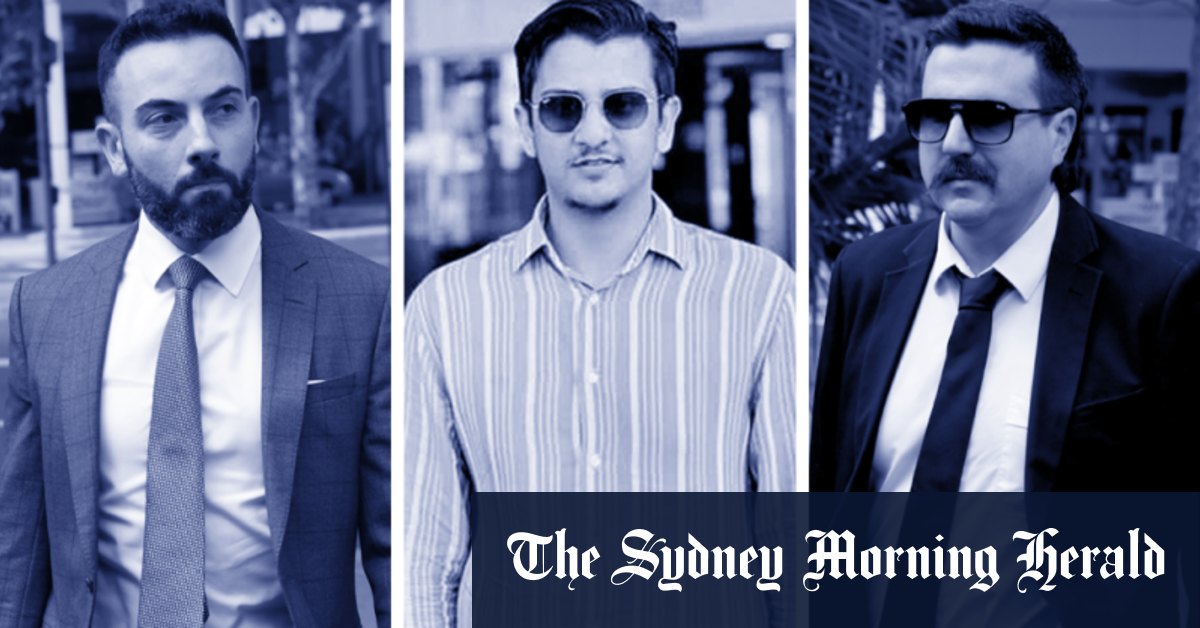
Alleged fraud mules Soukiana Hachem, Bilal Cheema (top right) and Abdul Kasbati (bottom right) are all wanted by NSW Police over the fraud syndicate.Credit: NSW Police
Abdul Ahad Kasbati left Australia in April 2022, which was unfortunate timing because bank accounts in his name were about to fill up.
Kasbati’s bank accounts received $162,299 between July and November 2022. Almost $75,000 of that was later traced to elderly victims in Victoria, Queensland and Western Australia.
From October 2022 the money was being withdrawn and $94,749 went straight into Cheema’s own bank accounts, police said.
Loading
It was an identical modus operandi to Hachem.
NSW Police told this masthead they had issued arrest warrants for the 34-year-old Hachem, 31-year-old Kasbati and Bilal Cheema, 35. All are believed to be overseas.
Cheema had lived modestly when he arrived in Australia. At first, his own bank accounts only received living expenses and wages.
But, in just four days in early 2021, almost $65,000 was deposited into his account and then quickly disappeared to Pakistan through money remitters.
That year he also committed multiple COVID disaster payment frauds and received more than $10,000.
Tens of thousands were flowing in and out of his accounts from unknown sources.
Police detected 49 deposits totaling $125,285 by November 2021, but Cheema’s recorded income that year was just $916, he told the Australian Tax Office.
More than $17,000 landed in his account from random ATMs around Sydney’s west in just one day in November. Police called it an “egregious” sign of fraud.
By late 2022, Cheema appeared to be pulling in far more and he used Kasbati’s identity to rent a house in Villawood. In January last year, he bought a Mercedes-Benz C200.
He paid for the $51,000 car using cryptocurrency. Some of his bank accounts had been shut down, others received regular injections from mules that had been broken up to avoid any red flags.
But Cheema had failed to put enough distance between him and the stolen money and Campsie detectives began digging into a web of bank accounts.
“Investigators have analysed these accounts and note that the accused regularly receives multiple large cash deposits into ATMs,” police wrote.
“It’s not uncommon for the accused to receive over $10,000 in a day, with transactions broken up into smaller amounts in an attempt to evade reporting requirements to AUSTRAC.”
Cheema was wiring much of the money overseas, tens of thousands of dollars a day, which has never been recovered.
By early 2023 police were circling. Multiple victims had complained their computers had been taken over or they had been tricked into sending massive sums to random accounts.
Detectives and riot squad officers forced entry into Cheema’s home in April 2023.
He refused to explain where his money was coming from, but enough evidence was found in his fraudulently obtained rental to tie him to the criminal network.
Investigators found Hachem’s Emirates plane ticket had been bought just a few kilometres from Cheema’s family home in Gurjanwala, Pakistan.
He admitted he didn’t work and lived off funds collected by others. Ultimately, Cheema pleaded guilty to dealing with the proceeds of crime and fraud.
His lawyer Nick Hanna successfully argued it was not clear Cheema was a major player or director of the syndicate – a charge of directing a criminal group was dropped.
The banks covered some of the stolen money for a handful of victims and, when he was sentenced, Cheema was ordered to repay some victims more than $210,000, though he officially has no money and few assets aside from the repossessed Mercedes.
Cheema was sentenced in April to 24 months in prison, but he is to be released in July 2024 after spending 15 months in prison.
He is not a citizen, and will be deported back to Pakistan, the court heard, the suspected home of the syndicate and likely destination for the stolen funds.
Start the day with a summary of the day’s most important and interesting stories, analysis and insights. Sign up for our Morning Edition newsletter.
Read the full article here