



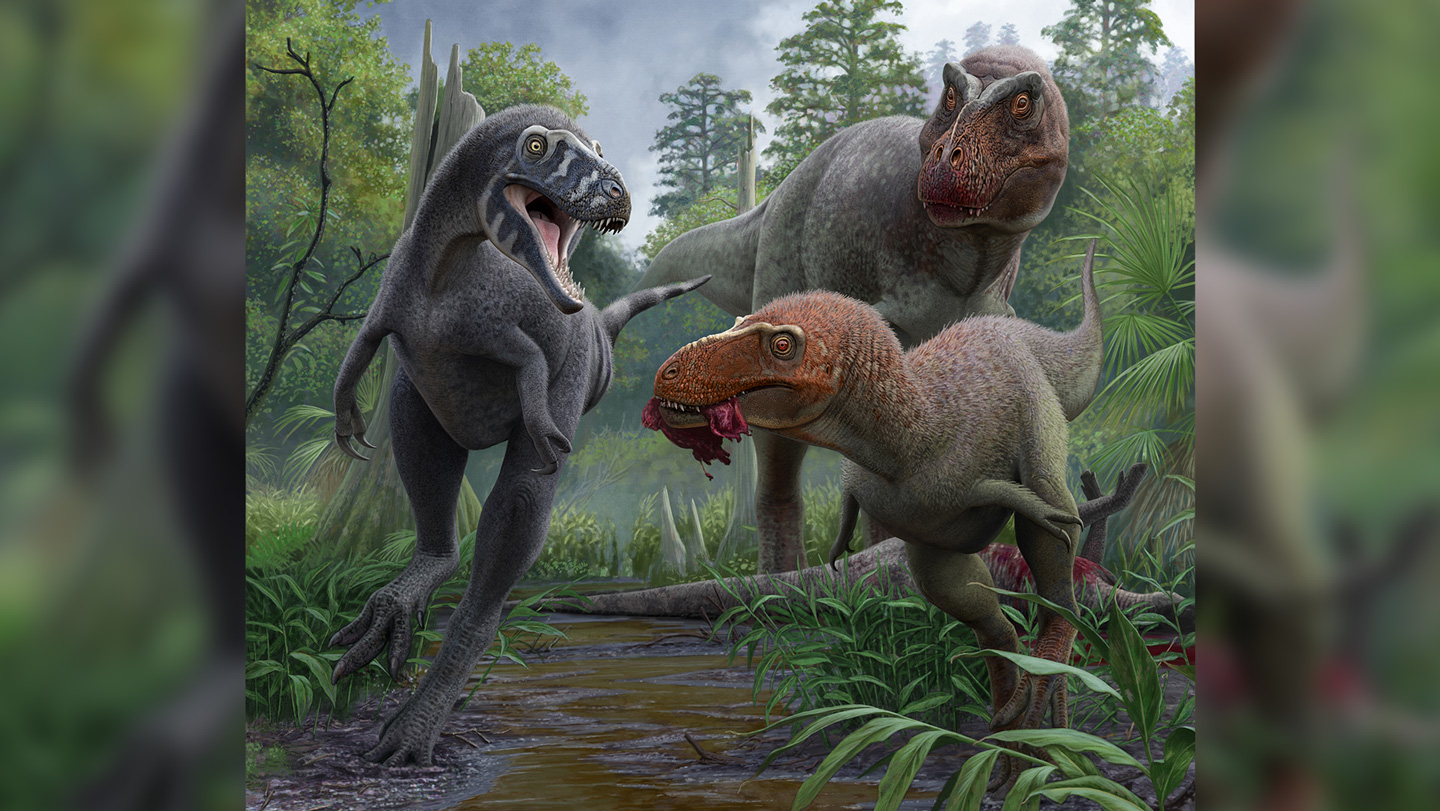
Let the record show: In 2025, one of paleontology’s oldest debates was settled. A second study in as many months confirms — using an independent and novel analysis — that the the tiny tyrannosaur Nanotyrannus is indeed its own species and not a young T. rex.
A mysterious fossil skull of a small, sharp-toothed dinosaur, unearthed in the 1940s, is at the heart of the controversy. Researchers have debated for decades what kind of dinosaur the skull belonged to. Until this year, the consensus was that it was a teenage T. rex, but some researchers argued it was a separate species, a type of miniature tyrannosaur dubbed Nanotyrannus.
In the new study, paleontologist Christopher Griffin and colleagues took a fresh look at that skull. Griffin specializes in bone histology, the study of growth rings to assess age, and he wondered if the technique could be used on a fossil with no limbs. The skull did have a hyoid, a group of throat bones with a simple tubelike structure akin to limb bones. The team examined thin cross-sections of the hyoid under a microscope, analyzing its growth pattern.
“We thought we would find it’s immature, juvenile,” says Griffin, of Princeton University. At the time, the T. rex hypothesis was prevailing, he says, and as “I’m not a Tyrannosaur expert, I was just taking everybody at their word.”
To the team’s surprise, the hyoid analysis not only worked but also showed that this animal was all grown up, the researchers report December 4 in Science.
“My initial reaction was, ‘We’re going to have to do a lot more work on this,’” Griffin says.
Hyoids in reptiles, including birds, are part of their feeding apparatus (in mammals, the hyoid also plays a role in complex speech). To test the accuracy of hyoid age analysis in reptiles, the team studied hyoid cross-sections from living dinosaur relatives such as caimans, alligators and ostriches, as well as fossils of T. rex, Allosaurus and other dinosaurs.
The hyoid-estimated ages were in line with other estimates of maturity, such as limb bone histology.
As for the skull that started it all — it belonged to a fully grown Nanotyrannus lancensis.
That’s the same conclusion another team reached independently last month, reporting that a tiny tyrannosaur in another fossil was also no young T. rex, but a mature N. lancensis.
“We converged on the same ultimate conclusion,” Griffin says, “using two very different lines of evidence.”
Read the full article here