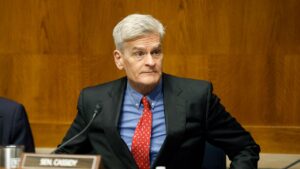


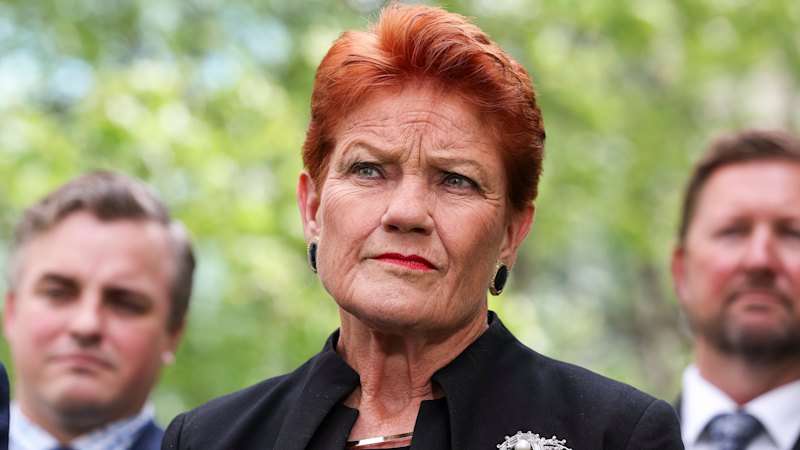
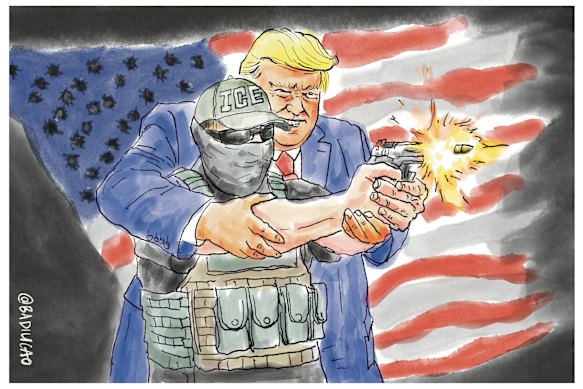
It appears that Greg Moriarty is eminently qualified to be Australia’s next ambassador to the United States (“Defence Secretary, former Turnbull aide to become next Australian ambassador to US” January 25). One would expect that Mr Moriarty, in normal times, would be able to keep the relationship with our long-term ally on an even keel. But these are not normal times. A once-great democracy is crumbling before our eyes. An armed paramilitary force, ICE, is terrorising US citizens and executing some of them. Martial law may be declared in the next few months. It is possible that the 2026 half-term election and/or the 2028 presidential election will not be held because of a perceived insurrection. An armed coup cannot be ruled out. As Mr Moriarty gets his feet under his new desk, Australia should be reconsidering the defence policies that have for the past 80 years relied on a rock-solid relationship with a global superpower that shared our democratic values. That US no longer exists. Mike Reddy, Vincentia
President Trump has chosen to put down the efforts of his allied troops in Afghanistan in a most insulting way (“Australian veterans wounded by Trump’s war claims”, January 25). To say that they “stayed a little back” is a lie. Does Trump think that all the allied troops killed were simply in the wrong place at the wrong time and not engaged in frontline combat? Does he care about truth or the fatalities of people from other nations? Hillary Clinton was talking about Trump’s supporters when she used the term “deplorables”. In fact, the term applies well to Trump himself. His insults, lies and refusal to acknowledge the efforts of many thousands of troops over the 20 years of the Afghanistan war truly is deplorable. Meg Mangan, Tamworth
Trump’s comments on the allied contribution to the war in Afghanistan are appalling. Coming from a draft-dodger and a country who entered both world wars late when victory was in sight, I guess it is only to be expected. Genevieve Milton, Dulwich Hill
It was Oscar Wilde who observed, quite presciently over a century ago, that America was the only country to have gone from barbarism to decadence without experiencing civilisation in the intervening period. More pertinent today than ever before, I suggest. Prue Sheldrick, Peppermint Grove (WA)
Coalition comedies
How refreshing to read Malcolm Turnbull’s account of the self-induced catastrophe created by the former federal coalition in the wake of the Bondi tragedy (“Partisan politics after Bondi sowed seeds of Coalition’s demise”, January 24). They are now in a well-deserved mess, having shamelessly politicised the event rather than co-operated with the government to ease tensions and offer constructive solutions. The leaders of both coalition parties have shown anything but leadership and deserve condemnation for their role in dividing the community. Thank you, Mr Turnbull, for stating what should have occurred. What a pity you didn’t show this kind of leadership when you were in a position to do so. Max Redmayne, Drummoyne
Coalitions should form government, not opposition. The federal Liberal Party must take this split from the Nationals as an opportunity to regroup, establish sensible policies and continue to hold the government to account (“Inside the Coalition split: From attack to collapse in 48 hours”, January 24). The next year will be difficult economically. We need an opposition to focus on the economy, not on themselves. So there is no requirement for a change in leadership, rather a concerted effort on forming policies adhering to the philosophy of the Liberal Party, smaller government and rewarding individual endeavours with lower taxes. After the election, should there be a significant shift away from the Labor government, then the parties should look to form a coalition government, as occurs in many other countries. Dennis Bluth, Cammeray
Reasons for rise
Karen Middleton argues that voters are shifting to One Nation because they feel unsettled by what she describes as permanent economic and social insecurity, particularly housing, energy and cost-of-living pressures (“Coalition crumbled, not by opposing One Nation, but by aping it”, January 24). I beg to differ. Voters are not naive. Few seriously believe that Pauline Hanson or her party have the depth of talent or policy capacity to manage a modern economy or resolve complex structural problems such as housing supply or energy costs. The recent surge in support for One Nation is better explained by Hanson’s long-standing criticism of Muslim migration and concerns about assimilation – matters many Australians feel have been ignored or minimised by the major parties. That sentiment sharpened after the Bondi Beach massacre and what many perceived as the prime minister’s initial reluctance to acknowledge Islamic extremism as a growing problem. Only after the Liberals and Nationals began speaking more plainly about a long-avoided matter did Anthony Albanese finally acknowledge it, despite the political risks in inner-city electorates. Hanson will not be a saviour on housing or living costs, but she has undeniably forced a national conversation on migration and social cohesion. John Kempler, Rose Bay
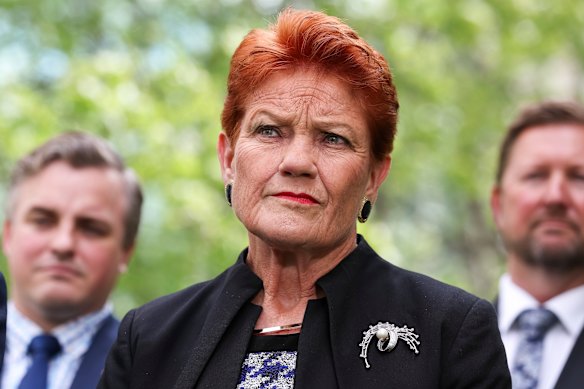
Karen Middleton has clearly explained how the Coalition lost its way. The Liberals and Nationals have gone from standing against One Nation to stealing their ideas. On that understanding, it’s not such a stretch to see a disaffected and ignored former Nationals leader, in search of headlines, to make the switch to One Nation. The stealing of One Nation’s ideas became natural as the right-inspired fringe of the Liberals ousted their moderate members and lost in a landslide election. One Nation has no credible policies, just populist fearmongering. The idea of Pauline Hanson becoming PM is ridiculous, and by stealing her ideas, the former Coalition has become irrelevant. The question is what happens now? Geoff Nilon, Mascot
I have never voted Liberal and never will, yet I find correspondent Tony Mitchell’s criticism of Liberal MP Angus Taylor for his absence from parliament last week unfair (Letters, January 24). I don’t like the bloke or his politics, but that’s not the point. Taylor would have booked the holiday for the parliamentary summer recess. He could not have foreseen the special recall of parliament any more than he could have predicted the Bondi shooting that caused it. Even ASIO and the AFP missed any signals. And with the government’s huge majority there was no point in him rushing back to vote on the legislation in parliament. Presumably his wife and their four children are with him, making a forced, rushed return a complicated and expensive endeavour. Surely we can let him off this time. Daniel Flesch, Bellingen
When members of the Liberal Party publicly say they fully back Sussan Ley, it reminds of when the same thing is said about an NRL coach just before they are sacked. It’s only a matter of time before Andrew Hastie or Angus Taylor challenge Ley for the leadership (“Hastie rebuffs deputy suggestion”, January 25). Peter Miniutti, Ashbury
At most workplaces, this time of year is performance review time. Can I suggest that for the former federal coalition, the performance rating is “does not meet expectation”. Furthermore, they need to be placed on a performance improvement plan with clear expected outcomes. And our taxes pay for these MPs. Just think how much good these taxes could do if directed towards health, education and housing. Ish Mehta, Naremburn
Let’s drop disunity and thrive
A Resolve poll has found seven out of 10 people reject the call to change the date of Australia Day (“Even Gen Z wants to keep Australia Day date: poll, January 25). It noted a decline in support for Invasion Day marches. People are getting fed up with debates and disunity – we want one Australia and we want to move on. Accept the past, stop trying to rewrite or change it, learn from it. Let’s stay in the here and now, work with what we’ve got, move forward and, like the kangaroo and emu on our national coat of arms, never take a backward step. Jenny Greenwood, Hunters Hill
What a pity that Australia Day is not a day of national unity and national pride, but a day of both social and political division and discord. We live in a country that is the envy of the world but seemingly have little respect for it, collectively, taking the freedoms and lifestyle we enjoy here for granted, dwelling on the past rather than looking to the future. Our major political parties share a large part of the blame for this. Michael Gamble, Belmont (Vic)
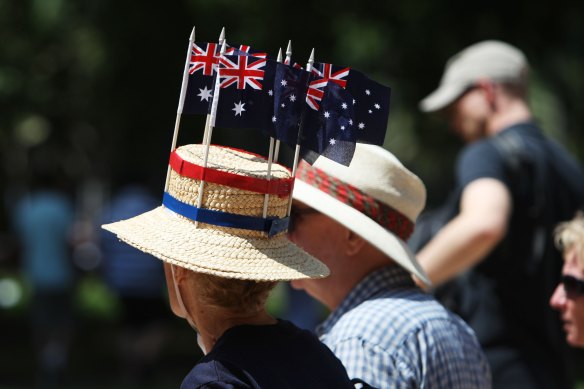
I’d like to see a special day dedicated to our First Nations People to celebrate their ownership of this country. Ask them to choose an important day for them and let’s legislate it onto the calendar. I’d love to see the beautiful Aboriginal flag waved by everyone on that special day. Jaqui Fitch, Bayview
I’m just wondering how many people in that Resolve survey sample were of Aboriginal heritage. Brian Roach, Westleigh
Close DV loopholes
How much longer do the public have to read about murders motivated by domestic violence while the perpetrator is on bail with AVOs in place (“Accused triple murderer bailed on domestic violence charges weeks before death of ‘gentle’ mother-to-be”, January 24)? Electronic ankle bands are surely cheaper than jailing these individuals. These bands are obviously not perfect and rely on police arriving quickly if the perpetrator breaks the rules. However, they may be more effective than AVOs and save a life. Stronger deterrents and harsher consequences must be implemented before more women are killed. The days of talking about the domestic violence should be over. Lawmakers should be given the power to impose stricter penalties, as obviously the guidelines in their current format are too generous to these dangerous individuals. Jill King, Land Cove
We are very good at responding to shock. After something terrible happens, systems move quickly. Reviews are announced. Events are isolated. Responsibility is narrowed to a moment, a person, a place. What is harder to confront is everything that came before. The figures state what cannot be ignored. In the most recent year, 3307 deaths were recorded as suicide. Seventy-nine women were killed in domestic violence. Thirty-three Aboriginal people died while in custody. Different circumstances, different systems, the same outcome. None of these deaths arrived without warning. Risk accumulates. It shows up in missed follow-ups, thresholds that are too high, services that do not speak to each other, and responsibility that drifts between institutions. It sits in the space between what is known and what is acted on. We talk about safety after harm occurs. We talk far less about prevention. Root causes remain easier to acknowledge than to address because prevention requires sustained attention, co-ordination across systems and action while outcomes are still uncertain. If we are serious about safety, the question is not how quickly we respond once lives are lost. It is whether we are willing to respond earlier, while there is still time to prevent harm. Lynne Strong, Jamberoo
Keep speech civilised
An excellent precis on the subject of free speech, but one point was unsettling (“How Adelaide’s writers’ week collapse is shaping Australia’s major literary festivals”, January 24). Kathy Shand says we must have diverse perspectives and not increasingly partisan voices and “inflammatory rhetoric”. We must allow partisan voices to be heard, but we must not link it inevitably to inflammatory rhetoric. The goal is to hear all voices in a balanced mix – hard but doable. The heat of passion is human and to be managed, not proscribed. Richard Hambly, Potts Point
Fake grass facts
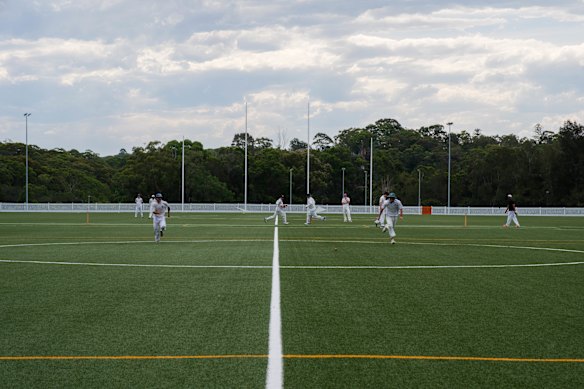
A great article from Emily Kowal on the dangers of fake grass (“The number of NSW schools with synthetic turf revealed”, January 24). Children’s skin is also more likely to burn at 45-50C, and with these fake grasses reaching recorded temps of 75C, it is a risk we shouldn’t be taking. Not enough information, if any, is given to parents about the heat, microplastics and PFAS in the crumb filler (shredded tyres, in most cases) The fake grasses need to replaced every eight to 10 years, so the long-term costs are comparable to natural grass. We need to give parents all the information about costs and risks and let them decide if they want this surface in their kids’ playgrounds. Janet France, Northbridge
Free power agenda
Your reports (“Three hours of free solar to cut household power bills by $800”, January 24, and “Retailers push back on free power plan”, January 19) mention that electricity retailers want a further year’s delay in the introduction of the government’s proposed “three hours of free power in the middle of the day”. This set me wondering why they needed this extra time. A review of my last few years’ electricity bills told all. Under their “time of day” charging, the retailers designate the period between noon and 3pm either as a combination of “peak” and “shoulder” or, in one case, for certain seasons of the year, as “shoulder” – in other words, they are charging among their highest prices for periods for which they incur a very cheap or even negative wholesale price. The practice was applied by all five of the retailers I have used over the past five years. The retailers clearly want more time to be able to continue ripping us all off, for which they should be roundly condemned. Vernon Winley, Mosman
New Year’s folly
Wendy Squires is a role model and national hero for her musings on the folly of New Year’s resolutions (“Already broken your New Year’s resolutions? Take this advice”, January 24). All health professionals and counsellors take heed of this sensible, balanced advice. It should be on toilet doors all over the country. Jan Marshall, Collaroy
Noise annoys
Patrick Dodd decries the loud grunting of tennis players and exhorts the tennis authorities to ban the practice (Letters, January 24). If the authorities enforce this request, many players will become disgruntled. Bruce Johnson, Lakewood
- To submit a letter to the Sydney Morning Herald, email letters@smh.com.au. Click here for tips on how to submit letters.
- The Opinion newsletter is a weekly wrap of views that will challenge, champion and inform. Sign up here.
Read the full article here