




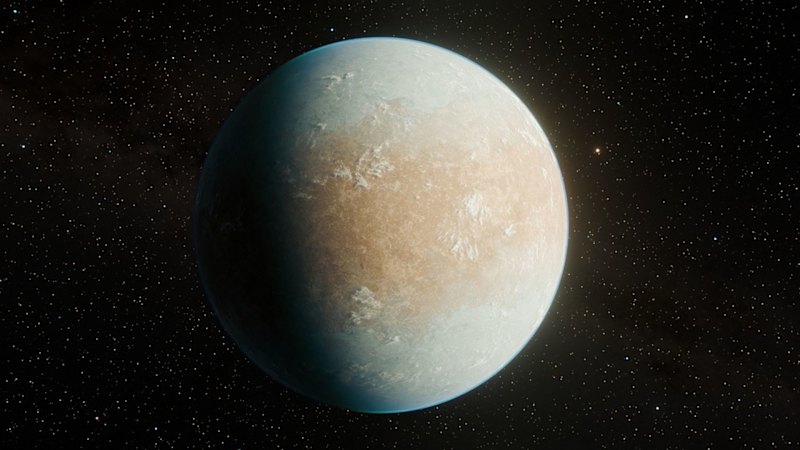
It’d take several million years to get there, but a planet that could potentially support life has been discovered by scientists in Queensland.
The celestial body – named HD 137010 b – is about 150 light years away, and just slightly larger than Earth.
It would take about 3 million years to reach with current rocket technology, and the distance means scientists are viewing it as it was during the 19th century.
University of Southern Queensland PhD student Alexander Venner first discovered clues the planet could exist with a citizen science group while still in high school almost a decade ago, and chose to reexamine the data with a research team in a study published in January.
“Based on current physics obviously we can’t easily travel 150 years within our lifetime, but I think it’s inspirational to know what type of worlds are out there and we also just want to understand how life could be developed in the universe,” Dr Chelsea Huang, a co-author of the study, said.
“I think that sometimes helps us learn more about the context of our Earth and solar system.”
It was identified using 2017 data from NASA’s extended Kepler mission, K2, leaving the faintest trace as it passed in front of its star.
It’s still officially a “candidate planet” according to NASA, with more sighting required to prove its existence, but Huang said the team was confident.
Estimates suggest the surface temperature could be below -70 degrees Celsius, but if it has a thicker atmosphere and more greenhouse gases than Earth then liquid water would be possible.
Huang said it was still one of the closest Earth-like planets orbiting a star similar to our Sun, making it a perfect candidate for future research.
“There are some ambitious space missions that are planned for the next decade and they’re aiming to image a planet around Sun-like stars. We believe we will be able to study the atmosphere of this planet.
“In fact, this is currently the best candidate for such study, and all the astronomy field is working very hard towards that goal.”
The research team included scientists from Australia, the UK, the USA and Denmark.
Start the day with a summary of the day’s most important and interesting stories, analysis and insights. Sign up for our Morning Edition newsletter.
From our partners
Read the full article here