



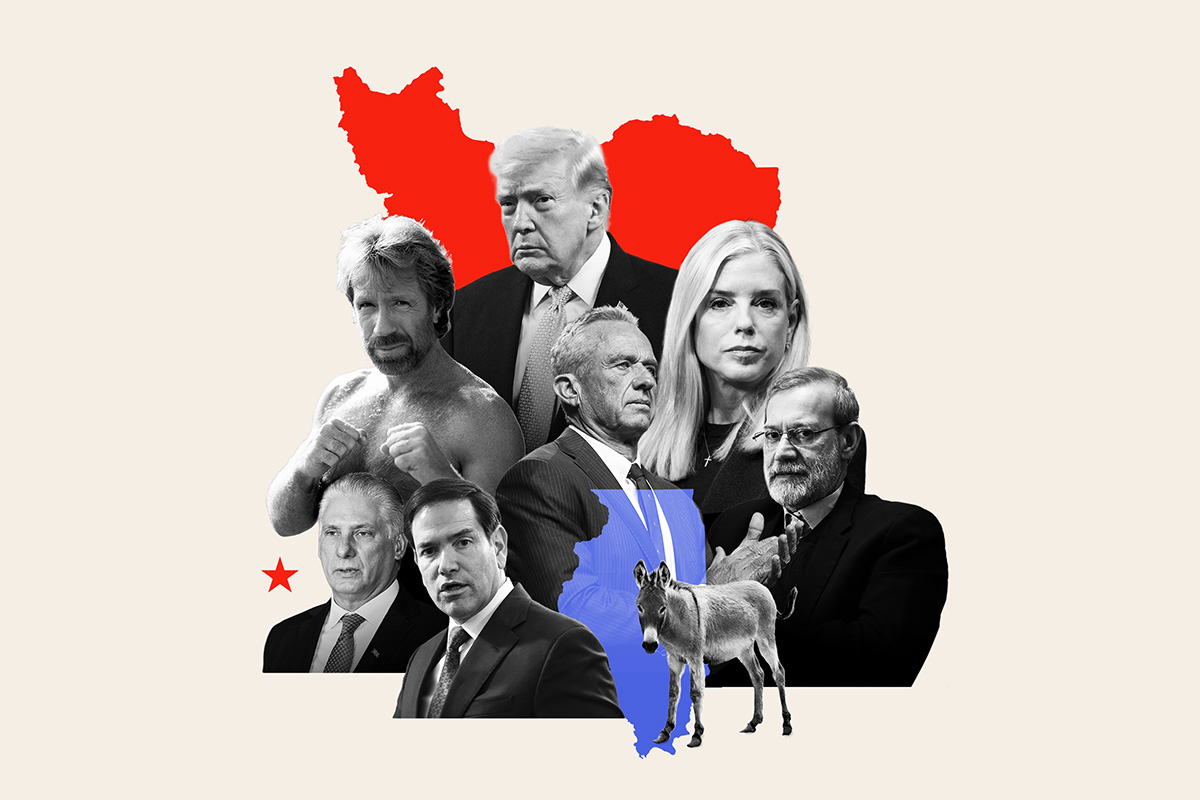
Concerns deepened this week over the risk of escalation in the Iran war, oil prices soared and Cuba’s possible endgame grew closer. At home, the death of Chuck Norris prompted a look back at his outsized cultural and internet-era legacy. In Washington, a legal setback involving RFK Jr. highlighted the continuing intensity of debates over health care and identity. Questions surrounding Jeffrey Epstein-related records lingered, keeping pressure on officials. In Illinois, primary results revealed Democratic divisions over Israel, while developments in Iran—including the death of a senior figure—pointed to potential shifts within the regime.
1. Trump’s Iran Strategy Comes With Five Built-in Traps
Donald Trump’s effort to contain a widening Iran conflict is colliding with the realities of escalation. The situation around the South Pars gas field highlights five overlapping risks: further military escalation, strain with Israel, credibility issues over shifting red lines, vulnerability to energy shocks and domestic political fallout ahead of the midterms. Even limited strikes risk spiraling once Gulf energy infrastructure, shipping routes and inflation pressures are drawn in. The administration is attempting to balance deterrence with restraint—but the dynamics of the conflict suggest that avoiding a broader war may prove increasingly difficult.
Read in full
2. Chuck Norris Became the Internet’s First True Digital Myth
Chuck Norris’ death marks more than the loss of an action star—it closes a chapter in the early history of internet culture. Long before meme culture became mainstream, Norris was its defining figure: a larger-than-life persona built on exaggerated toughness that resonated because it had a grounding in reality. His military background, martial arts achievements and film career gave credibility to the jokes that spread online. Unlike later ironic memes, his appeal was universal and sincere. In that sense, Norris helped shape the blend of celebrity, folklore and repetition that now defines digital culture.
Read in full
3. RFK Jr.’s Court Loss Showed the Culture Wars Are Still Raging
A federal court ruling against Robert F. Kennedy Jr.’s health policy push underscored how unresolved America’s culture wars remain. A judge blocked efforts by the Department of Health and Human Services to pressure providers over gender-affirming care for minors, rejecting a key plank of Kennedy’s agenda. The decision highlights how deeply contested issues of identity, health care and government authority continue to play out through the courts. Rather than signaling a political resolution, the case shows that even with shifting leadership in Washington, these battles remain active, divisive and central to the country’s political landscape.
Read in full
4. Pam Bondi’s Epstein Problem Is Turning Into a Political Time Bomb
The handling of Jeffrey Epstein-related records continues to pose a growing political challenge. Attorney General Pam Bondi faces mounting scrutiny after declining to commit to complying with a congressional subpoena for sworn testimony, prompting a dramatic walkout by Democrats. The issue remains especially sensitive because it combines demands for transparency with long-standing suspicions of a cover-up and lingering connections to powerful figures. As pressure builds, the controversy risks becoming a broader liability—one that extends beyond legal questions into the realm of political trust and accountability.
Read in full
5. Cuba May Be Approaching Its Most Consequential Turning Point in Decades
Cuba appears to be entering a period of profound uncertainty, driven by economic collapse, widespread blackouts, rising migration and growing public unrest. The situation echoes the severity of the post-Soviet crisis, but with new external pressure as the U.S. adopts a more hard line approach. Diplomatic engagement is now paired with efforts to force political and economic concessions, adding to the volatility. With infrastructure failing and resources dwindling, the country faces a narrow set of paths forward: adapt, tighten control to maintain the status quo, or risk systemic breakdown.
Read in full
6. Illinois Democrats Delivered a Warning to Both AIPAC and Its Critics
Primary results in Illinois highlighted the complex and evolving role of money in Democratic politics, particularly around Israel. AIPAC and affiliated groups remain powerful, capable of pouring millions into key races, but the outcomes showed that influence is no longer absolute. Some candidates backed by heavy spending fell short, while others targeted by outside funding still prevailed. The results point to a shifting dynamic in which financial power can shape races—but can also trigger backlash in an increasingly polarized electorate. The balance between money, messaging and grassroots support is becoming less predictable.
Read in full
7. Ali Larijani’s Killing Could Shake the Iranian Regime’s Core
The killing of senior Iranian figure Ali Larijani could mark a significant moment in the conflict with Israel. More than a tactical strike, it represents a blow to the inner workings of Iran’s political establishment. His death leaves a gap within the regime and reinforce perceptions of deep intelligence penetration by Israel. It also carries symbolic weight, signaling vulnerability at the top levels of power. Such a development could have ripple effects within Iran’s leadership, intensifying uncertainty.
Read in full
Hey gang, Carlo Versano here. I hope you enjoyed this article. As Newsweek‘s Director of Politics and Culture and editor of the 1600 newsletter, I’m keen to hear what you think. Now, Newsweek is offering a new service to allow you to communicate directly with me in the form of a text message chat. You can sign up and get a direct line to me, as well as the reporters who work for me. You can shape our coverage.
As a Newsweek member, we’re offering this service to you for free. You can sign up below, or read more about how it works here. Let’s talk!
Read the full article here