



Repair work continues in Calgary, where Mayor Jeromy Farkas said the city is committed to fixing a problematic water main that has burst twice now in a year and a half.
At the same time, officials are urging residents in the region to save water — something city data shows hasn’t happened since the break happened two days ago.
On Thursday afternoon, the City of Calgary held a technical briefing on the Bearspaw water main break, providing an overview of the infrastructure and engineering considerations.
Farkas said the Bearspaw South Feeder Main remains “very much in the red zone” after a major failure in critical infrastructure led to a rupture on Dec. 30, and the city is using more water than it can produce and store.
“We’re requiring the help of every single Calgarian and as well as our outlying regional customers to assist us,” Farkas said.
Typically, Calgary has 600 million litres of water stored underground on a daily basis.
After the feeder main broke, the city lost about 80 million litres of water and the reserve dropped down to 459 million litres.
In the two days since, the level has come back up slightly to 468 million liters — but city officials say that isn’t enough.
Chris Huston, Calgary’s manager for drinking water distribution, said the city of 1.6 million people needs to use below 485 million litres of water every day for several weeks.
“We need to increase the volume of storage in our system in case we have another issue come up, and so that we have water for firefighting and life safety,” Huston said.
“It is the main reason we are asking all Calgarians, businesses and ourselves to reduce water consumption while we do these urgent repair to the feeder main and we work to get it back into service.”
Nicole Newton, director of climate and environment, says the city hasn’t seen a “measurable reduction” in water use since the rupture.
“People seem to be continuing their day-to-day patterns,” Newton said, noting there was an Alberta Emergency Alert issued but it hasn’t appeared to have made an impact.
Huston says Calgarians can do their part and save 10 to 30 litres per day by showering for three minutes instead of 10 and only running their washing machines or dishwashers when they are full.

Get breaking National news
For news impacting Canada and around the world, sign up for breaking news alerts delivered directly to you when they happen.
The target for repairs is two weeks from when the line burst, Huston said, making Jan. 13 the date the city aims to have the line fixed.
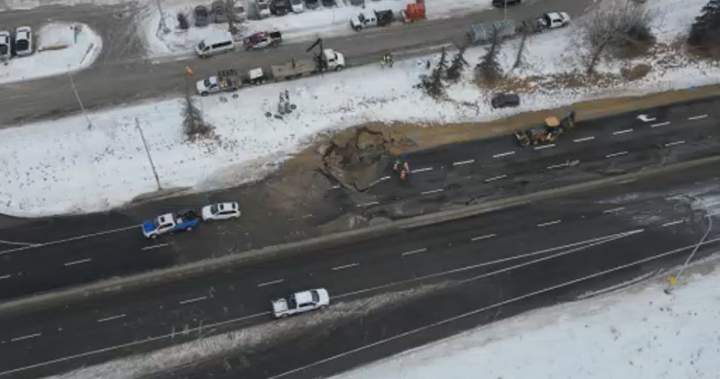
Crews are now working to fix the road, which buckled in spots near Sarcee Trail and the 16 Avenue Northwest/Trans Canada Highway interchange, close the Bowness community.
Michael Thompson, general manager of infrastructure services, said it’s not clear why the Bearspaw feeder main broke for the second time, after the first break in the summer of 2024 prompted months of water restrictions and advisories.
The city said overnight, crews successfully pumped out water surrounding the break, allowing repairs to proceed safely.
The damaged section of pipe is now fully exposed, and excavation is continuing to provide full access for repairs. A camera inspection inside the pipe is underway to gather detailed information about the extent and cause of the damage.
“We can see the results of the failure, but now we need to understand why it happened,” Thompson said. “That information will directly inform how we manage the rest of the feeder main moving forward.”
He noted the city is better prepared this time around as a result of that first burst in the summer of 2024.
“We’ve got the parts on hand to go and do these emergency repairs. The teams know how to do this work. We’ve got different plans and how to shut the pipe down, how to move water differently across the city, and how to get this done as quickly as we can,” Thompson said.
After inspections in 2024, the city completed 23 urgent pipe repairs and installed a real-time acoustic fibre optic monitoring system to detect wire breaks.
While the system was functioning normally at the time of the burst, the city said no wire snaps were detected on Tuesday night.
“In the two months up until December 30th, we had not heard a wire snap along the pipe or anything in this area,” Thompson said.
“However, as we learned this week, monitoring reduces our risk — but it doesn’t eliminate it, and the pipe can break without us hearing a wire snap.”
Farkas said crews are working hard and fast to restore service, but the work will still take time.
“This is heavy, technical, high-risk work. And in this kind of work, there are no shortcuts. There is no margin for error.”
That said, while the crews are working to repair the burst section right now, the city is also aware it’s just a band-aid fix on a larger, looming issue.
“Water is the lifeblood of our city and this Bearspaw feeder main is a critical artery – it is the critical artery – it is part of the beating heart of our water system,” Farkas said.
“The hard truth is, it has reached the end of its reliable life. We can keep patching it, we can keep reacting, but it will continue to fail until there is an alternative built. No amount of short-term fixes will change that.”
The only path forward is to build a new artery, the mayor said, while sharing information about two new water projects he called generational investments.
“Calgary is Canada’s third largest city and one of the fastest growing in North America. A city like ours cannot accept uncertainty in something as very fundamental as water — so this is about more than fixing a pipe.”
The first is the Bearspaw South Feeder Main improvement project.
“This project will add approximately six kilometers of new parallel pipe along the existing feeder main. Over time that new pipe will take over service from the current line, reducing risk and increasing reliability and guaranteeing that this will never happen again,” Farkas said.
The second is the North Calgary water servicing project.
“This project will build a new 22-kilometer feeder main and supporting facilities to ensure Northwest Calgary continues to have reliable drinking water and true system redundancy,” the mayor said.
The Bearspaw South Feeder Main ruptured Tuesday night, flooding the Trans-Canada Highway near the site of Canada Olympic Park.
Drivers were trapped in a river of icy water, and 13 people had to be rescued from eight vehicles.
More than 3,000 homes and businesses in three neighbourhoods near the break — Montgomery, Parkdale and Point McKay — are under a boil-water advisory.
All city residents, as well as those in the surrounding communities of Strathmore, Airdrie, Chestermere and the Tsuutʼina Nation, are urged to conserve water.
That includes limiting showers to three minutes, flushing toilets only when necessary, and only running dishwashers and washing machines when they’re full.
— With files from The Canadian Press
Read the full article here