



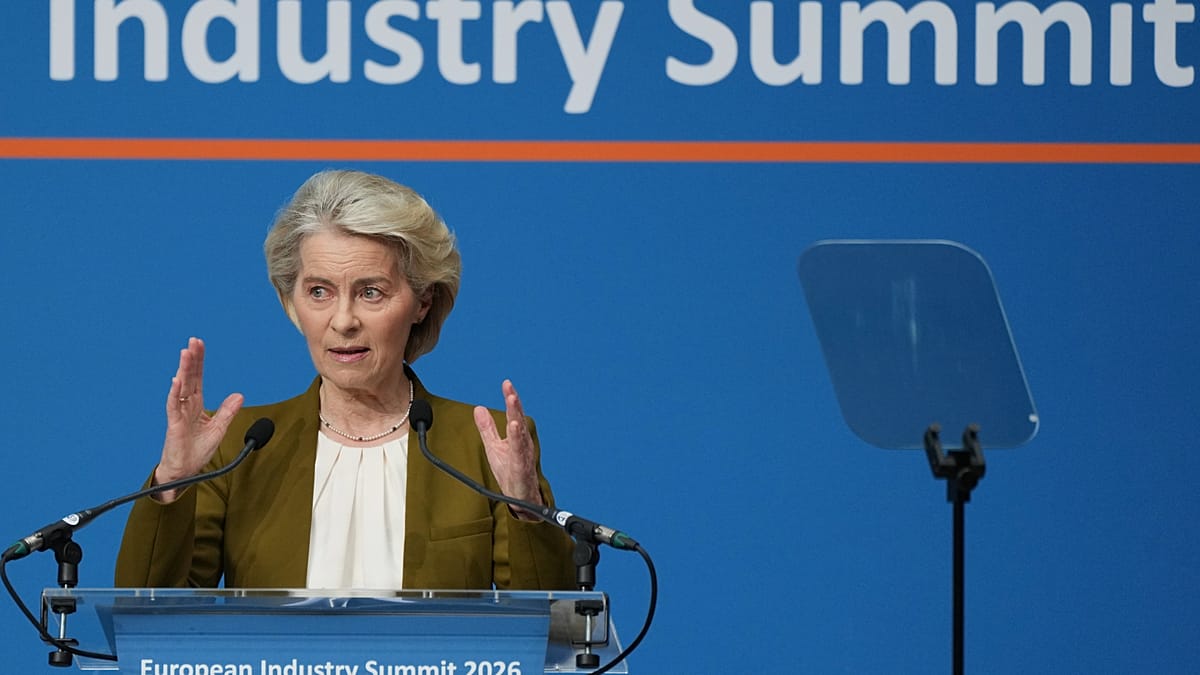
European Commission President Ursula von der Leyen announced the Commission’s “One Europe, One Market” strategy at the EU leaders’ summit on 12 February. Moving from an incomplete single market to “one market for one Europe” within two years, the Commission plans to bridge the competitiveness gap with the US and China.
The International Monetary Fund predicts that the EU will account for only 12.91% of the global GDP in 2030, compared to 20.36% of China and 13.86% of the US. “One Europe, One Market” is set to change this and become Europe’s ticket back to global competitiveness.
“We have the second-largest economy in the world, but we are driving it with the handbrake”, von der Leyen told heads of states and governments, stressing that “interstate barriers in our Union are three times higher than interstate barriers in the US”.
The Commission will focus on five key pillars to propel Europe back to the forefront of global competition: regulatory simplification, unified market, trade, digital, and energy.
In her announcement, von der Leyen called for a “deep house cleaning on the acquis” as the first main step as “less directives and more regulations” would keep the fragmented EU from having 27 different regulatory realities.
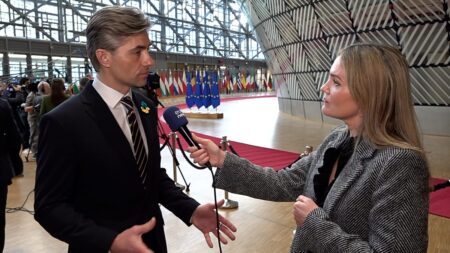
According to Fredrik Ericsson, Director of the European Centre for International Political Economy in Brussels, “looking at capital markets [we need to] find a way for more European savings to be invested in European markets”. “If they come up with something on services, that would be fantastic, because the single market for services exists in name only”, Ericsson added.
Why now?
European leaders are becoming increasingly concerned that companies still face a “market of 27” instead of a unified one, which stunts growth and favours competing economies.
In his 2024 report, Enrico Letta argued that Europe needs deeper integration, calling for a shift “from 27 to 1”. He identified “regulatory complexities” and a “patchwork of national regulations” as critical barriers, and warned that the current legislative implementation setup is too slow and complex.
Fragmentation increases business costs and lowers consumer welfare. The International Monetary Fund estimates that non-tariff barriers between member states reach around 44% for goods and 110% for services. €150 billion is lost annually in capital markets due to different national regulations and tax systems, and roughly €228 billion is forgone in goods and €279 billion in services each year.
European industrial electricity prices are 2 to 3 times higher than in the U.S and China. As diagnosed by Letta and Mario Draghi’s reports, this makes energy-intensive industries (steel, chemicals, glass) financially unsustainable.
Leaders have also warned that the bloc has become a “regulatory maze” that stifles innovation. EU companies dedicate 1.5 times more senior staff to compliance than U.S firms. This red tape discourages investment, an issue even more pressing in fast-moving sectors like AI and biotech.
The final issue on the Commission’s radar is Europe’s excessive reliance on external suppliers for critical materials and technology. So, leaders are urgently pressing for strategic autonomy, for Europe to act independently in key areas like defence, energy, technology, etc.
To tackle these challenges, the Commission committed to developing a detailed, time-bound roadmap and action plan. The initiative builds on earlier competitiveness work from 2024–2025.
The roadmap is scheduled to be formally presented at the March 2026 European Council, where leaders aim to endorse concrete actions and deadlines. A key early milestone is the target to deliver the first phase of the Savings and Investment Union by June 2026, followed by expected legislative proposals in the second half of 2026 and a broader implementation window running through 2026–2027, with a longer-term horizon extending toward 2028.
Simplifying the administrative burden
The EU is currently a barren, inhospitable ecosystem for startups and companies. To clear a path through the vines, the Commission is putting forward a series of “omnibus” packages: legislative proposals that bundle together different laws.
They are designed to cut administrative burdens across multiple EU laws at once through scope reductions, data consolidation, and value-chain protections for SMEs. They’ll also raise reporting thresholds, consolidate data entry points, and limit the data large companies can request from SME partners. The expectation is a reduction of red tape costs by roughly €15 billion per year for businesses.
According to von der Leyen, ten such packages are already in motion, with three completed and seven still moving through the legislative process. In February EU leaders urged the European Parliament and the Council to speed up negotiations so these measures can be adopted quickly.
Beyond these targeted revisions, the Commission also plans a broader “house cleaning” of the EU acquis Communautaire – a review of existing legislation to identify outdated, overlapping, or excessively complex rules.
A key focus is tackling “gold-plating,” where member states add extra national requirements to EU laws (creating 27 different regulatory realities). To limit this, leaders foresee a shift toward more regulations rather than directives, since regulations apply uniformly across all member states.
The Commission will also introduce “sunset clauses” so that certain laws automatically expire unless renewed.
One market
The strategy’s second pillar answers a key question: how is the EU planning to build “one market” for EU companies?
The first step is creating the 28th regime, also called “EU Inc”. It’s a single, optional, EU-wide corporate framework to allow companies to set up and operate across the bloc under one unified rulebook.
Under the proposal outlined by von der Leyen at the 2026 World Economic Forum, firms would be able to register a company digitally within about 48 hours and run it under the same legal conditions in all member states. The Commission aims to table this proposal ahead of the March 2026 European Council, with leaders pushing for rapid progress during the 2026–2027 window.
Beyond that, leaders want to advance the Savings and Investment Union, a major strategic framework launched in March 2025. The goal is to create integrated capital markets and improve access to financing for European companies. It hopes to mobilise the estimated €10 trillion in European household savings currently sitting in low-yield bank deposits, and channel them into productive investments. The first phase, focused on market integration, supervision, and securitisation, is targeted for completion by June 2026.
At the same time, Brussels is revising its merger guidelines to make it easier for large European firms (particularly in sectors like telecoms) to scale and form “European champions.” It also plans to introduce an Industrial Accelerator Act to accelerate investment in strategic sectors. It’s expected to include targeted European preference measures, designed based on economic analysis.
Towards energy independence
The Ukrainian war was a wake-up call to Europe’s energy import dependence. Over the past years, the Commission has put forward a set of measures, the most recent being REPowerEU, aimed at moving from excessive extra-EU energy reliance towards energy sovereignty.
In pursuit of an energy union, the Commission’s “One Europe, One Market” focuses on two main aspects: the planning and implementation of the EU’s energy infrastructure, and the design of the EU energy market.
The Grid Package is Europe’s new approach to energy infrastructure which is set to modernise and expand the bloc’s energy grid by removing cross-border barriers. By increasing interconnectivity across member states, the Commission wants to lower energy prices, increase supply security and achieve independence.
As part of the package, eight energy highways will address Europe’s major cross-border electricity bottlenecks for a more efficient energy flow between member states, stronger renewables integration, and lower energy prices.
The second focus is on the market design. The Commission will evaluate if and how it can change the current merit order pricing system. This system sets electricity prices based on the marginal cost of power plants.
Under the EU’s current merit order, gas is the most expensive resource at €100 Megawatt-hour, compared to €34 for renewables, which sets the market price. Increased investment in renewables is necessary to reduce energy costs for businesses and households.
Although no inter-institutional agreement has been reached, President von der Leyen promised to table options for a possible potential market design changes at the next EU Council.
Boosting the digital sector
As for the tech sector, the idea is to make it the backbone of market integration, using digital policy to help companies operate seamlessly across borders. The Digital Networks Act is central and aims to speed up telecom investment and allow greater consolidation so European operators can reach the scale needed to compete globally. Timelines for its adoption are expected to be included in the March 2026 roadmap.
Leaders also agreed to push forward a European Business Wallet, a single digital identity system that would allow companies to interact with authorities across all member states through one channel.
The Commission is also preparing a broader tech sovereignty package that includes a planned Chips Act 2.0 and a Cloud and AI Development Act.
Another priority is expanding computing infrastructure. Existing AI “factories” will be upgraded into large-scale AI ecosystems, often called AI gigafactories with initial steps expected by mid-2026. These initiatives are designed to improve access to high-performance computing for companies and researchers, helping European firms develop and deploy advanced technologies more rapidly.
A new trade policy purpose
The EU’s trade model is strongly economic-driven. Since 2004, the EU has expanded its global trade network to include over 40 free trade agreements (FTAs) and around 80 partners. In 2023, its average trade openness reached 141% of GDP.
In the past two years, extra-EU trade in goods and services amounted to around 20-25% of EU GDP. Total EU-US trade exceeded €1.68 trillion while trade with China surpassed €845 billion.
But trade is not just about economic growth. It’s also security and resilience. The pandemic and the energy crises following the Ukrainian war showed that over-reliance on external trade makes one vulnerable to disruptions and geopolitical tensions.
To remain open to international trade and reduce its economic exposure, the Commission aims to rethink Europe’s “trade naiveness” by shifting the narrative from pure liberalisation to strategic independence. According to EU Council President António Costa, an “ambitious and pragmatic trade policy […] is in our collective interest”.
Europe plans to expand market access for its businesses by fast-tracking the ratification and implementation of completed FTAs and accelerating work on future ones. By de-risking and diversifying supply chains and export markets, the Commission wants to reduce dependence on single suppliers, especially in the raw materials, energy and strategic technologies sectors.
This will strengthen the single market. “Restrictions […] within the single market have increased a lot because of a variety of developments, but one of them is a much stronger regulation coming from member states”, said Ericsson. By simplifying internal rules, the Commission will address market distortions, facilitate intra‑EU trade, and remove defensive trade measures that fragment the single market or disproportionately favour industry giants.
Read the full article here