


A business owner in Edmonton’s northwest is voicing his frustration after dealing with the same drainage problem for decades. He says temporary solutions offered by EPCOR are no longer working.
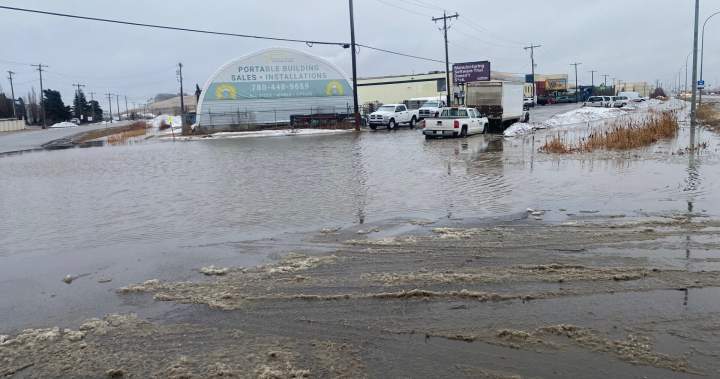
Outside Central Auto and Truck Parts, a massive pool of water has formed — an issue the owner, Nick Spina, says he’s tired of dealing with.
“Coming up in June, I got a $130,000 tax bill and I got to put up with that,” Spina said.
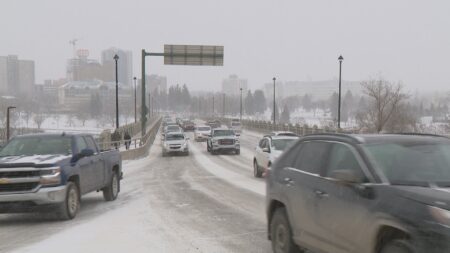
The intersection in front of his business at 170th Street and 129th Avenue fills with water as the spring melt begins, and it has for the past 30 years, creating problems for staff and customers.
“My guys can’t go to the mailbox, they can’t park on the street. Customers are probably scared to turn in here cause they can’t see where the road is. In the morning when it’s ice, you can’t see, it’s one big glare,” he said.
Spina says last week, a car drove through the water without knowing how deep it was. The car died. Two vehicles are also stuck in the frozen pool. Spina has been in contact with the City of Edmonton and EPCOR, but says it’s hard to get a solution.

Get breaking National news
Get breaking Canada news delivered to your inbox as it happens so you won’t miss a trending story.
“This year, they’re passing the buck. Phone the city, the city puts through EPCOR, EPCOR says it’s the city’s fault, city’s responsibility, and EPCOR says vice versa,” Spina said.
On Tuesday morning, EPCOR was working on the pooling.
In a statement to Global News, EPCOR says several factors make this area uniquely challenging.
“Including how 170 Street aligns with the railway tracks and where private and public land intersects with the existing stormwater management infrastructure. At this time, we also know a blocked culvert on private property is contributing to higher volumes of water in this area,” read the statement.
“We have also assembled a team who is actively reviewing longer term design solutions to improve the flow of water in the future.”
Spina says he’s not confident in a solution.
“Nothing’s gonna happen. We’ve seen the same thing for the last 30 years, they go out there. They play with it a little bit, put some barricades up and leave them there. They leave them and wait for the water to go down by itself. Sometimes it could take a month or two, depending on the weather,” he said.
© 2026 Global News, a division of Corus Entertainment Inc.
Read the full article here